It's the Thursday before Labor Day weekend, and you've been staring at the same email all afternoon. "LABOR DAY MEGA SALE. UP TO 70% OFF. 48 HOURS ONLY." The countdown timer is ticking in red. The standing desk you've been eyeing for six months is marked "was $2,400, now $879." And a small, tired part of your brain asks: really?
That's the moment this guide is for. Labor Day is one of the biggest furniture-selling weekends of the year in the US, which means it's also one of the most theatrical. Some of the deals are genuine. A lot of them are just the regular price wearing a costume. The trick to telling them apart isn't a secret, but it does require knowing what things cost when nobody's shouting.
So here's the plan for this post. We'll walk through the Labor Day desk deals actually worth your money in 2026, with the real sale price and the real regular price side by side, no asterisks. We'll cover what to skip even when it's cheap, what to buy depending on your situation, and how to check any deal anywhere in about ninety seconds. By the end, you'll know exactly what your money should buy this weekend, and what it shouldn't.
The Labor Day Trap: Fake Discounts, Doorbusters, and Restocking Fees
Let's start with how the trap works, because once you see it, you stop being annoyed by it and start being mildly entertained by it.
The fake discount. A product's regular price quietly goes up a few weeks before the sale, and then the sale price is set at... the old regular price. You're not saving anything. You're just being shown a big red number that used to be the sticker price. This is why every deal guide on the internet tells you to compare the sale price against the product's normal price, not against whatever "was" number is printed next to it. If a store can't show you a stable regular price, it can't show you a real discount.
The doorbuster. A doorbuster is a loss leader: a product sold below cost, in tiny quantities, to get you onto the site so you'll buy something else with better margins. The problem with doorbusters in furniture is that the "something else" is usually a marked-up accessory, a floor model with a two-week wait, or a size that only fits one specific room. If the deal seems too good to be true and there are seven left at 2am, treat it like a lottery ticket, not a purchase plan.
The restocking fee. This one is quiet, and it's the one that actually burns people. You order a chair on sale. It arrives. The lumbar doesn't hit where you need it. You go to return it. "15% restocking fee applies." Suddenly your great deal costs an extra forty dollars plus shipping both ways. That's not a deal. That's a rental with extra steps.
So here's the rule we'll use for the rest of this post. A real deal has four things: a stable regular price, a genuine sale price below it, free or cheap shipping, and a return policy that doesn't punish you for the chair not fitting your body. If any of those four is missing, the size of the banner doesn't matter.
What's Actually Worth Buying on Sale This Labor Day
Not everything is a trap. Chairs, desks, and stands are the three categories where a genuine sale actually matters, because they're the three things you touch every single workday. Here's what Rackora's honest Labor Day pricing looks like, with the regular price right next to the sale price so you can see the actual gap.
Before the price list, one honest note about why these three categories matter. Furniture sales are only worth your attention when the product is something you'll use for years, because that's the only way a discount actually compounds. A fifty-dollar saving on a chair you replace in a year is a rounding error. A $280 saving on a desk you'll use for a decade is real money. Chairs, desks, and stands are the three things in a home office that fit that description, which is why they're the three things in this sale worth planning around.

The 40×24 standing desk: $599.99 (regularly $879.99)
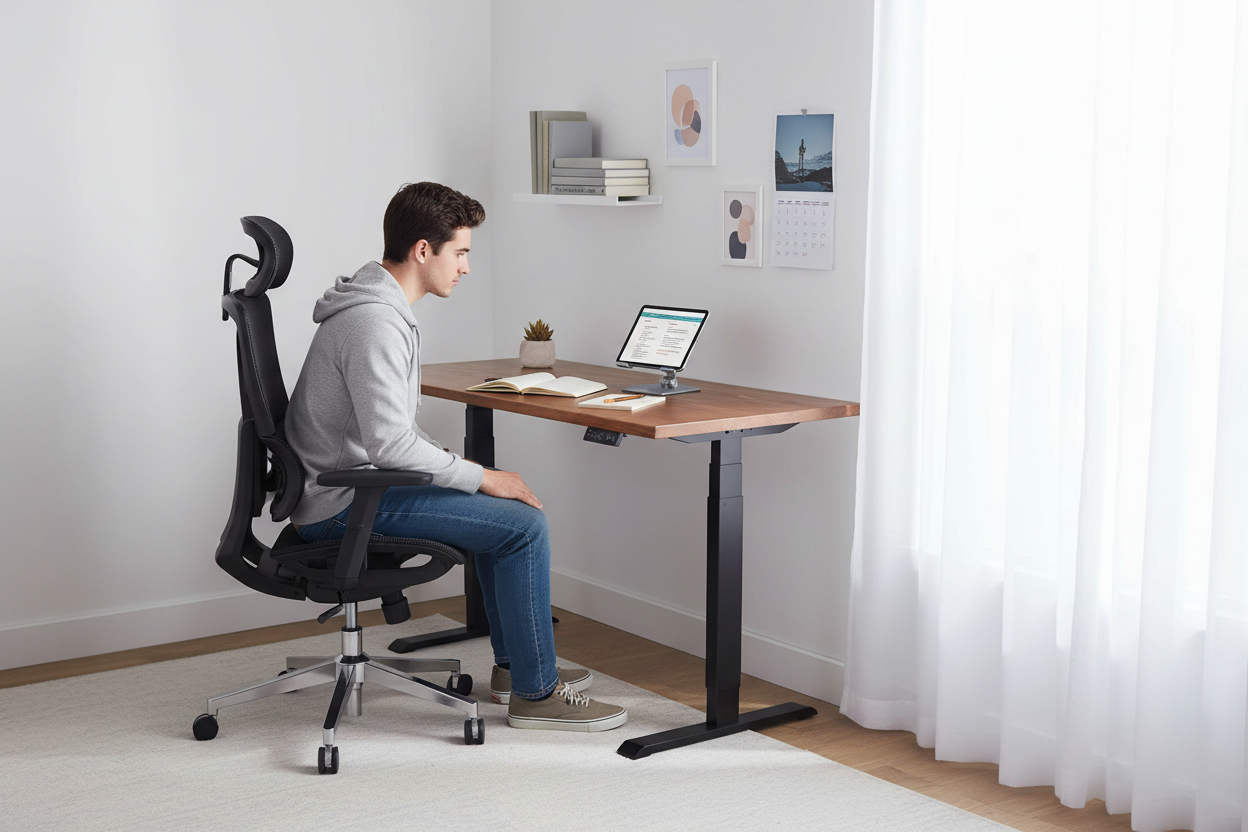
The 40×24 Ergonomic Electric Height-Adjustable Standing Desk is the centerpiece of this sale, and it's the piece I'd call first. Forty inches wide and twenty-four deep is the sweet spot for a home office: big enough for a monitor, a laptop, and a coffee mug without feeling like you're working in a conference room, small enough to fit against a wall or into a corner.
The regular price is $879.99. The Labor Day price is $599.99. That's a $280 difference, and it's a real difference, not a manufactured one. If you've been putting off the sit-stand question because the price felt like a second mortgage, this is the weekend to stop putting it off.
The L1 Ergo Upgrade 518: $329.00 (regularly $399.00)
The L1 Ergo Upgrade 518 is the entry point into a chair that actually supports you, and it's the chair I'd recommend to anyone whose back pain is new, or who has never owned an ergonomic chair at all. At $329.00 on sale, down from $399.00, it's a seventy-dollar step down that puts it firmly in "why not" territory. You're not buying a stripped-down version of a better chair here; you're buying a proper ergonomic chair at its lowest price of the year.
The L2 Ergo Pro 633: $379.00 (regularly $449.00)
The L2 Ergo Pro 633 is the L1 plus one specific feature that matters more than you'd think: a built-in footrest. If your feet don't reach the floor when you sit back in a chair, your hamstrings and lower back quietly pick up the slack for eight hours. The footrest changes that. At $379.00 on sale, it's seventy dollars off the regular $449.00, and it's the chair I'd pick for long sessions, because the footrest is the thing that keeps you from slowly melting into a weird position by hour four.
The L3 FlexBreath: $429.00 (regularly $499.00)
The L3 FlexBreath is the top of the line, and the thing that makes it top of the line is auto-tracking lumbar support. The lumbar piece moves with you as you shift through the day, instead of you having to stop what you're doing and pump a lever to chase it back into place. On sale it's $429.00, seventy dollars off the regular $499.00. If your lower back is the reason you're shopping at all, this is the chair the whole sale has been building toward.
The Ergo Elite laptop stand: $79.99 (regularly $129.99)
The Ergo Elite laptop stand is the single cheapest thing in this sale that will change your posture today, not eventually. Raise the laptop screen to eye level and your neck stops bending forward. On sale at $79.99, fifty dollars off the regular $129.99. If you work on a laptop more than an hour a day, this is the easiest upgrade in the entire lineup, and it's small enough to take with you everywhere.
The tablet stand: $49.99 (regularly $69.99) and the Pro Stand 100: $59.99 (regularly $99.99)

Two more small pieces round out the sale. The tablet stand, $49.99 down from $69.99, is for secondary screens, recipe screens, video calls on a tablet, that sort of thing. The Pro Stand 100, $59.99 down from $99.99, is the more adjustable all-purpose option, and at forty dollars off it's one of the biggest percentage savings in the entire sale. Both are the kind of thing you don't think you need until you use one for a week, and then you use it forever.
Now, a note on the stands, since this is where people overthink. The tablet stand at $49.99 and the Pro Stand 100 at $59.99 are both genuinely good deals this weekend. But if your main screen is a laptop, spend the extra twenty dollars on the Ergo Elite at $79.99. It's built for the laptop that travels with you, and the difference between a laptop at eye level and a laptop propped on a stack of books is the difference between a good workday and a neckache.
What's NOT Worth Buying, Even at a Discount
Now the fun part. Here's what to walk past, even when the sale sticker is enormous.
Cheap laptop risers. You know the ones: the $30 folding plastic riser with four preset heights, sold in every office supply store, usually stacked in a bin by the register. They're not bad because they're cheap. They're bad because the cheapest risers wobble, and the ones with "adjustable height" adjust in two-inch jumps that never quite match your eye line. A riser that puts your laptop at a height that's close but not right is still a neckache, just a slightly more expensive one. If you're going to fix your screen height, fix it properly. The Ergo Elite at $79.99 on sale does what a $30 riser claims to do, and it does it without the wobble.
"Gaming" chairs under $200. This is the one that gets people every year, and I get it. The racing stripes, the bucket seat, the name that sounds like a spaceship. But a gaming chair at that price point is mostly marketing with a chair-shaped hole in the middle. The lumbar support is a pillow strapped to the back. The seat is a bucket, which means your hips are locked in one position, which is exactly what an ergonomic chair is trying to avoid. And the bonded leather starts flaking around month eight. If you want a chair that's actually comfortable for eight-hour sessions, the L1 at $329.00 on sale beats every sub-$200 gaming chair on the planet, and the L2 at $379.00 beats the ones above it too.
Cable organizers at three times the markup. Every Labor Day sale includes a "cable management kit" for $25 that contains ten clips, four zip ties, and a Velcro roll with a combined value of about eight dollars. It's not a deal. It's a convenience tax. Buy the eight-dollar version at a hardware store, or skip it entirely. Nobody has ever looked at a tidy under-desk cable run and thought, "thank goodness I paid seventeen dollars extra for this."
Anything with a "doorbuster" timer that resets. If the countdown hits zero and the price doesn't change, you're looking at a permanent sale with a dramatic font. It's fine to buy the product if the price is right. Just don't make a decision on a Tuesday because you're scared of a Thursday deadline that isn't real.
So to summarize the skip list: anything that wobbles, anything with racing stripes under $200, anything that's mostly plastic clips, and anything whose "sale" price is permanent. The common thread is that none of these fix a real problem. They're purchases that feel productive. The Labor Day version of a productive-feeling purchase is still just a purchase.
One more category that deserves a mention, because it's everywhere this weekend: the "ergonomic" accessory that's really a gadget. Contoured mouse pads that are just a wedge of gel, "posture correctors" that are elastic straps, laptop risers with built-in speakers nobody asked for. None of them are in this sale, and none of them are in your future. If a product's main job is to sit on your desk and look like it's helping, it isn't helping.
Budget by Role: Student, Gamer, and Home-Office Professional
Everybody's sitting differently, and the right Labor Day cart depends on who you are. Here are three honest builds.
The student. Budget is the whole game, and the good news is the sale has you covered. Start with the tablet stand at $49.99 if you study with a tablet, or the Pro Stand 100 at $59.99 if you mostly use a laptop. Then, when the semester grind kicks in and you're in the chair for six-hour study blocks, the L1 at $329.00 is the one chair that will actually hold up. Total: under $400 for a setup that fixes the two worst things about studying at a desk, which are the screen height and the seat. And because the sale prices are already the low ones, you're not gambling on a better deal next week.

The gamer. You're in the chair for long sessions, and your setup is probably already a monitor-and-desk situation, which means you need a chair that doesn't punish hour five. The L2 Ergo Pro 633 at $379.00 is the pick here, and not just for the footrest. Long sessions mean your feet end up on the chair base, the desk, or the floor in a position that wrecks your knees. A built-in footrest gives them somewhere to go. If you're also still on a folding table, the 40×24 standing desk at $599.99 turns your whole rig into a proper station, and it means you can stand for the ranked games and sit for the chill ones.
The home-office professional. You're in this desk eight hours a day, five days a week, and you're the person this sale is actually aimed at. The build: the 40×24 standing desk at $599.99, the L3 FlexBreath at $429.00, and the Ergo Elite laptop stand at $79.99 for your secondary laptop. That's about $1,109 for a setup where every joint that's supposed to be at ninety degrees is at ninety degrees. If you price the same pieces outside the sale window, the same cart is about $1,509. The difference is a real weekend's worth of saving.
One thing all three builds share: none of them include anything from the skip list. The builds work because every dollar is aimed at a specific problem, and that's the whole game. Decide which role you're in, pick the build, and you're done shopping in ten minutes.
The Honest Math: What $329 vs. $429 Buys in a Chair
Here's a question people actually ask, so let's answer it straight: what does the extra money buy as you move up the chair lineup?
The L1 at $329.00 buys a chair that's properly adjustable in the ways that matter, with real lumbar support and an honest seat. For most people, most of the time, it's enough. This is the "I just need to stop hurting" chair, and on sale it's seventy dollars less than usual, which makes the decision that much easier.
The L2 at $379.00 buys everything the L1 has, plus the built-in footrest. That's fifty dollars for a feature that matters if your feet don't comfortably reach the floor, which is more people than you'd think. It's also the chair I'd pick for long sessions, because the footrest is the thing that keeps you from slowly melting into a weird position by hour four, whether you're gaming, studying, or on back-to-back calls.
The L3 at $429.00 buys the auto-tracking lumbar. This is the one that's hardest to explain in a spec sheet and easiest to feel in person. Standard lumbar support is static: you set it, and it stays there while your back moves through a hundred different positions over the day. Auto-tracking lumbar follows you. Every time you lean forward to read something and lean back to think, the support is already where your back is. For people with existing lower-back trouble, this is the difference between a chair you tolerate and a chair you forget you're sitting in.
So the honest math is: $329 gets you out of pain. $429 gets you out of thinking about your back at all. If you're young, new to ergonomics, and the budget is tight, the L1 is a legitimate choice, not a compromise. If you're buying one chair for the next five years and you already know your back is the problem, the L3 is the one. The how-to-choose guide walks through this in more detail, but the short version is: buy for the part of your body that already hurts.
The sale changes the decision in one specific way: it collapses the starting line, not the gaps. Outside a sale, the difference between the L1 at $399.00 and the L3 at $499.00 is a hundred dollars, which is a real decision. During the sale, it's also a hundred dollars, from $329.00 to $429.00, and that's still real money. What the sale actually does is make the entry price lower, which is the version of the deal that matters for most people. The gap between tiers is the same; the starting line just moved.
How to Check Any Deal in About Ninety Seconds
You don't need to be a deal expert to shop Labor Day without getting played. You need three checks, and each takes thirty seconds.
Check one: is the regular price real? Look at the "regular" or "was" price and ask whether you've ever seen the product sold at that number. If you've been watching a desk for months and it's always been $879.99, then $599.99 is a real sale. If the "was" price appeared last Tuesday, it's theater.
Check two: is the sale price better than the normal sale price? Some products are "on sale" 300 days a year, and Labor Day is just the same price with a fancier banner. The standing desk buyers guide has the full breakdown of what a fair price for a desk looks like, and the same logic applies to chairs and stands. A real Labor Day deal is a price that's meaningfully below the everyday price, not a sticker that says "was" next to a number nobody ever paid.
Check three: what happens if it doesn't fit? Read the return policy before you add to cart, not after. Restocking fees, return shipping, and "final sale" language are the three things that turn a good deal into a bad one. You want free returns, a real window (thirty days is the standard we use), and no restocking fee. A chair that doesn't fit your body is worthless no matter how much you saved on it.
That's it. Ninety seconds, three checks, and you can shop any sale anywhere without a spreadsheet. The reason this matters more on Labor Day than on any other weekend is volume: there's more sale signage per square inch this weekend than all year, and most of it is noise. The checks are how you find the signal.
And one bonus check, for furniture specifically: ask what the product was last year. Furniture lines change names and prices constantly, and the "new model" that's on sale this Labor Day is often last year's model with a different name and a higher "was" price. It's not necessarily a bad product. It's just not the deal it claims to be. If the regular price is real, the sale is real, and the return policy is fair, you don't need the product's life story. You just need the three checks.
Order Early: The Labor Day Shipping Math
Here's the part nobody puts in the banner: Labor Day weekend is a shipping traffic jam.
The sale usually starts midweek, which means orders pile up for four or five days before the holiday even arrives. Warehouses get slammed, popular sizes sell out, and the Monday holiday means carriers aren't moving at all. An order placed Monday night can end up shipping two days later than the exact same order placed Friday morning, for no reason other than timing.
Rackora ships free across the US, but free shipping doesn't mean instant shipping. If you want your new desk or chair before the end of next week, order early in the weekend, not late. The doorbuster mentality works against you here: the people who "wait for the best price on Monday" are the same people who get their desk in ten business days. The people who order Friday get it in five. Same product, same price, better week.
One more argument for ordering early: it gives you time to actually live with the product before the return window starts burning. A chair that arrives Friday and gets returned Monday cost you a weekend. A chair that arrives in ten business days eats a third of your 30-day window before you've sat in it for a full week. Early ordering isn't just about shipping speed. It's about protecting your trial period.
Also worth knowing: the things that sell out fastest in a furniture sale are almost never the expensive items. It's the middle of the range, because that's where most people land. The L2 at $379.00 and the Ergo Elite at $79.99 are exactly the kind of products that vanish by Sunday. If you've decided, decide.
One more piece of Labor Day math worth doing before you order: measure your space now, not after the box arrives. The 40×24 desk fits a wall or a corner, but "fits" assumes you've checked the corner. Grab a tape measure, write down the width and depth you have to work with, and keep the number next to your keyboard while you shop. The ten minutes it takes will save you a return and a weekend of rearranging furniture.
FAQ
Are Labor Day furniture deals real?
Some are, and the ones that are share the same shape: a real regular price, a real sale price below it, free shipping, and a fair return policy. The rest are the regular price with a bigger font. Use the three checks above and you'll be able to tell them apart in about ninety seconds.
What should I buy first?
The thing that hurts. If your neck hurts, the Ergo Elite laptop stand at $79.99 fixes that today. If your back hurts, the chair is the priority. If you're sitting in one position for eight hours, the standing desk changes the whole game. Deal order matters less than body order.
Is $599.99 for a desk a deal or normal price?
For the 40×24 electric standing desk, $599.99 is a real deal against its regular price of $879.99. That's a $280 difference, and it's the kind of gap that only shows up a few times a year. If you've been waiting for the price to move, this is it moving.
Will prices drop after Labor Day?
Don't count on it. The sale price is the price for the sale window. After the weekend, the regular prices return, and the next real discount event is typically months away. If the price is right now, the rational move is to take it now.
Do Rackora products have restocking fees?
No. If a product doesn't fit your space or your body, returns are handled straight, without a restocking fee. That's part of what makes a sale price a real price: you're not gambling the discount on a return.
Can I combine discounts?
The Labor Day sale prices are already the discounted prices on the lineup, so the sale pricing is the deal. The straightforward move is to pick the pieces that fit your build and take the sale price as it stands.
How fast is shipping?
Free US shipping is included on all orders, and orders placed early in the sale window move fastest. The Labor Day Monday slowdown is real, so ordering earlier in the weekend beats ordering later. Same price either way, better week one way.
What if it doesn't fit?
You've got 30 days to live with it and decide. If the desk doesn't fit your space or the chair doesn't fit your body, send it back within the window and get your money back. No restocking fee, no interrogation.
Here's the whole sale in one paragraph, because that's what you came for. The 40×24 standing desk is $599.99 instead of $879.99. The L1 chair is $329.00 instead of $399.00. The L2 with the built-in footrest is $379.00 instead of $449.00. The L3 with auto-tracking lumbar is $429.00 instead of $499.00. The Ergo Elite laptop stand is $79.99 instead of $129.99, the tablet stand is $49.99 instead of $69.99, and the Pro Stand 100 is $59.99 instead of $99.99.
Every one of those prices includes free US shipping and a 30-day money-back guarantee, which means the risk is the shipping time, not your money. If you've been living with a chair that hurts or a desk that never quite worked, this weekend is the cheapest it's going to get for a while. Start with the piece your body complains about most, whether that's the 40×24 standing desk, the L2 Ergo Pro 633, or the Ergo Elite laptop stand, and order before the Monday rush. Your back has been waiting.
