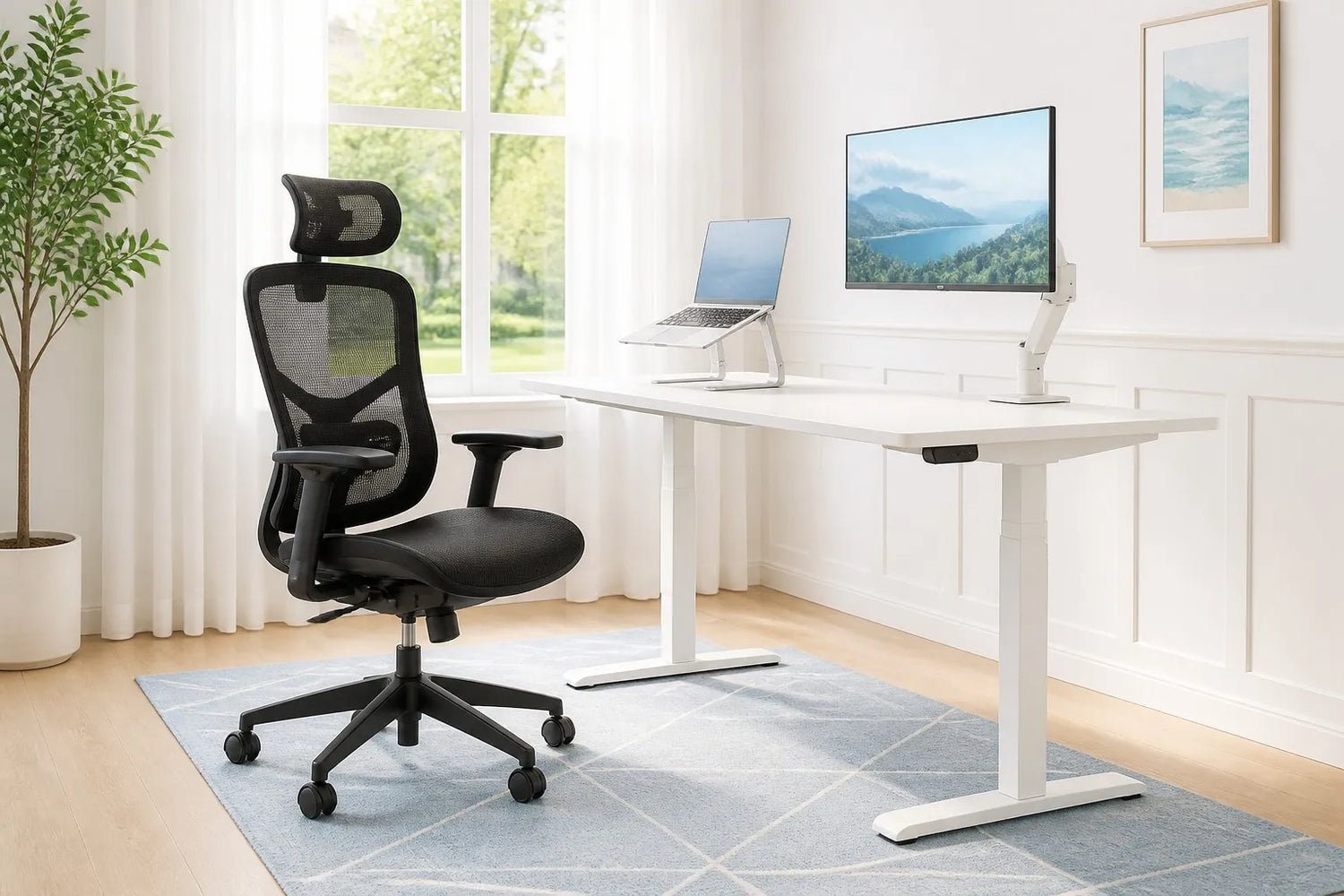
It's 11:40 on a Thursday night and you have fourteen browser tabs open. Eight are office chairs. Four are standing desks. One is a monitor arm you're not sure you need, and one is a video review filmed three years ago on a phone with a cracked lens. You've been trying to buy a decent home office setup for three weeks, and somehow you're further from a decision than when you started.
We see this exact scene play out constantly, because we're the people on the other side of it. Rackora is a small ergonomic furniture company. We're the ones who answer the emails, pack the boxes, and process the returns. We see what comes back and why. We hear the "I should have bought this six months ago" stories and the "this thing wobbles so bad I can't type" stories in about equal measure.
So for Labor Day 2026, we're doing something different from the usual "HERE ARE 47 DEALS" roundup. No listicle bait. No fake countdown timers. Just the honest answer to the question we get every single day: if it were our money, what would we buy?
This is that answer, at three price points: around $400, around $600, and the complete setup. We'll tell you exactly what we'd pick, why we'd pick it, and what we'd skip even if it were marked down to a dollar.
The Honest "What We'd Buy" Post
Let's get the obvious thing out of the way first: we sell these products. This is a company blog, and when you click a link in this post, it goes to our store. You deserve to know that before you read another word.
But here's the part that usually surprises people: the "what we'd buy" framing isn't a marketing gimmick for us. It's the literal truth. The chair we recommend at the $400 tier is the chair most of our own team sits in eight hours a day. The desk we recommend at the $600 tier is the desk our office runs on. When a product comes back with the same complaint three times in a week, we stop selling it. Not because we're noble. Because returns cost us money, and refunds cost us sleep.
That's the filter this post runs through. We're not picking products because a spreadsheet says they carry the best margin. We're picking the ones that don't come back. The ones we'd buy again ourselves, with our own money, knowing what we know about what breaks, what wobbles, and what gets quietly returned in month two.
One more thing about that filter: it runs on complaints as much as compliments. When a chair comes back, we don't just print a label and move on. We ask why, and the why is usually short. It wobbled. It sagged. It squeaked. Products that survive those answers are the only ones that make it into a post like this, and products that don't get cut, no matter how nice the marketing photos were.
And honestly, the Labor Day timing matters here. Furniture discounts are real in September in a way they aren't in February. Brands clear inventory before the holiday quarter, and you're shopping at a moment when the market actually favors the buyer. We'll get to that timing logic later, because it's the part of Labor Day shopping everyone ignores and nobody should.
But first, the picks.
How We Picked These (and What We Ignored)
Before the specific products, a quick note on how we think about any ergonomics purchase, because it will make the rest of this post make more sense.
We ignore four things when we evaluate gear. Flashy marketing photos. "Ergonomic" used as a buzzword instead of a description. Star ratings with fewer than fifty reviews. And anything that requires tools we don't already own. None of those tell you how a chair feels at hour six. A chair can look stunning in a studio render and still make your lower back hate you by Tuesday afternoon.
We pay attention to four other things instead.
One: adjustability range. If a chair can't adapt to different body sizes, it's not ergonomic, it's just a chair with a nice name. Height adjustment that actually covers a range, armrests that move, lumbar that can be positioned. Those are the differences between a chair that fits you and a chair that fits everyone and no one.
Two: the mechanism. Cheap chairs cheap out on the part that lets you recline, and a recline that clunks is a recline you'll stop using. The mechanism is the heart of the chair. If it's not smooth on day one, it's not getting better on day 300.
Three: what the reviews say over time, not on day one. Day-one reviews are excitement. Month-three reviews are truth.
Four: what comes back in returns. That's the data nobody else gets to see. We do, and it changes how we read everything else.
The picks below are products that cleared all four filters, at the three price points where people actually land when they're building a setup.
Worth noting what didn't make the cut, too. There are chairs in our catalog that cost more than the L2, and some of them are excellent, but this post is about the best buy at each price, not the most expensive thing we sell. There are also desks with fancier features than memory presets, but for the way most people actually work, presets are the feature that pays for itself every single day. And anything that needed a degree in engineering to assemble got disqualified before it ever reached the price check.
The $400 Tier: The L2 Ergonomic Office Chair ($389)

Here's the thing about the "best ergonomic chair under 400 dollars" question: at $389, the L2 isn't just under $400. It's under $400 with room to spare, which means you're not making the usual compromise of "I'll accept the wobbly armrests because the price is right."
The L2 is a mesh chair, and that's worth pausing on, because mesh is the material that keeps working at hour five. It breathes, so you're not sitting in a pool of your own heat by midafternoon. It gives where you need it to give and stays firm where you need it to stay. Anyone who has ever peeled themselves off a leather chair in July knows exactly what we're talking about.
The regularly $449 price tag tells you where this chair sits in the lineup. The current $389.00 Labor Day price is the kind of discount that's small enough to be real: you're saving sixty dollars, not being lured in by a fake "70% off" sticker that was never true.
But the number that matters most is the reviews: 4.9 out of 5 stars, from 418 reviews.
We'll be straight with you: 418 reviews is not a massive sample. But a 4.9 average with that many reviews is genuinely unusual. Chairs in this price band tend to settle into the 4.2 to 4.5 range, because at some point somebody's mechanism starts clunking or somebody's seat pan digs into their thighs. The L2 holding at 4.9 means the people who bought it are, almost unanimously, still happy after the return window closed. That's the review pattern you want to see, and it's rare.
Who is the L2 for? The person who sits for real hours. The person who works from home, takes calls, writes, thinks, and does all of it from the same chair five days a week. The person who has already tried the cheap chair once and is done re-buying one every eighteen months. If you sit twenty minutes a day at a desk you barely use, you don't need any of this, and we'd tell you to save your money. But if the chair is where you live from nine to five, this is the price to do it properly.
Why the L2 Wins at This Price
Let's talk about what $389 actually gets you, because "you get what you pay for" is true but useless without specifics.
First, it gets you a chair that isn't a gamble. The $150 chair from a name you can't pronounce is a gamble in the strict sense of the word: it might be fine, it might sag in six months, and you won't know until you've owned it. The L2 is a known quantity. Four hundred eighteen people have already done the test run, and they rated it 4.9 stars. You're not the first person to sit in this chair; you're just the next one.
Second, it gets you adjustments that do their job. Seat height that goes low enough and high enough for a real range of users, armrests that move where you need them, lumbar support you can actually feel when you sit back. These are the things you adjust once and then never think about again, which is exactly how it should be. A chair you're constantly fiddling with is a chair that's winning the argument.
Third, it gets you a mechanism that doesn't act up. You'll recline in this chair. You'll lean back when you're thinking, rock when you're on a call, sit bolt upright when the email is bad. All of that movement goes through one mechanism, and if it's cheap, you'll hear about it every single time. The L2's recline is quiet and smooth, the kind of thing you only notice because you don't notice it.
Fourth, it gets you the honest version of a sale. The regular $449 price is the real value of this chair. At $389.00, you're getting that same chair for less, and nothing about the chair is reduced to make that happen. It's the same build, same everything, at the sale price.
Here's the other thing the price gets you, and it's the part people forget: the risk-free trial. Every chair we sell carries a 30-day money-back guarantee, which means the decision isn't made the day you click buy. It's made the day you've sat in it for a week and you know. That changes the whole calculus. You're not choosing blind, you're choosing with a month of evenings and deadlines to back you up.
And the obvious comparison, while we're here: the L2 is not a gaming chair, and that's a feature. Gaming chairs look fast and sit stiff. The race-car bucket shape that looks great in a streamer setup is the same shape that pins your shoulders forward and turns your lower back into a question mark by hour three. The L2 is built for the unglamorous reality of work: long sits, shifting postures, the occasional recline at 4pm when the day is done but you're not. It doesn't need to look like a cockpit to do the job.
And if you want the full breakdown of what chairs actually cost and where the money goes, we wrote a longer piece on what you should spend on an ergonomic chair this year. The short version is right here: at $389, the L2 is the chair we'd put our own money on.
The $600 Tier: The 40×24 Electric Standing Desk ($599.99)

Now the desk, because a chair is only half of the ergonomic chair and standing desk combo, and the other half is where people make the expensive mistake. If you've been asking about the best standing desk under 600 dollars, this is the section for you.
The 40×24 electric standing desk is our pick at the $600 tier, and the price math is the first thing to understand. It's $599.99 right now, regularly $879.99. That's a $280 gap, and it's the difference between "on sale" and "actually marked down."
What you're getting for that: an electric desk with memory presets, at a size that fits the average home office without a fight. Forty inches wide, twenty-four inches deep. Big enough for a monitor, a keyboard, a notebook, and a coffee mug. Small enough that it doesn't turn your spare room into a boardroom.
The memory presets are the feature people underestimate until they've used them, so let's spend a second on why they matter. The entire point of a standing desk is that you move during the day. Sit for a while, stand for a while, sit again. The problem with desks without presets is that every change costs you a few seconds of holding a button and hoping you land on the same height as last time. With presets, your sitting height and your standing height are saved. One touch, it goes there. One touch, it comes back.
That might sound like a small thing. It's not. The desks that get used are the desks that make switching effortless, and presets are the difference between "I'll stand after this email" and "I'll just stay sitting, it's a hassle." You'll stand more with presets. That's what they're for.
And it's electric, which matters more than people think. A desk you have to crank is a desk you'll use twice: once to try it and once to prove you tried it. An electric desk makes the change a one-touch decision, and one-touch decisions are the ones you actually make.
Before you order any desk, do yourself a favor and measure your space. The 40×24 is a friendly size, but "friendly" still needs a floor plan. Know where the desk goes, know what's on it, and know how much room the chair needs to roll back when you stand up. That last one is the one everyone forgets, and it's the difference between a desk you use and a desk you orbit awkwardly. Twenty minutes with a tape measure now saves you a week of regrets later.
Why This Desk Beats a $200 "Wobble Desk"
We should talk about the $200 desks, because they're everywhere on Labor Day, and they're the trap of the season.
Here's what a $200 "standing desk" usually is: a frame that wasn't built to hold its own weight at standing height, a lift that strains, and a wobble that shows up the moment you stand up to use it. It wobbles when you type, it sways when you lean on it, and the wobble is the thing that kills it. Because here's the secret about cheap desks: the wobble isn't annoying, it's disqualifying. You can't type accurately on a desk that sways. You can't look professional on a video call with a monitor that shimmies every time you hit the space bar. A desk that wobbles at standing height is a desk you'll lower once and never raise again, which means you paid $200 for a desk that doesn't stand.
The 40×24 holds steady where it matters, and it's stable for a reason: it's built to do the standing thing all day, every day, not just on the afternoon you assemble it.
But let's also be fair to the budget argument. If you genuinely can't stretch past $200, a decent fixed-height desk is a better use of that money than a wobbly "standing" desk, because at least the fixed desk doesn't lie to you. It's a table, and it tables well. But if you want to stand, and you can find the extra money, the difference between "I have a desk that stands" and "I have a desk I actually stand at" is the single biggest upgrade in this whole post.
And let's talk about the hidden cost of the cheap desk, because it's never just the $200. Cheap frames come back. They come back because the lift gives out, because the wobble makes the monitor unusable at standing height, because the parts that arrived were the parts that were supposed to last and didn't. When you add the replacement, the shipping, and the afternoon you spent rebuilding, the $200 desk quietly becomes a $500 desk with a worse story. The $599.99 desk is the one that ends the cycle.
If you're still deciding, our full standing desk buyer's guide walks through the whole decision from the ground up.
The Full Setup: Desk + Chair + Monitor Arm + Laptop Stand
This is the tier for people who want the whole room handled in one order, and it's the build we'd actually put together for ourselves.
The math first, because it's honest and it's simple:
- 40×24 electric standing desk: $599.99
- L2 ergonomic office chair: $389.00
- Single monitor arm: $139.99
- Ergo Laptop Stand Elite Edition: $79.99
- Total: $1,208.97


That's the complete build. Four products, one total, no hidden line items.
Here's why each piece earns its spot.
The monitor arm comes first, because it's the piece people skip and then regret. A single monitor arm at $139.99, regularly $169.00, does two things at once: it lifts your screen to eye level, which is the single most important alignment in your whole setup, and it clears the desk surface your monitor stand was taking up. That reclaimed space is where your keyboard goes, where your notebook goes, where your coffee goes. You'll feel the difference in the first hour, not the first month.
The Ergo Laptop Stand Elite Edition is the laptop person's version of the same idea. If you work on a laptop, the screen is too low and the keyboard is too high, and those two problems fight each other. The Elite Edition, at $79.99, regularly $129.99, lifts the screen to a height your neck agrees with. If you'd rather spend less, the Pro Stand 100 at $59.99, regularly $99.99, does the same core job. And if you're the rare person who needs the whole workstation to move between rooms, the laptop computer cart at $158.46, regularly $239.46, is the mobile option.
And the two big pieces you already know: the 40×24 desk and the L2 chair. The desk holds everything steady at sitting and standing height. The chair keeps you comfortable through the sitting half. Together, that's the ergonomic chair and standing desk combo done properly, in one order, at the honest price.
If you can't do the whole build at once, do it in this order: chair first, desk second, monitor arm third, laptop stand whenever the neck complains. The chair is the piece that touches your body all day, so it's the piece that earns its money fastest. The desk changes how you work; the chair changes how you feel. And if you're on video calls all day, move the monitor arm up the list, because eye level is the upgrade everyone sees.
What We Would Not Buy on Labor Day
Every year, Labor Day brings out the same four temptations, and every year we watch people fall for them. Let's save you the trip.
First: the bargain chair. We're talking chairs under $150, usually "gaming" chairs or "ergonomic" chairs with a made-up-sounding brand name and a photo of a smiling model in a showroom. Here's what's actually in the box: foam that flattens in a season, armrests that wiggle, a lumbar pillow that slides down and lives behind your back, and a mechanism that starts clicking around week three. We know because we've taken these apart. They're not bad deals. They're bad products at low prices, and the price is the only good thing about them.
Second: the fixed-height "standing desk." If it doesn't move, it's not a standing desk, it's a tall table with good marketing. The whole point of standing is that you can switch, and a desk that never changes height has no switch. If "standing desk" appears in the name and the product doesn't adjust, the marketing is doing the heavy lifting, not your posture.
Third: the mystery brand. If you can't find the company's return policy in under a minute, if the reviews are all "five stars, fast shipping" with no detail about the product, if the price is 80% below everyone else's, you're not getting a deal, you're being the deal. Labor Day is when the junk brands run their biggest discounts because it's when the biggest crowds are shopping.
Fourth: the "ergonomic" accessory that's really just foam. Wrist rests, seat cushions, lumbar pillows sold as solutions. Some of these are fine in a supporting role. None of them fix a chair that doesn't fit. You can't bolt comfort onto a chair that's the wrong shape, and you shouldn't try.
One more skip: extended warranties on furniture under $500. Read the warranty before you buy it, not after. If the product is built to last, the coverage that comes with it is usually enough, and if it isn't, the warranty is just a surcharge on a product the seller doesn't trust either. Your money is better spent on the chair that doesn't need the extra coverage in the first place.
Why Labor Day (Not Cyber Monday) Is the Move
Here's the timing logic, because it's the part of this post people actually use.
Labor Day is the back-to-work holiday. Kids go back to school, adults go back to the office, and everyone who spent the summer ignoring their home setup suddenly has to sit in it again. That's why the furniture deals are real in September: it's the season's biggest furniture moment, and the discounts reflect it. The desk and chair above are at their Labor Day prices right now, and those are the prices in this post.
Second, buying in September gives you time. The 30-day money-back guarantee means your Labor Day purchase is also your September test drive. Buy the setup now, live with it through the month, and you're still inside the return window when October starts. You can't do that in December, when the holiday shipping crush makes returns slower and every decision feels rushed.
Third, you get the use. This is the boring reason, and it's the best one. Every week you sit in the right chair instead of the wrong one is a week your back notices the difference. If you're going to buy anyway, the question isn't "is now a good time?" The question is "what is one more month of the wrong setup worth to me?"
Fourth, you beat the crowd. Holiday-season shipping delays, sold-out sizes, delivery windows that stretch into January. September orders go out like normal orders, because September is still a normal month.
One honest note before the FAQ: we can't tell you the exact day your box arrives, because that depends on where you are and what we're packing that week. What we can promise is that the prices in this post are live, the guarantee is real, and the 30-day clock starts when the box lands. Shop like that, and the timing takes care of itself.
FAQ
Is the L2 chair worth $389?
Yes, if you spend real hours in it. You're paying for a mesh seat that breathes, adjustments that actually adjust, and a 4.9-star average across 418 reviews, which is the kind of consistency that doesn't happen by accident. At $60 off the regular $449 price, it's the strongest value we sell in the under-$400 space.
Is the 40x24 desk a good deal at $599?
The regularly $879.99 price makes the $599.99 Labor Day price a $280 discount, and for an electric desk with memory presets, that's a fair deal in any season. The presets are the feature you'll use every single day: one touch to your sitting height, one touch to standing.
What's the best ergonomic chair under $400?
For our money, the L2 at $389.00. It clears the under-$400 budget with room to spare, it's mesh so it holds up to long days, and the 4.9-star average from 418 reviews is the strongest public record at this price. If you're shopping that exact number, that's where we'd point you.
What's the best standing desk under $600?
The 40×24 electric standing desk at $599.99, currently $280 off its regular $879.99 price. It's electric, it has memory presets, and at 40 by 24 inches it fits most home offices without taking over the room. Under $600 with those features, it's the one we'd buy.
Do I need a monitor arm?
Not strictly, but once you use one you won't go back. A single monitor arm, $139.99 (regularly $169.00), lifts the screen to eye level and frees the desk space your monitor stand was hogging. It's the cheapest upgrade that changes how the whole desk feels.
Can I combine desk and chair deals?
You don't need to. The prices in this post are the live store prices right now, so the L2 and the 40×24 desk are already at their Labor Day numbers. Add both to your cart and the discounts are already there, no code juggling required.
What should I skip on Labor Day?
Bargain chairs under $150, fixed-height desks with "standing" in the name, and deals from brands you can't verify have a return policy at all. A $120 chair that hurts your back by week two isn't a deal, it's a future landfill contribution.
How fast is shipping?
Orders ship with tracking, and the 30-day trial clock starts when the box lands, not when you click buy. So even a Labor Day weekend order gives you a full month to decide, which is the number that actually matters.
If we had to rebuild a home office from scratch this Labor Day, here's exactly what we'd buy: the L2 Ergonomic Office Chair at $389.00, the 40×24 electric standing desk at $599.99, a single monitor arm at $139.99, and the Ergo Laptop Stand Elite Edition at $79.99. That's $1,208.97 for a setup that covers sitting, standing, screen height, and laptop heat, the complete build at the honest price.
Every product in this post ships free in the US and carries our 30-day money-back guarantee. Buy it, live with it for a month, and if it's not right, send it back. That's the whole Labor Day plan: buy the good stuff, skip the junk, and let the trial do the deciding.
