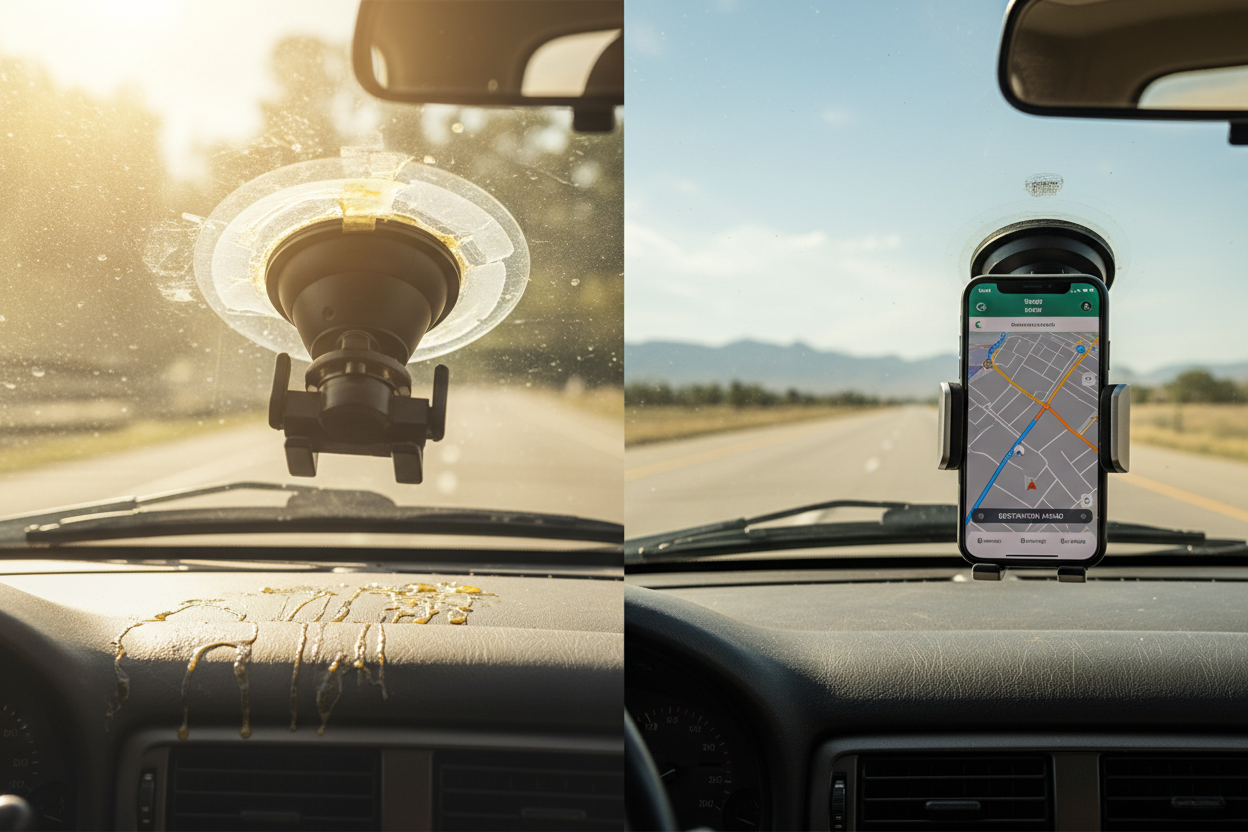
You've been there. You're twenty minutes into a road trip, the GPS is finally routing you around the highway backup, and then — thwack. Your phone peels off the windshield and lands face-down on the passenger seat. Again.
It's one of those small frustrations that feels embarrassingly universal. And yet, every summer, the same thing happens to millions of drivers across the country. The phone mount that worked fine in March is suddenly useless by July. You buy a replacement. It lasts six weeks. Repeat.
Here's the thing: this isn't a quality-control fluke. It's not even bad luck. It's a predictable, repeatable failure caused by a combination of physics and cheap materials — and once you understand exactly why it happens, you'll never buy the wrong type of car phone holder again.
Let's break it down.
The Summer Cabin Furnace: What's Actually Happening Inside Your Parked Car
Most people know that parked cars get hot in summer. What most people don't realize is just how extreme those temperatures get — and how fast.
On a sunny 90°F day, the interior of a closed car can reach 130°F within 20 minutes. Leave it for an hour, and you're looking at 160°F or higher. But here's the part that matters for your phone mount: the windshield surface temperature runs significantly hotter than the air inside the cabin.
Glass is a near-perfect solar collector. It absorbs and re-radiates infrared radiation, and because the windshield faces the sun at a direct angle for hours at a time, surface temperatures on the glass itself routinely exceed 150°F to 180°F during peak summer afternoons in states like Arizona, Texas, Nevada, and Florida. Even in more temperate climates — California, Georgia, the Carolinas — windshield temps regularly hit 140°F on clear summer days.
That number matters because most standard adhesive compounds and gel-based suction materials begin to soften somewhere between 120°F and 140°F. You're not just approaching that threshold in summer. You're blowing past it every single afternoon your car sits in a parking lot.
And it gets worse when you factor in the thermal cycling. Every morning, your car cools down overnight. Every afternoon, it bakes again. Each expansion-and-contraction cycle degrades the adhesive bond a little more. A mount that survives one heat wave might fail on the third or fourth. This is why so many drivers report that their phone holder "just started falling off" seemingly out of nowhere — it didn't fail suddenly. It failed gradually, and summer just accelerated the timeline.
The windshield isn't the only problem zone, either. Dashboard surfaces — especially dark-colored ones — absorb even more solar radiation. A black dashboard in direct sun can reach 200°F. If your mount is attached to the dash rather than the glass, you're dealing with even more extreme conditions.
Bottom line: your car's interior in summer is a thermal stress environment that most consumer-grade phone mounts were simply never designed to handle.
The Failure of Traditional Suction Cups: A Closer Look at the Physics
To understand why cheap suction cups fail, you need to understand how they're supposed to work in the first place.
A traditional suction cup creates a seal by pressing against a smooth surface and expelling the air from the cavity between the cup and the surface. The atmospheric pressure outside the cup — about 14.7 PSI at sea level — then pushes the cup against the surface, creating the "suction" effect. It's not actually suction in the vacuum sense; it's differential pressure doing the work.
This system works reasonably well under controlled conditions. The problem is that it depends on two things remaining stable: the integrity of the seal material and the smoothness of the contact surface. Summer heat attacks both.
How Heat Destroys the Seal Material
Most budget suction cups are made from PVC (polyvinyl chloride) or a low-grade silicone compound. These materials have a glass transition temperature — the point at which they shift from a firm, elastic state to a soft, pliable one — that sits uncomfortably close to summer windshield temperatures.
When the material softens, two things happen simultaneously. First, the cup loses its ability to maintain its domed shape, which is what creates the pressure differential in the first place. A softened cup conforms to the surface rather than pushing against it, and the seal degrades. Second, the softened material becomes slightly tacky — which sounds like it would help, but actually makes things worse. Tacky material picks up microscopic dust and debris from the windshield surface, further compromising the seal quality.
The result is a mount that feels secure when you press it on in the morning (when the car is still relatively cool) but progressively loses grip as the day heats up. By 2 PM on a July afternoon, the suction force may have dropped by 60% or more from its rated capacity.
Thermal Expansion and the Dashboard Problem
Gel pad mounts — the kind that stick to your dashboard using a sticky adhesive pad rather than a suction cup — have their own failure mode. The adhesive compounds used in these pads are typically pressure-sensitive adhesives (PSAs) formulated for room-temperature use. At elevated temperatures, the polymer chains in the adhesive soften and flow, reducing the cohesive strength of the bond.
Meanwhile, the dashboard surface itself is expanding. Plastic and vinyl dashboard materials have relatively high coefficients of thermal expansion. As the dashboard heats up, it expands slightly — and that expansion creates shear stress at the adhesive interface. The adhesive, already softened by heat, can't resist that shear stress, and the mount begins to creep — slowly sliding down the dashboard surface over the course of hours.
This is why you'll often find your dashboard-mounted phone holder has migrated several inches from where you originally placed it by the end of a hot day. It didn't fall off all at once. It crept.
And when these gel pads finally do release, they often leave behind a sticky residue that's genuinely difficult to remove from dashboard surfaces — especially textured or soft-touch finishes. Some drivers have reported permanent staining or surface damage from adhesive residue baked onto their dashboards by summer heat.
The Vibration Compounding Effect
Heat doesn't work alone. Road vibration is the other half of the failure equation.
Every bump, expansion joint, and rough patch of pavement sends vibration through your car's chassis and into your phone mount. Under normal conditions, a properly functioning suction cup or adhesive pad can absorb this vibration without losing its grip. But a heat-compromised mount is already operating at the edge of its holding capacity. Add vibration, and you're essentially shaking a weakened grip until it lets go.
This is why phone mounts tend to fail most dramatically on highway drives in summer — the combination of sustained high speed (more vibration from road surface irregularities) and prolonged sun exposure (more heat buildup) creates the worst possible conditions for a compromised mount.
The Intelligent Vacuum Solution: How Rackora Engineered Around the Heat Problem
Understanding the failure modes makes the solution obvious: you need a mounting system that doesn't rely on passive atmospheric pressure or temperature-sensitive adhesives. You need something that actively maintains its grip regardless of what the ambient temperature is doing.
That's exactly what Rackora built.

The Rackora Vacuum-Enhanced Car Phone Holder uses an active electronic air-pressure sensing mechanism — not a passive suction cup. Here's what that distinction means in practice.
A passive suction cup creates its initial seal when you press it against the surface, and then just... hopes for the best. If the seal degrades due to heat, vibration, or surface contamination, there's no mechanism to compensate. The grip weakens, and eventually the mount falls.
Rackora's system works differently. An integrated electronic vacuum pump actively monitors the air pressure inside the suction chamber. When the system detects that pressure has risen — meaning the seal is beginning to degrade — it automatically re-engages the pump to restore the vacuum. The mount is constantly self-correcting, maintaining a consistent grip regardless of temperature fluctuations.
The result is a holding force rated at 5 kilograms (11 lbs) — roughly 30 times stronger than a standard passive suction cup. Your phone weighs somewhere between 6 and 8 ounces. The math is not close.

The 1-Second Mounting Experience
One of the practical frustrations with traditional suction cups is the ritual of mounting them. Press, twist, press again, check if it's secure, press harder, wonder if it's actually going to hold this time. It's a minor annoyance that adds up over hundreds of commutes.
Rackora's vacuum system mounts in one second. Press the base against the windshield, trigger the pump, and the mount locks itself in place with an audible click. No twisting, no pressing and re-pressing, no uncertainty. It's either locked or it isn't, and the system tells you which.
Battery Life That Doesn't Require Babysitting
The obvious question with any battery-powered device: how often do you have to charge it? The answer here is genuinely impressive — up to 60 days on a single charge. The vacuum pump only activates when it detects pressure loss, so it's not running continuously. In practice, most users charge it once every one to two months.
That's a meaningful difference from a product that requires weekly charging. The goal of a phone mount is to be invisible — something you set up once and forget about. A 60-day battery life gets you much closer to that experience.
Ready to stop fighting your phone mount every summer?
The Rackora Vacuum-Enhanced Car Phone Holder is $99.00 (regularly $139.00) — and first-time customers get an additional 15% off with our welcome discount.
Claim 15% Off — Shop Now
Vibration Resistance on Summer Detours: The CNC-Machined Aluminum Skeleton
A secure base is only half the equation. The other half is what happens to your phone once it's mounted — specifically, whether it stays stable when the road gets rough.
Budget phone holders typically use injection-molded plastic for their arms and joints. Plastic is fine for light-duty use, but it has a fundamental problem: it flexes. Every bump in the road causes the plastic arm to flex slightly, which translates into screen wobble. On a smooth highway, this might be barely noticeable. On a rough road, a construction detour, or an unpaved surface, it becomes genuinely distracting — your navigation map is bouncing around, you're squinting to read it, and you're no longer paying full attention to the road.
Rackora's holder is built around a CNC-machined aluminum alloy skeleton. CNC machining (computer numerical control) produces components with tolerances measured in thousandths of an inch — far tighter than injection molding can achieve. The result is a structure with essentially zero flex under normal driving loads.

The aluminum alloy used here is the same category of material used in aerospace and precision instrument manufacturing. It's corrosion-resistant, which matters in humid summer conditions. It's dimensionally stable across a wide temperature range, which means the joints and pivot points maintain their precision even when the car interior is at 150°F. And it's significantly lighter than steel while being stronger than plastic — so you get rigidity without adding unnecessary weight to the windshield-mounted assembly.
360-Degree Rotation with Infinite Angle Adjustability
Rigidity doesn't mean inflexibility. The ball joint mechanism in Rackora's holder allows for 360-degree rotation and infinite angle adjustment — you can position your phone in portrait mode for navigation, landscape mode for video calls, or any angle in between. The joint is smooth enough to adjust with one hand but firm enough to hold its position without drifting.
This matters more than it might seem. A phone mount that's slightly off-angle forces you to tilt your head to read it, which is both uncomfortable on long drives and subtly distracting. Getting the angle exactly right — and having it stay there — is one of those small ergonomic details that makes a real difference over the course of a summer's worth of commuting.
Universal Compatibility: Every Phone, Every Case
The holder accommodates phones of all sizes, from compact 4-inch devices to large 7-inch phablets. The adjustable grip mechanism works with or without a case — including thick protective cases that often cause problems with cheaper holders. Whether you're running an iPhone 15 Pro Max, a Samsung Galaxy S24 Ultra, or a Google Pixel 9, the fit is secure and the phone is accessible.

Summer Commuting Security: Why Your Phone Mount Is a Safety Device
It's easy to think of a phone mount as a convenience accessory. It's actually a safety device.
The National Highway Traffic Safety Administration (NHTSA) consistently identifies distracted driving as one of the leading causes of traffic fatalities in the United States. In 2022, distracted driving claimed over 3,300 lives. And while texting while driving gets most of the attention, reaching for a phone that's fallen off its mount — or glancing repeatedly at a screen that's wobbling and hard to read — is exactly the kind of secondary distraction that contributes to accidents.
A phone mount that you trust completely changes your driving behavior in a meaningful way. When you know your phone is locked in place and the screen is at the right angle, you glance at it the same way you glance at your speedometer — briefly, efficiently, and without taking your attention off the road. When you're not sure if the mount is going to hold, you're subconsciously monitoring it. That cognitive load adds up.
Summer makes this worse. Longer days mean more driving. Road trips, beach runs, camping detours — summer is when Americans drive the most. It's also when phone mounts fail the most. The combination is not a good one.

Investing in a mount that actually works isn't about convenience. It's about removing one more variable from an already complex driving environment. You've got enough to pay attention to on a summer highway — construction zones, sun glare, distracted drivers around you. Your phone mount shouldn't be on that list.
The Real Cost of Cheap Mounts
Let's do some honest math. A budget suction cup mount costs $8 to $15. It lasts one summer — maybe two if you're lucky. Over five years, you've spent $40 to $75 on mounts that kept failing, plus the time spent replacing them, plus the frustration of mid-drive failures, plus the potential dashboard damage from adhesive residue.
The Rackora Vacuum-Enhanced Car Phone Holder is $99.00 (down from $139.00). It's built from aircraft-grade aluminum alloy and engineered to maintain its grip through multiple summers of thermal cycling. The active vacuum system doesn't degrade the way passive suction cups do. The CNC-machined joints don't develop the slop and wobble that plastic joints do over time.
This is a buy-it-once product in a category that's trained people to expect disposable ones. That's a meaningful distinction.
First-time Rackora customer?
Use your 15% welcome discount on the Vacuum-Enhanced Car Phone Holder — currently priced at $99.00 (compare at $139.00). That brings your out-of-pocket cost to under $85 for a mount that's engineered to last.
Get 15% Off Your First Order
What's in the Box
When your Rackora holder arrives, here's what you'll find:
- Vacuum-Enhanced Car Phone Holder × 1
- Electrostatic film × 3 (for optimal windshield adhesion)
- Charging cable × 1
- Instructions manual × 1
The electrostatic film is worth calling out specifically. Applying it to your windshield before mounting creates an ultra-smooth, clean surface for the vacuum seal — which is one of the reasons Rackora's system maintains such a strong grip even on windshields with minor surface texture or contamination. It's a small detail that makes a real difference in long-term performance.

Technical Specifications
- Material: Aluminum Alloy + PC + POM
- Suction Strength: 30× traditional holders
- Maximum Holding Capacity: 5 kg (11 lbs)
- Battery Life: Up to 60 days per charge
- Mounting Time: 1 second
- Rotation: 360 degrees, infinite angle adjustment
- Compatibility: Universal — fits all smartphones
- Price: $99.00 (compare at $139.00)
Frequently Asked Questions
Q: Will this phone holder actually stay on my windshield in 100°F+ summer heat?
A: Yes — and this is the core reason Rackora built an active vacuum system rather than a passive suction cup. The electronic pressure sensor continuously monitors the seal and re-engages the pump if pressure drops. Unlike passive suction cups, which lose grip as temperatures rise and the cup material softens, Rackora's system compensates automatically. The aluminum alloy construction also maintains its structural integrity across a wide temperature range, so the mount itself doesn't warp or degrade in high heat.
Q: How long does the battery last, and what happens if it runs out while I'm driving?
A: The battery lasts up to 60 days on a single charge under normal use. The pump only activates when it detects pressure loss, so it's not running continuously. If the battery were to run completely flat, the vacuum seal would gradually equalize with atmospheric pressure — the mount wouldn't suddenly drop, but grip strength would diminish over time. In practice, the 60-day battery life means this scenario is unlikely if you charge it during your regular device charging routine. The included charging cable makes this straightforward.
Q: Will it damage my windshield or leave residue?
A: No. The vacuum system works against the windshield surface without adhesives, so there's no residue left behind when you remove it. The included electrostatic film creates a clean interface between the mount and the glass. This is a significant advantage over gel pad mounts, which frequently leave adhesive residue that's difficult to remove — especially after being baked onto the surface by summer heat.
Q: My windshield has a slight curve. Will the suction cup still seal properly?
A: The suction base is designed to accommodate the gentle curvature of standard automotive windshields. The electrostatic film included in the package helps create a consistent seal surface. For extremely curved windshields (common in some sports cars and trucks with steeply raked glass), we recommend testing the mount in a shaded area first to confirm the seal before relying on it in high-heat conditions.
Q: How does the 5kg holding capacity compare to what I actually need?
A: Most smartphones weigh between 170g and 240g (roughly 6 to 8.5 oz). The Rackora holder's 5kg (11 lb) capacity is approximately 20 to 30 times the weight of a typical phone. This isn't marketing excess — the extra capacity is what gives the mount its resistance to vibration and sudden movements. A mount operating at 5% of its rated capacity handles road bumps and sudden stops very differently than one operating at 80% of its rated capacity.
Q: Does it work with thick protective cases?
A: Yes. The adjustable grip mechanism accommodates phones with or without cases, including thick protective cases and battery cases. The universal design fits phones from approximately 4 inches to 7 inches in screen size.
Q: Can I use this on my dashboard instead of my windshield?
A: The mount is designed primarily for windshield use, where the glass surface provides an ideal smooth, flat interface for the vacuum seal. Dashboard surfaces vary significantly in texture and material — some will work well, others may not provide a consistent seal. If you prefer dashboard mounting, we recommend testing on your specific vehicle before committing to that placement.
Q: How do I clean the suction base if it picks up dust or debris?
A: Rinse the suction base with clean water and allow it to air dry completely before remounting. Avoid soap or cleaning agents, which can leave a film that interferes with the seal. The electrostatic film on the windshield side should also be kept clean — replacement films are included in the package (3 total), and additional films can be sourced from Rackora if needed.
Q: Is this compatible with MagSafe or wireless charging?
A: The Rackora Vacuum-Enhanced Car Phone Holder is a mechanical mounting system — it holds your phone securely but does not include wireless charging functionality. Your phone can be charged via its standard charging port while mounted. If wireless charging integration is a priority for your setup, please check our current product lineup for updated models.
Q: What's the return policy if it doesn't work for my vehicle?
A: Rackora stands behind the quality of this product. Please refer to our store's current return policy for specific terms and timelines. If you have questions about compatibility with your specific vehicle before purchasing, feel free to reach out — we'd rather help you make the right decision upfront than process a return after the fact.
Stop Replacing Phone Mounts Every Summer
The Rackora Vacuum-Enhanced Car Phone Holder — $99.00 (was $139.00)
Active vacuum seal. CNC aluminum alloy. 60-day battery. Built for summer.
Claim Your 15% First-Order Discount →