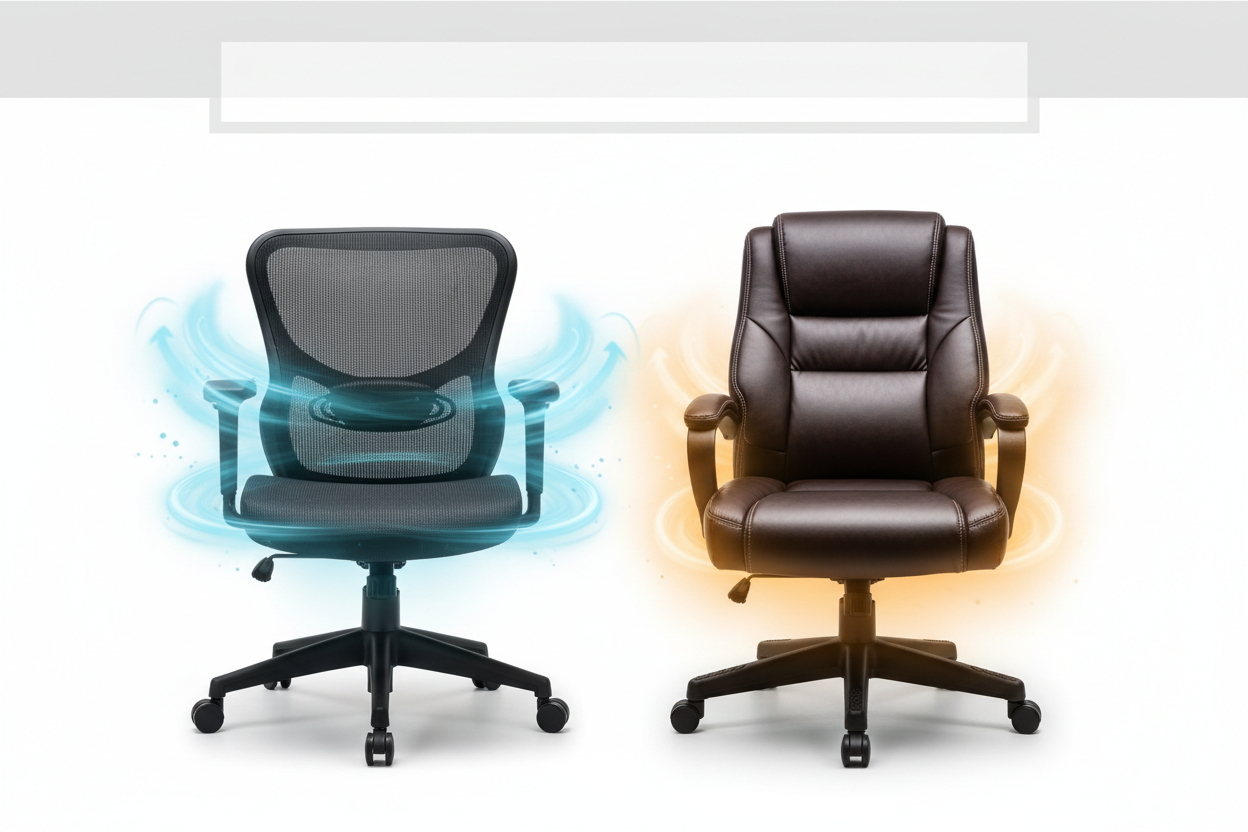
Let's be honest: nobody wants to talk about back sweat. But if you've ever peeled yourself off a leather office chair on a July afternoon, you already know the problem is real — and it's not just uncomfortable, it's a productivity killer.
Every summer, the same question floods ergonomic forums and Reddit threads: mesh or leather office chair for summer? The answers are all over the place. So we decided to go deeper than "mesh breathes better" and actually look at why — the physics, the materials science, and what it means for your 8-hour workday.
Spoiler: if you run warm, the chair you're sitting in right now might be working against you.
The Physics of Sitting: Why Your Chair Traps Heat
Your body generates heat constantly — even sitting still at a desk, you're producing somewhere between 70–100 watts of thermal energy. That heat has to go somewhere. In a well-ventilated room, most of it dissipates into the air around you. But the surface you're sitting on? That's where things get complicated.

When you sit down, you create a contact zone — the area where your back, seat, and thighs press against the chair surface. In that zone, heat transfer happens through three mechanisms:
- Conduction — direct heat transfer from your body to the chair material
- Convection — heat carried away by air movement across the surface
- Evaporation — moisture (sweat) evaporating from your skin, which cools you down
The chair material determines how well each of these mechanisms can work. And this is exactly where leather and mesh diverge dramatically.
PU Leather: A Thermal Trap by Design
Most "leather" office chairs sold today use PU (polyurethane) leather — a synthetic material that mimics the look of genuine leather at a fraction of the cost. It's durable, easy to wipe clean, and looks sharp in a professional setting.
But thermodynamically, PU leather has a serious problem: it's essentially non-porous.
The surface of PU leather has no meaningful air gaps. When your back presses against it, you're creating a sealed microclimate between your skin (or shirt) and the chair. Heat builds up in that zone because:
- Conduction transfers your body heat into the leather, which warms up and radiates it back at you
- There's no airflow path through the material, so convection is blocked
- Sweat can't evaporate efficiently — it just pools between you and the surface
Studies on seating thermal comfort consistently show that impermeable surfaces raise skin temperature and perceived discomfort significantly faster than permeable ones. One frequently cited metric: contact surface temperatures under PU leather can run 3–5°F higher than ambient room temperature within 20 minutes of sitting.
That might not sound like much. But over an 8-hour workday, that sustained heat load adds up — and your body responds by sweating more, which makes the problem worse.
Mesh: Passive Ventilation Built Into the Structure
High-quality mesh chairs work on a completely different principle. The open-weave structure — typically a tensioned polymer fabric stretched across a rigid frame — creates thousands of tiny air channels across the contact surface.
Here's what that means in practice:
- Convection is restored. Air can move through the mesh, carrying heat away from the contact zone continuously.
- Evaporation works properly. Sweat can evaporate through the mesh rather than pooling against your skin.
- Conduction is reduced. Because the mesh has far less solid material in contact with your body, less heat transfers directly into the chair surface.
The result is a chair that functions more like a breathable athletic garment than a piece of furniture. Your body's natural cooling system — perspiration and evaporation — can actually do its job.
This isn't marketing language. It's basic thermodynamics. And it's why ergonomics researchers and occupational health specialists consistently recommend mesh seating for warm environments and extended sitting sessions.
Structured Comparison: Mesh vs. Leather Office Chair for Summer
Let's put the two materials side by side across the dimensions that matter most for summer use:
| Category | Mesh Chair | PU Leather Chair |
|---|---|---|
| Breathability | Excellent — open weave allows continuous airflow | Poor — non-porous surface traps heat and moisture |
| Summer Comfort (8hr) | High — skin temperature stays closer to ambient | Low — heat and sweat buildup accelerates after ~20 min |
| Sweat Management | Evaporation-friendly; moisture passes through | Moisture pools at contact surface |
| Winter Comfort | Can feel cool in cold rooms (layer up) | Warmer initial feel; retains body heat |
| Maintenance | Vacuum or brush; harder to wipe spills | Easy wipe-clean; spill resistant |
| Durability | High-quality mesh resists sagging for 5–10 years | PU leather cracks and peels over time (2–5 years) |
| Long-Session Fatigue | Lower — cooler body temp reduces cognitive fatigue | Higher — heat stress increases mental fatigue |
| Aesthetics | Modern, professional; available in multiple colors | Classic executive look; premium appearance |
| Price Range | $150–$600+ for quality ergonomic models | $100–$800+ depending on build quality |
| Best For | Warm climates, hot offices, long work sessions | Cool offices, shorter sessions, executive aesthetics |
The Long-Session Fatigue Problem Nobody Talks About
Here's something that doesn't get enough attention in chair reviews: heat doesn't just make you uncomfortable — it makes you less productive.
Research on thermal comfort and cognitive performance consistently shows that elevated core and skin temperatures impair concentration, working memory, and decision-making speed. The effect isn't dramatic in a single hour, but over a full workday, the cumulative impact is measurable.
When you're sitting in a leather chair that's trapping heat, your body is constantly working to regulate its temperature. That's metabolic work — energy your brain could be using for actual thinking. By hour five or six, you're not just sweaty. You're slower, more irritable, and more prone to errors.
Mesh chairs reduce this load. By keeping your contact surface temperature closer to ambient, they let your thermoregulatory system coast rather than sprint. The difference in afternoon focus is real — and it's one of the most underrated arguments for breathable seating.
What to Look for in a Breathable Mesh Chair
Not all mesh chairs are created equal. Here's what separates a genuinely breathable, ergonomic mesh chair from a cheap knockoff that just happens to have holes in it:
1. Mesh Tension and Weave Density
The mesh should be taut — not saggy. A properly tensioned mesh distributes your weight evenly and maintains its airflow properties over years of use. Loose mesh compresses under your weight, closing off the air channels and defeating the purpose.
2. Lumbar Support Design
A high-back mesh chair should have built-in lumbar support that follows the natural curve of your spine. Adjustable lumbar is even better — it lets you dial in the support for your specific body geometry. Without proper lumbar support, you'll compensate by slouching, which compresses your diaphragm and increases fatigue.
3. Adjustable Armrests
3D or 4D adjustable armrests let you position your arms so your shoulders stay relaxed. This matters more than most people realize — shoulder tension is a major contributor to neck pain and end-of-day fatigue.
4. Seat Depth and Height Range
Your feet should rest flat on the floor with your knees at roughly 90 degrees. A chair with a wide height adjustment range accommodates more body types and desk heights.
5. Weight Capacity
Check the rated capacity. Quality ergonomic chairs are typically rated for 250–350 lbs. A chair that's undersized for your weight will compress the mesh and degrade faster.
Rackora's High-Back Mesh Chairs: Built for All-Day Comfort
If you've made it this far and you're ready to stop fighting your chair every summer, here are the Rackora mesh models worth looking at. These are designed specifically for extended work sessions — with breathable mesh backs, proper lumbar support, and ergonomic adjustability that holds up over years of daily use.
1. Ergonomic Office Chair – High Back Mesh with Lumbar Support & Footrest

A solid entry point into proper ergonomic mesh seating. The high-back design supports your full spine from lumbar to upper back, and the included footrest makes it easy to find a neutral sitting position even during marathon work sessions. The breathable mesh back keeps airflow moving all day.
Price: $241.00
2. High Back Mesh Office Chair with Adjustable Armrests – Ergonomic Desk Chair

Step up in adjustability. This model features multi-directional armrests that let you fine-tune arm position for your desk height and shoulder width — a detail that makes a significant difference over an 8-hour day. The mesh back maintains consistent airflow regardless of recline angle.
Price: $340.00
3. Ergonomic Office Chair with 3D Armrests, Headrest & Reclining – 300 lbs Capacity

The full-featured option. 3D armrests, an adjustable headrest, reclining function, and a 300 lb weight capacity make this the chair for people who spend serious time at their desk and want every variable dialed in. The high-back mesh construction keeps the breathability intact even with all the added adjustability.
Price: $459.00
4. L2 Ergonomic Office Chair with Footrest & 135° Recline

Rackora's flagship ergonomic chair. The 135° recline range lets you shift between focused upright work and a more relaxed position for reading or calls — without leaving your desk. The footrest and breathable mesh back make this a genuinely all-day chair for people who take their workspace seriously.
Price: $489.00
Is a Leather Chair Ever the Right Call?
Fair question — and the honest answer is yes, in specific situations.
If your office is heavily air-conditioned and stays at 68°F or below year-round, the breathability gap between mesh and leather narrows considerably. In a cold environment, leather's heat-retaining properties can actually feel comfortable rather than oppressive.
Leather also wins on maintenance simplicity. Spill coffee on a leather chair? Wipe it up. Spill coffee on a mesh chair? You're dealing with it for a while. For environments where cleanliness is a priority — medical offices, food-adjacent workspaces — leather's wipe-clean surface is a genuine advantage.
And aesthetically, a well-made leather executive chair projects a certain gravitas that mesh can't quite replicate. If you're meeting clients in your office and the visual impression matters, that's a real consideration.
But for the majority of home office workers in the US — especially those in warmer climates, non-climate-controlled spaces, or anyone who runs warm by nature — mesh wins the summer comfort battle decisively.
The Seasonal Compromise: What Some People Get Wrong
A common workaround people try: buying a leather chair and adding a mesh seat cushion or a lumbar pillow. The logic makes sense on paper — you get the look of leather with some added breathability.
In practice, it rarely works well. A mesh cushion on a leather chair still leaves your back in contact with the leather backrest, which is where most of the heat buildup happens. And adding layers between you and the seat changes the ergonomic geometry the chair was designed around, often creating new pressure points.
If breathability is a priority, the better move is to start with a mesh chair and get the ergonomics right from the ground up. Retrofitting a leather chair for summer comfort is a bit like putting a spoiler on a sedan — it looks like it should help, but the fundamentals haven't changed.
Setting Up Your Mesh Chair for Maximum Summer Comfort
Even the best mesh chair won't perform optimally if it's set up wrong. Here's a quick setup checklist for summer comfort:
- Seat height: Feet flat on the floor, knees at 90°, thighs roughly parallel to the ground. This minimizes pressure on the backs of your thighs, which improves circulation and reduces heat buildup in the seat area.
- Lumbar support: Position it so it contacts the natural inward curve of your lower back — typically around belt level. You shouldn't have to lean back to feel it.
- Armrests: Set them so your shoulders are relaxed and your elbows are at roughly 90° when typing. Armrests that are too high force your shoulders up; too low and you're hunching.
- Recline tension: Adjust the tilt tension so you can recline slightly without effort. A slight recline (100–110°) actually reduces spinal disc pressure compared to sitting bolt upright.
- Desk clearance: Make sure you can pull close enough to your desk that you're not reaching forward — reaching forward collapses your posture and increases back muscle fatigue.
- Room airflow: Position your chair so you're not sitting directly in front of a vent blowing cold air (which can cause muscle stiffness) but close enough to benefit from general room circulation.
Mesh Chair Maintenance: Keeping It Clean Through Summer
One legitimate concern with mesh chairs is maintenance — particularly during summer when sweat is a factor. Here's how to keep your mesh chair in good shape:
- Weekly: Use a soft brush or vacuum with a brush attachment to remove dust and debris from the mesh weave. This keeps the air channels clear.
- Monthly: Wipe down the mesh with a lightly dampened cloth and mild soap. Avoid soaking the mesh — you want to clean the surface, not saturate the material.
- For sweat: A light spray of fabric refresher (like Febreze) between cleanings helps manage odor. Some people also use a thin, breathable seat cover during summer — just make sure it's actually breathable and not defeating the purpose.
- Frame and armrests: Wipe down with a damp cloth. Most Rackora chairs use powder-coated or plastic-finished frames that are easy to clean.
- Avoid: Harsh chemical cleaners, bleach, or abrasive scrubbers — these can degrade the mesh fibers over time.
Final Verdict: Which Chair Wins for Summer?
If you work in a warm environment, run hot, or spend more than 4–5 hours a day at your desk during summer months, the answer is clear: a high-quality mesh chair outperforms leather in every thermal comfort metric that matters.

The physics aren't complicated. Open weave = airflow = cooler contact surface = less sweat = better focus. PU leather blocks all of that.
The investment in a proper ergonomic mesh chair pays off not just in comfort, but in the hours of productive, focused work you get back every day. If you're currently peeling yourself off a leather chair every afternoon, that's not a minor inconvenience — it's a daily tax on your output.
Rackora's mesh chair lineup is built for exactly this use case: all-day ergonomic support with breathability that holds up through a US summer. Whether you're starting at $241 or going all-in on the L2 at $489, you're getting a chair designed around how people actually work — not just how chairs look in a showroom.
Frequently Asked Questions
Q: Is mesh or leather better for a hot office in summer?
Mesh is significantly better for hot environments. The open-weave structure allows air to circulate through the chair back and seat, preventing the heat and moisture buildup that makes leather chairs uncomfortable during warm months. If your office isn't heavily air-conditioned, mesh is the clear choice.
Q: Do mesh chairs get hot too?
High-quality mesh chairs stay noticeably cooler than leather because air can pass through the material. That said, no chair is completely heat-neutral — if your room is very hot, you'll still feel warm. The difference is that mesh allows your body's natural cooling (sweat evaporation) to work, while leather blocks it.
Q: How long does a mesh office chair last?
A well-made mesh chair from a reputable brand should last 7–10 years with normal use. The key factors are mesh tension quality (it shouldn't sag) and frame construction. Cheap mesh chairs can lose tension within 1–2 years. Rackora chairs are built with commercial-grade mesh and tested for long-term durability.
Q: Can I use a mesh chair in winter without getting cold?
Yes, though mesh chairs do feel cooler initially in cold rooms. Most people adapt quickly, and the ergonomic benefits remain year-round. If you're in a very cold office, wearing a light layer or using a small space heater under your desk is usually enough to compensate. The breathability advantage in summer far outweighs the minor winter adjustment.
Q: What's the difference between cheap mesh and premium mesh chairs?
The main differences are mesh tension, frame quality, and adjustability. Cheap mesh chairs use lower-grade mesh that compresses and sags under body weight, closing off the air channels and losing ergonomic support. Premium mesh maintains its tension and shape over years of use. The frame quality also determines how well the chair holds its adjustments over time.
Q: Are mesh chairs good for people with back pain?
Yes — provided the chair has proper lumbar support. Mesh alone doesn't fix back pain; the ergonomic design does. Look for a high-back mesh chair with adjustable lumbar support that you can position at your specific lumbar curve. Rackora's ergonomic mesh chairs include built-in lumbar support designed for extended sitting.
Q: How do I clean a mesh office chair?
Use a soft brush or vacuum to remove debris from the weave weekly. For deeper cleaning, wipe with a lightly dampened cloth and mild soap. Avoid soaking the mesh or using harsh chemical cleaners. For odor management during summer, a light fabric refresher spray works well between cleanings.
Q: Is PU leather the same as genuine leather for heat retention?
PU leather is actually worse than genuine leather for breathability. Genuine leather has some natural porosity that allows minimal moisture transfer. PU leather is a synthetic coating over a fabric backing — it's essentially a plastic film, which means zero breathability. Most budget and mid-range "leather" office chairs use PU leather, not genuine leather.
Q: What weight capacity do I need in a mesh chair?
Always choose a chair rated for at least 20–30 lbs more than your body weight. This gives the mesh and frame adequate headroom to maintain their structural integrity over time. Rackora's ergonomic mesh chairs are rated for 300 lbs, making them suitable for a wide range of users without compromising on mesh tension or frame durability.
Q: Is a $489 mesh chair worth it compared to a $150 option?
For occasional use, a budget mesh chair might be adequate. For 6–8 hours of daily use, the investment in a quality chair pays off quickly — in comfort, productivity, and longevity. A $489 chair that lasts 8 years costs about $61/year. A $150 chair that sags and loses support in 18 months costs more per year and more in back pain. The math usually favors quality.
