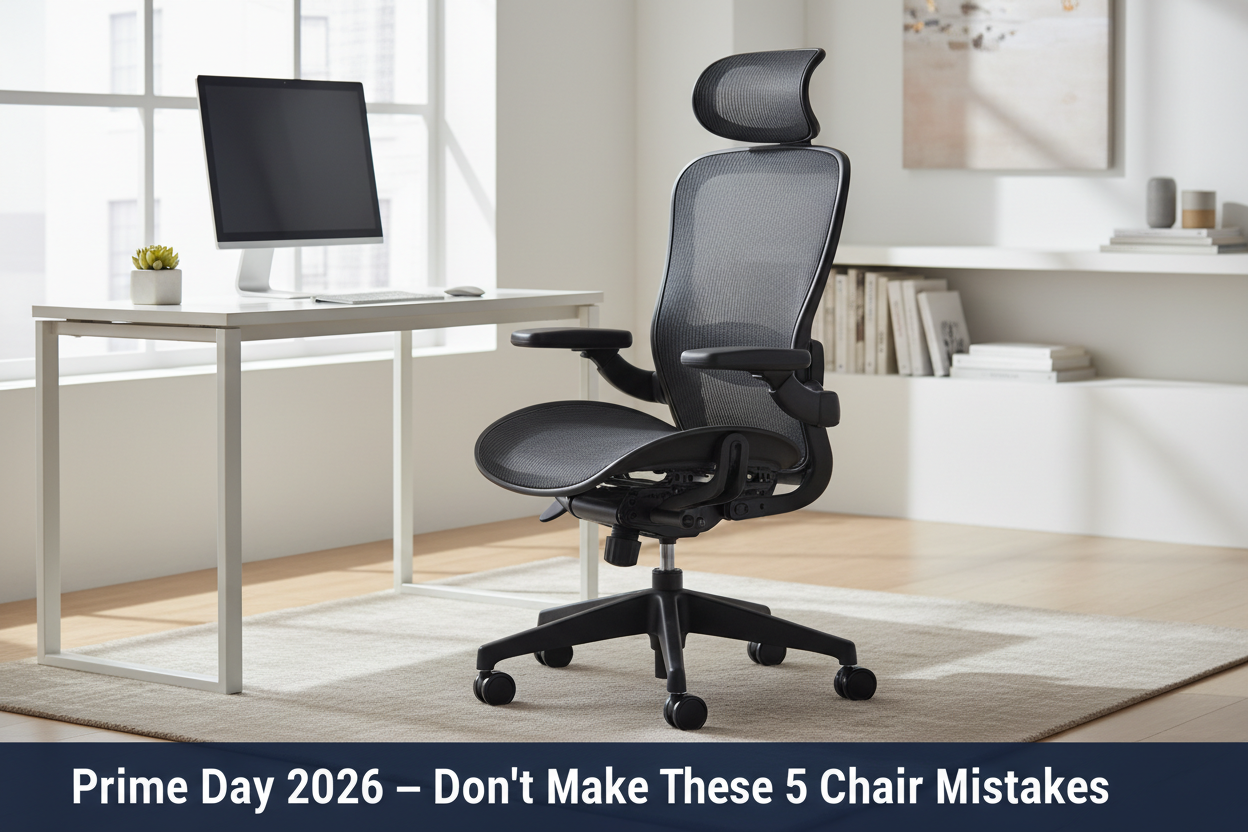
Don't Let a Great Deal Turn Into a Painful Mistake
Every year, Prime Day rolls around and millions of people finally pull the trigger on that office chair they've been eyeing for months. The price drops, the countdown timer ticks, and before you know it — you've spent $300 to $600 on something that ends up hurting your back worse than the $80 chair you replaced.
Here's the uncomfortable truth: most ergonomic chairs marketed during Prime Day are designed to look ergonomic, not function ergonomically. And the difference between those two things is the difference between a productive workday and a chronic lower-back problem.
This guide breaks down the five most common — and most expensive — mistakes people make when buying an ergonomic chair during Prime Day 2026. We'll also show you exactly what to look for, what specs actually matter, and which Rackora chairs are worth your money this year.
Let's get into it.
Mistake #1: Buying for Aesthetics Over 4D Adjustability
This is the big one. It's also the mistake that causes the most long-term damage.
You see a sleek, modern chair with a gorgeous mesh back, clean lines, and a color that matches your desk setup perfectly. It looks like something out of a high-end co-working space. So you buy it — and three weeks later, your shoulders are tight, your lower back aches by 2 PM, and you're shifting in your seat every 20 minutes trying to get comfortable.
What went wrong? The chair looked ergonomic but wasn't built to adjust to your body.
Real ergonomic support requires what the industry calls 4D adjustability — the ability to move your armrests in four directions: up/down, forward/backward, side-to-side, and pivot/angle. Without all four axes of adjustment, your arms, shoulders, and neck are forced to compensate for a fixed position that may not match your body proportions or your desk height.
Most budget chairs sold during Prime Day offer 1D or 2D armrests at best. They go up and down. That's it. And that's not enough if you're sitting 6–10 hours a day.
Beyond armrests, true ergonomic chairs also need:
- An adjustable lumbar support that moves with your spine — not a fixed foam pad
- A headrest that tilts and adjusts in height
- A seat depth slider so your thighs aren't cut off at the edge of the cushion
- A recline function that locks at multiple angles, not just one
If a chair doesn't have all of these, it's a desk chair with ergonomic branding — not an actual ergonomic chair.
What to Look For Instead
The Rackora Ergonomic Office Chair with Lumbar Support is a strong example of what real adjustability looks like at a reasonable price point. It features 3D adjustable armrests (up/down, forward/backward, and pivot angle), a sliding seat cushion for depth adjustment, a dynamic lumbar support that follows your waist as you shift positions, and a headrest that tilts up to 45 degrees.

At $459.00, it's BIFMA certified and built for all-day use — not just for looking good in a product photo.
→ Shop the Rackora Ergonomic Chair with 3D Armrests — $459.00
Mistake #2: Ignoring Weight Capacity — and Why It Destroys Gas Lifts
Here's something most chair listings bury in the fine print: the standard gas lift cylinder on a typical office chair is rated for 250 lbs. That's the person's weight, not the total load. And that 250 lb rating assumes the lift is used gently, on a flat surface, with no sudden drops into the seat.
In real life? People drop into chairs. They lean back hard. They sit for 10 hours straight. Under those conditions, a standard Class-3 gas lift on a 250 lb-rated chair starts degrading much faster than the spec sheet suggests — especially for anyone over 200 lbs.
The result: your chair slowly sinks throughout the day. You raise it, it sinks again. Eventually the lift fails entirely and the chair drops to its lowest position and stays there. You've just turned a $400 chair into a very expensive stool.
This is one of the most common complaints in Amazon reviews for Prime Day chair deals, and it's almost always tied to undersized gas lifts on chairs that were never engineered for real-world use.
What the Spec Sheet Should Say
Look for chairs with a Class-4 gas lift — the commercial-grade standard — and an SGS certification on that lift specifically. SGS is an independent testing body that verifies the lift can handle the rated load over thousands of cycles without failure.
The Rackora Heavy Duty Office Chair 500lbs is built around exactly this standard. It features an SGS-certified Class-4 gas lift, a reinforced iron base, and a 500 lb weight capacity — not the 250 lb limit you'll find on most Prime Day specials.

The extra-wide 30.4" seat, flip-up armrests, and breathable PU leather make it genuinely comfortable for larger frames — not just technically rated for them.
At $520.00, it costs more than a budget Prime Day chair. But it won't need to be replaced in 18 months because the lift gave out.
→ Shop the Rackora 500lbs Heavy Duty Chair — $520.00
Mistake #3: Skipping the Recline Range (and Locking Mechanism)
A lot of people think reclining is a luxury feature — something you use when you're slacking off, not when you're working. That's a misconception that costs people a lot of back pain.
Sitting perfectly upright at 90 degrees is actually one of the worst positions for your lumbar spine over long periods. Research consistently shows that a slight recline — somewhere between 100 and 120 degrees — reduces disc pressure significantly compared to sitting bolt upright. The ability to shift between positions throughout the day is what keeps your muscles from fatiguing and your spine from compressing.
The problem with cheap chairs isn't that they don't recline — most of them do. The problem is that they recline in one direction and lock at one angle, or they have a tension knob that's either too loose (you fall back unexpectedly) or too stiff (you can't recline at all without serious effort).
What you actually want is a chair that:
- Reclines to at least 115–135 degrees
- Locks at multiple positions along that range
- Has a tension adjustment so the recline resistance matches your body weight
- Returns smoothly to upright without snapping back
Two Options Worth Considering
If you want a solid mid-range option with a 115° recline and a 5-position lock, the Rackora Ergonomic Chair with Lumbar Support handles this well at $459.00. It's designed for people who want to shift between focused work and relaxed reading without getting up.
If you need something that goes further — literally — the Rackora 155° Reclining Swivel Chair reclines to a full 155 degrees with an integrated footrest that tucks away when you're working and deploys when you need a proper rest position.

At $546.00, the 155° model is built with thick foam and an S-spring seat pack — the kind of construction that holds its shape after years of daily use, not just the first few months.
→ Shop the Rackora 155° Reclining Chair — $546.00
Mistake #4: Overlooking Mesh Quality (Not All Mesh Is Equal)
Mesh backs became popular for a good reason: they breathe. If you've ever sat in a leather or foam-backed chair for eight hours in a warm room, you know exactly why mesh caught on. The airflow keeps you cooler, reduces sweating, and generally makes long sessions more tolerable.
But here's what the Prime Day listings won't tell you: mesh quality varies enormously, and cheap mesh fails in ways that are hard to spot until you've already bought the chair.
Low-quality mesh:
- Stretches out within 6–12 months, losing its tension and support
- Develops sag in the lumbar zone — exactly where you need the most support
- Can feel scratchy or rough against skin through thin clothing
- Doesn't distribute pressure evenly, creating hot spots on your back
Premium mesh, by contrast, maintains its tension over years of use, distributes your weight across the entire back surface, and feels smooth and supportive rather than just "not solid."
When evaluating a mesh chair, look for:
- A mesh that's described as "high-tension" or "elastomeric" rather than just "breathable nylon"
- A lumbar zone that's either reinforced or has a separate adjustable lumbar support behind the mesh
- A frame that holds the mesh taut — not just stapled to a plastic shell
A Mesh Chair That Gets It Right
The Rackora High Back Mesh Office Chair with 4D Armrests combines breathable mesh and fabric construction with a 4D multi-directional armrest system — one of the few chairs in this price range that actually delivers on both breathability and adjustability simultaneously.

At $340.00, it reclines from 90° to 120°, swivels 360°, and fits neatly under a workbench when not in use. The high-density foam fill means the seat cushion won't pancake after a few months of daily use.
→ Shop the Rackora 4D Mesh Chair — $340.00
Mistake #5: Treating "Ergonomic" as a Certification Instead of a Feature Set
This is the subtlest mistake on the list, but it might be the most important one to understand before you shop Prime Day.
"Ergonomic" is not a regulated term. Any manufacturer can put it on any chair. There's no minimum standard a chair has to meet to be called ergonomic — which means the word itself tells you almost nothing about whether the chair will actually support your body.
What does tell you something are third-party certifications from independent testing bodies. The two most relevant ones for office chairs sold in the US are:
- BIFMA (Business and Institutional Furniture Manufacturers Association): Tests for structural integrity, durability, and safety under commercial use conditions. A BIFMA-certified chair has been tested to withstand the kind of daily use a real office environment demands.
- SGS Certification: An independent global testing and inspection body. SGS certification on a gas lift, for example, means the lift has been independently verified to perform at its rated capacity over a defined number of cycles.
When you see these certifications listed in a product description, they mean something. When you see only the word "ergonomic" with no supporting certifications, treat it as marketing language — because that's all it is.

The Comparison That Makes This Clear
Here's a quick breakdown of what separates a genuinely ergonomic chair from a chair that's just marketed as one:
| Feature | Basic "Ergonomic" Chair | Premium Ergonomic Chair |
|---|---|---|
| Armrest Adjustability | 1D (height only) | 3D or 4D (height, depth, width, pivot) |
| Lumbar Support | Fixed foam pad | Dynamic / adjustable, follows spine movement |
| Seat Depth | Fixed | Sliding seat cushion (adjustable depth) |
| Recline | Single angle or no lock | Multi-position lock, 115°–155° range |
| Gas Lift | Class-3, 250 lb limit | Class-4, SGS-certified, 300–500 lb capacity |
| Weight Capacity | 250 lbs | 300–500 lbs |
| Certifications | None listed | BIFMA, SGS, or equivalent |
| Headrest | Fixed or absent | Height + tilt adjustable |
| Mesh Quality | Basic nylon, sags over time | High-tension, maintains shape for years |
| Warranty / Support | 30 days or none | 1+ year with accessible customer support |
Print this table out if you need to. Use it as a checklist when you're evaluating Prime Day deals. If a chair can't check at least 7 of these 10 boxes, it's not worth buying at any price — because the cost of chronic back pain, physical therapy, or a replacement chair in 18 months will far exceed whatever you saved on the deal.
Bonus Mistake: Buying Without Considering Your Specific Use Case
We'll throw in a sixth mistake for free, because it's one we see constantly: buying a chair based on general reviews without thinking about your specific situation.
Are you over 250 lbs? You need a chair with a Class-4 lift and a 300–500 lb capacity rating — not a standard chair that technically fits your budget.
Do you work 10+ hour days? You need a chair with a dynamic lumbar, seat depth adjustment, and a multi-position recline — not just a chair that's comfortable for the first 90 minutes.
Do you take naps or long breaks at your desk? A chair with a 135°+ recline and an integrated footrest will serve you far better than a standard task chair.
Do you run hot or work in a warm environment? Mesh is non-negotiable. PU leather and bonded leather trap heat and become genuinely uncomfortable in warm conditions.
The right chair for you depends on your body, your work habits, and your environment — not just the star rating on a product listing.
Rackora's Prime Day 2026 Picks: The Short List
Here's a quick summary of the Rackora chairs worth considering this Prime Day, organized by use case:
Best for All-Day Work: Ergonomic Chair with 3D Armrests & Dynamic Lumbar
Rackora Ergonomic Office Chair with Lumbar Support — $459.00
BIFMA certified, 3D armrests, sliding seat, dynamic lumbar, 115° recline. Built for 8–10 hour workdays.
Best for Larger Frames: 500 lbs Heavy Duty Executive Chair
Rackora Heavy Duty Office Chair 500lbs — $520.00
SGS-certified Class-4 lift, 30.4" wide seat, reinforced iron base, flip-up armrests. The only chair on this list engineered specifically for heavy-duty use.
Best for Recline & Rest: 155° Reclining Chair with Footrest
Rackora 155° Reclining Swivel Chair — $546.00
Full 155° recline, integrated footrest, S-spring seat pack, thick foam cushion. Ideal if you want to work and rest in the same chair.
Best Mesh Option: High Back Mesh Chair with 4D Armrests
Rackora High Back Mesh Chair — $340.00
Breathable mesh + fabric, 4D armrests, 90°–120° recline, high-density foam seat. Best value for people who prioritize airflow.
Best Budget-Conscious Pick: Ergonomic Mesh Chair with Footrest
Rackora Ergonomic Mesh Chair with Lumbar & Footrest — $241.00
Lockable 90°–135° recline, retractable footrest, adjustable headrest, lumbar support pillow. A solid entry point if you're working with a tighter budget.

How to Shop Prime Day Ergonomic Chair Deals Without Getting Burned
Before you click "Add to Cart" on any Prime Day chair deal, run through this quick checklist:
- Check the armrest spec: Does it say 3D or 4D? If it only says "adjustable height," that's 1D.
- Find the gas lift class: Class-4 is commercial grade. Class-3 is standard. If it's not listed, assume Class-3.
- Look for certifications: BIFMA and SGS are the ones that matter. "Meets safety standards" without naming the standard means nothing.
- Check the weight capacity against your actual weight: Add 20–30% buffer for real-world use conditions.
- Read the 1-star reviews: They'll tell you exactly what fails first — usually the gas lift, the armrest mechanism, or the lumbar support.
- Calculate the cost per year: A $200 chair that lasts 18 months costs more annually than a $450 chair that lasts 5 years.
Prime Day is a great opportunity to invest in your workspace. Just make sure you're investing in something that will actually support your body — not just something that looks like it will.
Frequently Asked Questions
What does 4D adjustable armrests actually mean?
4D armrests adjust in four directions: up and down (height), forward and backward (depth), left and right (width), and pivot/angle. This lets you position your arms to match your exact desk height and shoulder width, reducing strain on your neck, shoulders, and wrists during long work sessions. Most budget chairs only offer 1D (height only) or 2D (height + depth) adjustment.
Is a 300 lb weight capacity enough for a 250 lb person?
It's technically within spec, but it's cutting it close for all-day use. Weight capacity ratings are typically measured under controlled lab conditions — not accounting for the dynamic load of someone dropping into a chair, leaning back hard, or shifting weight repeatedly over 8–10 hours. If you're near the rated limit, look for a chair with a 400–500 lb capacity and an SGS-certified Class-4 gas lift for real-world durability.
What's the difference between a Class-3 and Class-4 gas lift?
A Class-3 gas lift is the standard found in most consumer office chairs. It's rated for lighter loads and typical office use. A Class-4 gas lift is the commercial-grade standard — it's built to handle higher weight capacities and more frequent adjustment cycles without degrading. For anyone over 200 lbs or anyone who adjusts their chair height frequently throughout the day, a Class-4 lift is worth the upgrade.
Is mesh or leather better for an ergonomic chair?
It depends on your environment and priorities. Mesh breathes significantly better than leather or PU leather, making it the better choice for warm environments or people who run hot. High-quality leather (or breathable PU leather) offers a more premium feel and is easier to clean, but can trap heat during long sessions. For pure ergonomic function, mesh is generally preferred — as long as the mesh quality is high enough to maintain its tension over time.
How do I know if a chair's lumbar support is actually adjustable?
Look for specific language in the product description: "adjustable lumbar height," "dynamic lumbar," "back-chasing lumbar," or "lumbar depth adjustment." A fixed lumbar pad — even a well-shaped one — sits at one height and one depth. If your torso proportions don't match that fixed position, the lumbar support will either miss your lower back entirely or push into the wrong spot. Adjustable lumbar support lets you dial in the exact position for your body.
What does BIFMA certification mean for an office chair?
BIFMA (Business and Institutional Furniture Manufacturers Association) is the primary safety and performance standard for commercial office furniture in the United States. A BIFMA-certified chair has been independently tested for structural integrity, durability, and stability under conditions that simulate real commercial office use — including repeated weight loading, armrest stress tests, and caster durability. It's one of the most meaningful certifications to look for when evaluating office chair quality.
Are Prime Day ergonomic chair deals actually worth it?
Some are, some aren't. The key is knowing what you're looking for before the sale starts — because Prime Day creates urgency that makes it easy to buy based on price alone. Use the checklist in this article: verify the armrest adjustability, gas lift class, weight capacity, and certifications before you buy. A genuine discount on a well-built chair is a great deal. A deep discount on a poorly built chair is still a bad purchase.
How long should a quality ergonomic chair last?
A well-built ergonomic chair with commercial-grade components should last 5–10 years with normal daily use. The components that typically fail first are the gas lift (if it's undersized for the user's weight), the armrest adjustment mechanisms (if they're plastic rather than metal), and the foam cushion (if it's low-density). Chairs with BIFMA certification and SGS-certified gas lifts are tested to meet durability standards that support multi-year use.
Can I use an ergonomic office chair for gaming?
Yes — and in many ways, a proper ergonomic office chair is better for gaming than a dedicated gaming chair. Gaming chairs are often designed for aesthetics first, with fixed lumbar pillows and limited adjustability. An ergonomic chair with 3D or 4D armrests, adjustable lumbar, and a multi-position recline will support your posture better during long gaming sessions than most gaming-branded chairs at the same price point.
What's the best ergonomic chair for someone who works from home full-time?
For full-time remote workers, prioritize: dynamic lumbar support (not fixed), 3D or 4D armrests, a seat depth slider, and a recline that locks at multiple angles. The Rackora Ergonomic Chair with Lumbar Support at $459.00 hits all of these marks and is BIFMA certified for commercial use — which means it's built to handle the kind of daily use that a full-time home office demands.
Rackora designs ergonomic workspace furniture for people who take their health and productivity seriously. All chairs ship from US warehouses with fast delivery and full customer support.
