You saved up, you watched the streamers, and you bought the chair with the racing stripes and the RGB trim. It looked incredible in the thumbnail. It matched your setup perfectly. It was, you were sure, the final piece of the battlestation.
Six months later, the cushion has flattened out where you sit. The faux leather is peeling on the armrest where your forearms rest. Your lower back starts aching about forty minutes into a session, and you've started putting a pillow behind you — the same pillow you swore you'd never need because you bought a gaming chair.
Sound familiar? You're not alone. And here's the uncomfortable truth nobody in the marketing department tells you: the word "gaming" on a chair doesn't guarantee anything about your back. What it usually guarantees is a certain look, a certain price tag, and a bucket-style seat that was designed for a race car, not for a person.
This guide is the honest breakdown — what gaming chairs actually are, what ergonomic chairs actually are, where the money goes, and why a growing number of serious gamers (including big-name streamers) have quietly switched to ergonomic chairs. No marketing, no brand loyalty, just the stuff you'd want to know before you spend a few hundred dollars on something you'll sit in for thousands of hours.

The Chair Marketing Got You
Let's start with a little history, because it explains everything.
Racing-style "gaming chairs" didn't come from the gaming industry. They came from the car accessory world. A manufacturer in China that built bucket seats for racing simulators and car interiors realized there was a market for the same look in office chairs, slapped "gaming" on it, and the category was born. The design DNA is still there: high side bolsters, a bucket shape, a reclining backrest, and a headrest pillow — all borrowed from a race car cockpit.
Here's the problem with that DNA: race car seats are designed for holding you in place during G-forces, for short bursts, in a car that vibrates. They are not designed for sitting still for eight hours. The side bolsters that keep a driver planted in a corner also squeeze your thighs and shoulders when you're just trying to play for a couple of hours. The bucket shape pushes your pelvis back and encourages a slouch. And the "lumbar pillow" that ships with most gaming chairs? It's a throw pillow with a strap. It moves. It falls down. You spend the session fighting it.
None of this means gaming chairs are evil, by the way. They look great, and if you only game an hour a night and you love the look, enjoy yourself. But if you're spending serious hours — and let's be honest, most of us are — you deserve to know what you're actually sitting on.
What "Gaming Chair" Actually Means (and What "Ergonomic" Means)
Let's define terms, because the industry has made a mess of them.
A "gaming chair" is a style. It's a racing-inspired bucket design with bolsters, usually upholstered in faux leather, sold with pillows. That's it. There's no standard, no certification, no testing requirement that a chair has to pass to call itself "gaming." Any factory can stamp the word on anything with a lumbar pillow.
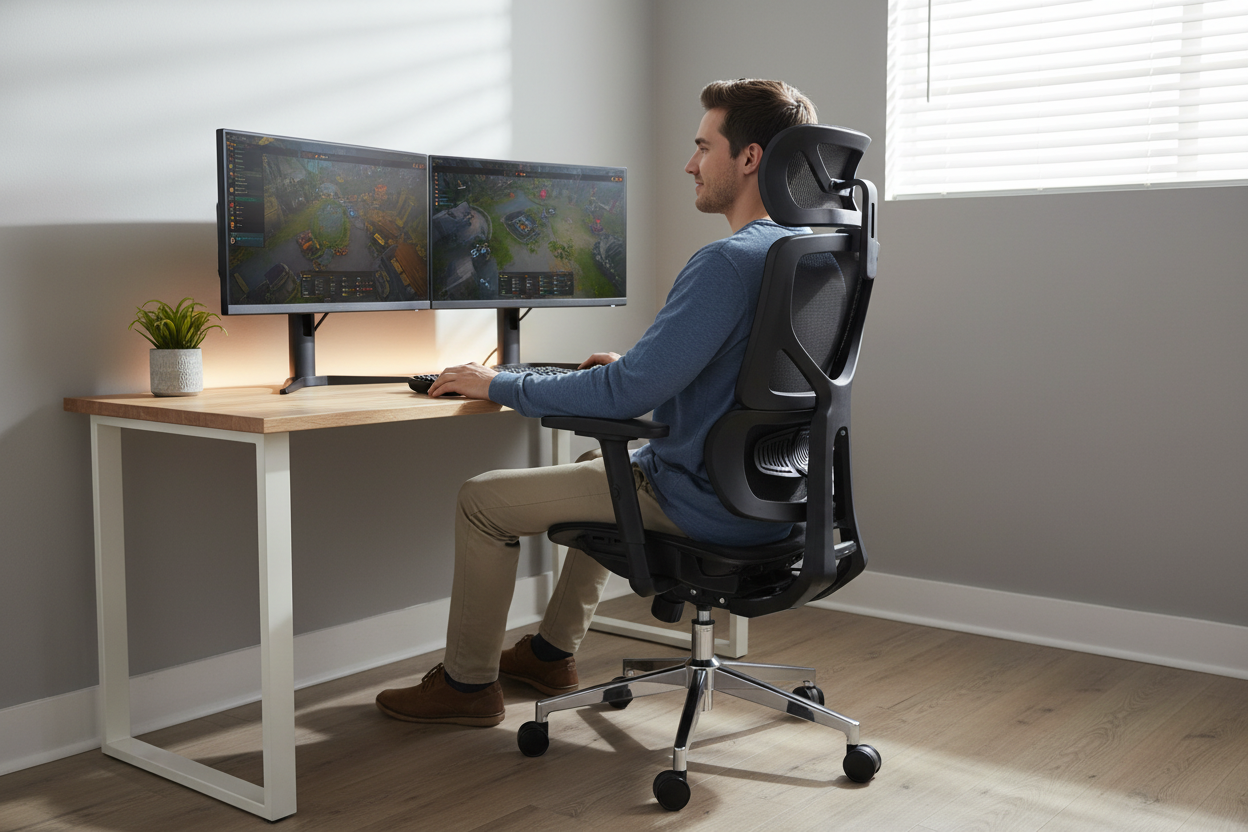
An "ergonomic chair" is a set of features. Adjustable lumbar support, seat depth adjustment, adjustable armrests, a backrest that moves with you, breathable materials, and — importantly — a design tested against how real bodies sit. There are actual standards bodies (BIFMA, for instance) that test office chairs for durability and safety. The word "ergonomic" gets thrown around loosely too, but the features are real and measurable: does the chair support your lower back, or doesn't it?
The honest way to compare them isn't "gaming vs ergonomic." It's "a chair with racing styling vs a chair with actual adjustability." Once you frame it that way, the decision gets a lot clearer.
The Big Differences That Actually Matter
Let's go through the differences one by one, because "the back hurts" isn't a great way to shop.
Lumbar support: a pillow vs a mechanism
This is the single biggest difference, and it's not close.
Gaming chairs usually give you a strap-on pillow. It sits wherever it drifts to, it compresses to nothing after a few months, and it doesn't adjust to your spine — it adjusts to wherever gravity leaves it.
Ergonomic chairs give you a lumbar mechanism: a built-in curve in the backrest, or an adjustable pad, or in the fancier ones, a dynamic support that moves with you. The Rackora chairs, for example, have built-in lumbar support that's part of the backrest frame — it's always there, at the right spot, whether you're sitting upright or reclining. You don't fight it. It just works.
If you've ever ended a long session with a knot between your shoulder blades, this is the feature that fixes it.

Seat depth: fixed vs adjustable
Most gaming chairs have a fixed seat depth. If your legs are longer or shorter than average, you're either sliding forward (no thigh support, extra pressure on your tailbone) or pressing your knees into the front edge.
Adjustable seat depth — where the seat slides forward and back — lets you dial in the position where your thighs are fully supported and your knees bend at about 90 degrees. It sounds minor. It's not. Seat depth is one of the top two causes of "why does my butt hurt after an hour" complaints, right behind the cushion itself.
The seat itself: bucket vs flat
The bucket seat is the racing heritage, and it's the thing your thighs will complain about. Those side bolsters squeeze your legs when you sit with your feet flat — which is the position your body actually wants. A flatter, wider seat lets your legs sit naturally, which matters a lot for long sessions.
Armrests: fixed plastic vs adjustable
Gaming chairs in the budget range have fixed armrests — hard plastic or thin padding, no adjustment. If your desk height doesn't match, your arms hover or your shoulders hunch, and that's how you get the neck/shoulder tension that follows you off the computer.
Ergonomic chairs have armrests that adjust: height, sometimes rotation, sometimes front-to-back. The Rackora L1 and L2 chairs give you 3D adjustable armrests — set them once so your elbows rest at 90 degrees, and your shoulders stop doing the work.
Materials: faux leather vs mesh
This one deserves its own section, because it's the difference people feel first.
Mesh vs Leather: The Heat Problem
Here's the thing nobody mentions in the gaming chair ads: faux leather doesn't breathe. At all.
Leather (or "PU leather," which is plastic) traps heat and sweat against your body. It feels cool when you first sit down — that's the showroom effect — and then it slowly turns into a sauna over the next hour. In summer, or in a room without great AC, or during a long ranked session when your heart rate is up and you're leaning forward? You're basically marinating.
Real user quote, from a Rackora L1 review: "No more sweat seshes in my old leather chair." That's the entire argument in one sentence.
Mesh, by contrast, is a fabric weave with air gaps. Your back and thighs get airflow, heat escapes, and you don't end a session with a damp back. For anyone who games more than an hour at a stretch — which, again, is most of us — this is a daily quality-of-life difference, not a cosmetic one.
There's a durability angle too: faux leather cracks and peels, especially at the armrests and the seat edges, usually within 12 to 24 months. Mesh doesn't peel. It can stretch over years, but a good mesh holds its tension for a long time. One of the main reasons people replace gaming chairs is the leather peeling — and that's not a "premium brand" problem, it's a "faux leather is a consumable material" problem.
Big Guys Need Big Numbers
Let's talk about a group the chair industry quietly ignores: bigger players.
If you're over 250 pounds — or over 6 feet tall, or both — you've probably noticed that most "gaming chairs" feel like they were built for someone smaller. The seat is narrow, the bolsters squeeze, the gas lift strains, and the whole thing wobbles when you shift. It's not your imagination. A lot of chairs are rated for 250 pounds, and "rated" is doing a lot of work in that sentence.
Here's a real review from a Rackora L1 owner — 6'2", 307 pounds: "I don't write reviews often, but this chair is the exception. Solid frame, easy assembly, and at 307 pounds 6ft2 I feel confident in this chair."
That's the thing to look for: not the marketing, but the numbers. What's the weight capacity? What's the seat width? Does the seat depth adjust far enough for long legs? Is the frame steel and reinforced, or is it plastic pretending?
The Rackora L1 518 is rated for up to 350 pounds with a wide, flat seat — built with the big-player crowd in mind, because that's who keeps showing up in the reviews saying "I was skeptical, but this holds me." When a 300-pound guy says he feels confident in the chair, that's worth more than any spec sheet.
Why the Streamers Switched
You might have noticed something if you watch the big streamers: the chairs changed. The racing bucket with the flashy logo started disappearing from setups, replaced by plain-looking mesh chairs that cost twice as much.
There are three reasons, and they're all practical.
Stream sessions are long. A sponsored streamer isn't gaming for fun — they're working an 8-to-10-hour shift in the chair. The bucket seat that feels fine for an hour feels like a mistake at hour six. The people who sit the longest figured out first which chairs survive the long sit.
They talk about their bodies on stream. Streamers answer chat questions about their back pain. They can't pretend the racing chair with the logo is comfortable when they're visibly stretching every thirty minutes. The honest ones switched, and their chat noticed.
The sponsorship math changed. For years, gaming chair brands paid streamers to sit in their chairs, which is why every stream had the same chair. That era is winding down — and once the contract is over, the streamers buy their own chairs. The plain mesh chair with the adjustable lumbar isn't sponsored. It's just what they chose.
You don't have to take streamers' word for it. You can do the same math they did: you're going to sit in this thing for thousands of hours over the next few years. Which design is built for that?
What It Actually Costs
Okay, money time. Because the price comparison is where a lot of people get stuck.
A decent gaming chair with a recognizable brand: $250–$400. It looks the part, it has the logo, and it will be comfortable for about six months before the cushion and the leather start giving up.
An ergonomic chair with real adjustability: $300–$700, depending on features.
Rackora's chairs sit in that ergonomic band:
- The L1 Ergo Upgrade 518 — $329 (regular $399): the value pick. Full mesh, 350-pound capacity, 3D armrests, adjustable seat depth, and the wire-control mechanism that makes adjustment effortless. This is the one to get if you want ergonomic features without the flagship price.
- The L2 Ergo Pro 633 — $379 (regular $449): adds a built-in, pull-out footrest, so you can recline, stretch, and actually rest between matches without moving to a couch.

Compare that to a $329 gaming chair and the difference in where the money goes is stark. The gaming chair spends its budget on the look: the stitching, the logo, the racing trim. The ergonomic chair spends its budget on the mechanism: the gas lift, the lumbar, the adjustability, the mesh. You can't see the second list in a thumbnail. You feel it in month six.
And the value math is the same one from the standing desk article: spread a few hundred dollars over thousands of hours of use, and you're paying pennies per hour. The question isn't "can I afford it." It's "am I willing to sit in a chair that hurts for a few hundred dollars of savings?"
How to Decide: A Simple Decision Tree
Not sure which side you're on? Run yourself through this:
Pick the gaming chair if:
- You game less than a few hours a week, sitting is secondary, and the look matters to you most.
- You're replacing a chair that died and you want something cheap and fun for the corner.
- You already know it's a temporary piece and you don't care about longevity.
Pick an ergonomic chair if:
- You game 3+ hours a day (be honest with yourself).
- You've ever had neck, shoulder, or lower-back pain after a session.
- You're over 200 pounds or over 6 feet tall and want something that actually holds you.
- You work at the same desk — a lot of people game on the same chair they work in, and that chair now does double duty.
- You want to buy one chair and not think about it again for five years.
If you land in the ergonomic column (and if you're reading this far, you probably do), here's the Rackora breakdown:
| Need | Chair | Price |
|---|---|---|
| Value pick, best all-rounder | L1 Ergo Upgrade 518 | $329 (regular $399) |
| Same ergonomics + built-in footrest for rest breaks | L2 Ergo Pro 633 | $379 (regular $449) |
| Auto-tracking lumbar, flagship | L3 FlexBreath | $429 (regular $499) |
Both the L1 and L2 come with the features that matter most for gamers: full mesh, 3D armrests, adjustable seat depth, built-in lumbar support, and a 350-pound weight capacity. And both come with a 30-day money-back guarantee — which, honestly, is the right way to buy a chair. Nobody knows if a chair works for your body until they sit in it for a few days. Buy it, test it for real, and return it if your back disagrees.
FAQ
Are gaming chairs bad for your back?
Not automatically, but most aren't good for it. The bucket shape, fixed seat depth, and strap-on lumbar pillow don't support long sitting the way adjustable ergonomic chairs do. If you game for hours at a time and you've felt back or neck pain, that's the chair talking.
Is an ergonomic chair better than a gaming chair for long sessions?
For sessions over a couple of hours, yes, generally. Ergonomic chairs have adjustable lumbar support, seat depth, and armrests that let you fit the chair to your body, plus breathable mesh instead of heat-trapping leather. Those features matter more the longer you sit.
Why do gamers prefer ergonomic chairs now?
Streamers and serious gamers started switching for practical reasons: long stream sessions, back pain, and the fact that mesh holds up better than faux leather. Once the sponsorship contracts ended, a lot of streamers quietly bought ergonomic chairs for themselves.
Will a $329 ergonomic chair hold up for a 300-lb person?
The Rackora L1 518 is rated for 350 pounds with a reinforced frame and a wide, flat seat — and its reviews include owners at 300+ pounds who report feeling solid and confident in it. Check the weight capacity and seat width before buying any chair, and don't trust marketing over numbers.
What's the difference between mesh and leather chairs?
Mesh is a breathable fabric weave that lets air through, so you stay cooler during long sessions and it doesn't peel over time. Faux leather (PU leather) traps heat and sweat and cracks or peels, usually starting at the armrests, within 12–24 months.
Can I game comfortably in an ergonomic chair?
Yes — that's the point. The adjustability is what makes it comfortable for gaming: recline when you're relaxed, sit upright for competitive matches, and set the armrests where your shoulders stay relaxed. "Ergonomic" doesn't mean "office only."
How long do ergonomic chairs last vs gaming chairs?
A gaming chair with faux leather typically starts showing wear (peeling, flattened cushion) within a year or two of daily use. A good ergonomic chair with mesh and a solid frame is built to last five-plus years — which is why the upfront cost works out cheaper per hour.
Which Rackora chair should I pick for gaming?
If you want the best value, the L1 Ergo Upgrade 518 at $329 covers everything most gamers need — mesh, 3D armrests, adjustable seat depth, 350-lb capacity. If you want to recline and actually rest between matches, the L2 Ergo Pro 633 at $379 adds a built-in footrest. Both have a 30-day money-back guarantee, so you can test them for real.
The Bottom Line
The gaming chair industry sells you a look and lets your body deal with the consequences. That's not a conspiracy — it's just what happens when a car-seat design meets a desk.
The chairs serious gamers are actually switching to aren't flashier. They're smarter: adjustable lumbar, breathable mesh, a seat that fits, and a frame that holds. Those features don't show up in a thumbnail. They show up in month six, when the leather chairs are peeling and your back is still fine.
If you're building a setup you'll live in for the next few years, the Rackora L1 Ergo Upgrade 518 ($329) is the value pick, and the L2 Ergo Pro 633 with built-in footrest ($379) is the one for gamers who want to actually rest between matches. Free US shipping, 30-day money-back guarantee, and a chair rated for the people the industry forgot.
