Halfway through the morning standup, Marcus realized he was doing something mildly embarrassing. His camera was on. His face was professionally neutral. And under the desk, his feet were doing tiny, rhythmic calf raises. Up, down, up, down. He'd been sitting for three hours, his lower back was staging a quiet protest, and the only exercise he could think of that wouldn't require muting himself and standing up mid-sentence was... this.
Here's the thing: he wasn't wrong to try. The meeting was the problem. Somewhere along the way, we decided that movement belongs in a gym and stillness belongs in a chair, and the two shall never meet. But your body doesn't clock out at five and start fresh in the morning. It's the same body that sat through the standup, the three hours of spreadsheets, and the video call where you smiled for forty straight minutes. It keeps score.
This guide is the realistic middle ground. It's not a workout plan, and it's not a promise that you'll leave your desk jacked. It's eight movements you can do in the space your desk already takes up, most of them invisible to anyone on the other end of a video call, plus the honest truth about what they will and won't do for you. Because the enemy isn't laziness. It's stillness.
The Honest Truth About Desk Exercise
Let's clear the air first, because the internet is full of "desk workouts" that are really just gym workouts with a monitor in the background, and they set everyone up to fail. You are not going to build muscle with shoulder rolls. You are not going to burn meaningful calories with a seated twist. If that's what you're here for, you're in the wrong article, and it's better that we both know that now.
Here's what desk exercise actually is: maintenance. The oil change, not the engine rebuild. Your body is designed to move, and your workday is designed to keep you still, and those two facts fight each other all day long. Desk exercises are the peace treaty. They interrupt the static posture, get the blood moving, put your spine back where it belongs, and keep your joints from seizing up like a door that hasn't been opened since winter.
The honest goal is movement breaks, not a workout. A couple of minutes of gentle movement most hours, spread across the day, does more for the aches than twenty intense minutes on Sunday could ever do. The chair doesn't hurt you in one sitting. It hurts you in the four hundred sittings that never end. So the fix has to be scattered through the day, the way the damage is.
What these movements will do for you, if you actually do them: relieve the worst of the sit-all-day stiffness, keep your shoulders, hips, and wrists mobile, reset your posture out of the slump, and give you a legitimate reason to look away from the screen. What they won't do: fix a badly arranged desk, undo eight hours of staring at a monitor, or replace the exercise you actually need to stay healthy. A desk with a bad chair and a monitor that's too low will beat any stretch routine you throw at it, and the stretches know it.
That's the truth, and it's freeing once you accept it. You don't need to be good at exercise. You don't need a mat, a timer, or a plan. You need to move a little, often, without making it a production. That's achievable in a way that "crush your lunch break workout" never was.
And one more piece of honesty, because you deserve it: if you've been ignoring the ache that shows up behind your shoulders around 3 p.m., this guide is for you, but the stretch is the treatment, not the diagnosis. We've covered the forward-head pattern that desk work creates in detail, and it's worth understanding what's actually happening back there: text neck. Knowing what you're fighting makes the fix stick.
Before You Start: Five Rules
These exercises are simple, which means the only way to do them wrong is to do them carelessly. Five rules, ninety seconds to read, zero equipment required.
Rule one: pain is a stop sign. You're aiming for a gentle stretch, a feeling of tension, maybe a pleasant warmth. You are not aiming for sharp pain, and you're not aiming to prove anything. If something hurts in a bad way, stop. Ease off. And if a movement consistently hurts, that's information, and the information is "see a professional."
Rule two: breathe. It sounds silly to say, but people hold their breath while stretching, especially when they're doing it at a desk, half-watching a meeting. Exhale into the stretch. The breath is what tells your muscles it's safe to let go.
Rule three: nobody can see you. This deserves its own paragraph, because it's the fear that stops everyone from doing any of this. On a video call, your coworkers see your face and shoulders, and that's it. Your ankles, your hips, your forearms, all invisible. And in the office, everyone is looking at their own screen. You are more invisible than you think, and these exercises are specifically chosen to stay that way.
Rule four: pick three, not eight. A full routine you abandon by Thursday is worse than three movements you actually do. Start with three, master them, and let the habit grow. This isn't a completionist challenge; it's a daily life change.
Rule five: consistency beats intensity. Two minutes of movement most hours beats twenty minutes on a Sunday. The goal is a rhythm, not a session. Set a loose reminder if you need one, and don't beat yourself up when you miss one; just do the next one.
The Upper Body: Shoulder Rolls, Chin Tucks, and the Chest Opener
The upper body is where desk work does its most visible damage. The shoulders round forward, the head drifts forward, the chest collapses. These three movements are the counterattack, and each one is meeting-safe.
Shoulder Rolls (the meeting-safe classic)
The how: sit or stand tall, and roll your shoulders up, back, and down in slow, deliberate circles. Up to your ears, back, down, repeat. A few circles one way, a few the other. The slow part matters; fast, small rolls are just fidgeting. You're looking for the big, satisfying motion that takes the shoulders through their full range.
The why: all day long, your shoulders live in a forward, shrugged, protective position, like you're bracing against the next email. Rolling them up and back reminds them where home is, and it releases the tension that builds between your shoulder blades by 2 p.m.
How to do it without looking weird in a meeting: this is the single easiest one to hide, because the camera sees your face, not your shoulders. Do it while someone else is talking. Do it while you're "thinking" about the question. If you're paranoid, do one shoulder at a time, which just reads as a subtle adjustment. Marcus's calf raises have a cousin, and it lives in your shoulders.
Chin Tucks (the double-chin fix)
The how: sit tall, then pull your chin straight back, as if you're trying to make a double chin. Keep your eyes level; don't tilt your head down. Hold for a couple of seconds, release, repeat. That's the entire movement. It feels tiny, and that's because the fix for a small, slow drift is a small, deliberate correction.
The why: your head has been creeping forward all day, an inch at a time, and your neck muscles have been holding it there, overtime, without complaint or thanks. The chin tuck is the exact reverse movement. It lines your ears back up over your shoulders, which is the position your neck was designed for. It's the antidote to the forward-head pattern we covered earlier, and it's the closest thing to a magic pill on this list.
How to do it without looking weird in a meeting: it looks like nodding along. That's it. You can do chin tucks during an entire presentation and everyone will think you're deeply engaged. It might even improve your meeting reputation. This is the safest exercise on the list, and it's the one with the most direct payoff for desk workers.
The Chest Opener at the Desk Edge
The how: place your hands on the edge of your desk, shoulder-width apart. Step back until your arms are straight, then let your chest sink toward the floor between your arms. You should feel a stretch across the front of your chest and shoulders. Hold for a few slow breaths, then step back in. If you're seated, push your chair back a few inches and lean into the same position from a seated stance.
The why: sitting collapses the front of your body. The chest tightens, the shoulders round, and everything that was wide becomes narrow. This movement reverses the collapse, opening the chest and pulling the shoulders back into a position a human can breathe in.
How to do it without looking weird in a meeting: it reads as leaning in to look at your screen, which is a completely normal desk behavior. On mute, or between calls, do the full version. On camera, the seated version with a gentle lean looks like focus. Just don't sink so far that your forehead hits the keyboard; that reads differently.
The Lower Body: Calf Raises, Hip Flexor Openers, and Seated Twists
The upper body gets all the attention, but the lower body is where sitting does its quietest damage. Your hips have been folded at ninety degrees for hours. Your legs have been mostly still. These three movements address the parts of you that the desk chair has been slowly reshaping.
Standing Calf Raises (the Marcus special)
The how: stand up, hold the desk edge for balance if you want it, and rise up onto your toes. Pause at the top. Lower slowly. Repeat. Do both feet at once, or one at a time if you're feeling fancy. Keep going until your calves mention it, which is a friendly way of saying until you feel a warm burn, then stop. Ten to fifteen slow ones is a perfectly good session.
The why: sitting for hours lets blood pool in your lower legs, which is why your feet feel heavy and your ankles feel tight by the end of the day. The calf is a pump, and every raise squeezes the blood back up where it belongs. It's also the single most portable exercise in this guide, because it requires nothing but standing.
How to do it without looking weird in a meeting: this is the original meeting-safe move, and it has a proud history. If you're at a standing desk, your upper body is visible and your calves are not; the camera literally cannot see what your feet are doing. If you're seated, the desk hides everything below the waist anyway. Marcus did it for three hours and nobody said a word, which is either the point or the saddest sentence in this guide, depending on your meeting culture.
Hip Flexor Openers (the stretch your lower back has been asking for)

The how: stand next to your desk and hold the edge for balance. Step one foot back into a shallow lunge, keeping your back foot's heel down or slightly lifted, whatever feels stable. Tuck your pelvis slightly, then sink gently into the stretch. You should feel it across the front of the hip of the back leg. Hold for a few breaths, then switch sides. If you're short on space, do the standing version: stand tall, tuck your pelvis, squeeze your glutes, and feel the front of your hips open without any stepping at all.
The why: this is the stretch that most people discover they need the first time they try it. Sitting folds your hips closed for hours, and the hip flexors, the muscles at the front of your hip, get shorter and tighter in response. Tight hip flexors pull on your pelvis, which pulls on your lower back, which is a big part of why "my lower back hurts after a day at the desk" is the most common complaint in office life. Loosening the hips takes load off the back.
How to do it without looking weird in a meeting: do it on mute, or between calls, or during a meeting where you're clearly not on camera. If you must do it live, the subtle standing version, pelvis tucked, glutes squeezed, reads as "standing up straight," which is a thing people do on calls anyway. Nobody is counting your lunges through a webcam, and if they are, that's a different problem than the one we're solving here.
Seated Twists (the spine unlock)
The how: sit tall in your chair, feet flat on the floor. Place your right hand on the outside of your left knee, or on the back of the chair, and gently twist your torso to the left. Keep your hips facing forward; the twist comes from the spine, not the whole chair. Hold for a few breaths, release, and switch sides. You're looking for a gentle unwinding in your mid-back, not a contest.
The why: your spine spends the day locked in one forward-facing position, and the small muscles along it get stiff from disuse. A twist moves the spine through its lateral range, loosens the muscles between the shoulder blades, and feels absurdly good by 4 p.m. It's the closest thing to a chiropractor's adjustment that you can do quietly at your desk.
How to do it without looking weird in a meeting: it looks like you're reaching for something on the side of your desk, which is a completely normal thing to do. Grab the back of the chair and twist, and anyone watching just sees a person who likes their keyboard tray placement. This one is essentially invisible, which makes it one of the easiest to actually do.
The Finishers: Wrist and Forearm Resets
Your wrists and forearms have been holding the same position since this morning, hovering over the keyboard, curled around the mouse, doing thousands of tiny repetitive movements. They deserve the same maintenance as everything else, and these two moves are the whole routine.
The Wrist Stretch
The how: extend one arm in front of you, palm up. With your other hand, gently pull your fingers down toward the floor. Hold for a few breaths. Now flip the hand over, palm down, and gently pull the fingers back toward you. Hold. Switch arms and repeat. That's it. Two positions, two arms, a few breaths each.
The why: typing holds your wrists in a fixed, slightly extended position, and the tendons that run through the wrist don't love monotony. This stretch moves the wrist through both directions, giving those tendons their range of motion back. It's preventive maintenance for the most overused joints in the modern office.
How to do it without looking weird in a meeting: all of it happens below the desk line if you're seated, or at your sides if you're standing. The one visible version, arm extended, fingers pulled down, reads as "checking the time on a watch that isn't there," which people will absolutely ignore. If you do both wrists at once, it looks like you're cracking your knuckles in a dignified way, and even that is fine.
The Prayer Stretch (the typing hourglass)
The how: bring your palms together in front of your chest, fingers pointing up, like you're about to say a blessing. Now push your hands down toward your waist, keeping the palms together and the elbows out. You'll feel a stretch along the underside of your forearms. Hold for a few breaths, release, repeat. It's the mirror image of the typing position, which is exactly the point.
The why: typing and mousing keep your forearms rotated inward, palms down, all day. The prayer stretch rotates them the other way, palms together, and stretches the muscles that the keyboard has been quietly shortening. It's a two-minute reset for the most neglected part of the desk worker's body.
How to do it without looking weird in a meeting: palms together at chest level is a thinking pose. It's what people do in movies when they're considering a proposition, and it's what you'll look like you're doing. Hold it long enough and someone might assume you're deep in thought about the quarterly numbers. Let them. Your forearms know the truth.
The 60-Second Walk (The Best Exercise on This List)
Here's the honest ranking, in case you skim: the best exercise on this list isn't any of the stretches. It's the one that doesn't look like exercise at all. It's walking for sixty seconds.
Why is a walk better than every stretch above? Because a stretch changes one part of you, while a walk changes everything. It takes you out of the chair entirely. It moves your hips, your knees, your ankles, your spine, your shoulders. It pumps blood through your whole body, not just your calves. And it does the one thing no stretch can do: it gives your eyes a break from the screen. Your eyes have been locked on a backlit rectangle at the same distance for hours, and that's its own kind of fatigue. Walking to the window and looking at something far away, even for ten seconds, is eye maintenance that no shoulder roll can touch.
The how is deliberately undersold: stand up and walk somewhere. The kitchen and back. Around the room. To the window and back. Down the hall and back. Sixty seconds is the whole requirement, and sixty seconds is roughly the distance to the kitchen and the water cooler and back. If you want to make it a little more, walk to the window, look outside at the farthest thing you can see, and walk back. That version is worth double.
When do you fit it in? Between meetings, and there are always between meetings. After you finish a task, before you start the next one. During a call where you're not speaking: mute yourself, pick up your phone or your water glass, and pace. On camera, the pacing version needs the camera off or a phone held casually, but the between-meetings version needs nothing but a decision.
The rule, stated plainly: if you remember exactly one thing from this entire guide, make it this. Every hour, stand up and walk for sixty seconds. It's the cheapest, most effective, most invisible thing on this list, and it's the one your body will thank you for the most. The stretches are good. The walk is better.
Build the Sit-Stand Rhythm: The Desk Does Half the Work
Here's the truth that most desk exercise content won't tell you, because it doesn't sell anything: the stretches are the maintenance, but the real win is alternating between sitting and standing through the day. You can do every exercise on this list perfectly and still spend nine hours a day in one position, and the exercises will be fighting a losing war. The body doesn't want one perfect position. It wants variety, and it wants it on a schedule.
That's the case we made in detail in our sitting health guide, and it's worth reading if you've ever wondered whether the whole standing-desk thing is real or just another office fad. The short version: sitting isn't the enemy in reasonable doses, but the all-day, every-day sit is a real problem, and the fix is switching positions regularly, not picking a winner.
The rhythm that works for most people looks like this: roughly 45 to 60 minutes sitting, then 15 to 20 standing, all day long. Or the even simpler version: stand for the calls, sit for the deep work. Calls are when you're already on your feet mentally, and standing during them feels natural. Deep work is when you want to disappear into the task, and the chair helps. The exact split matters less than the switching, because every switch is a movement break wearing a disguise.

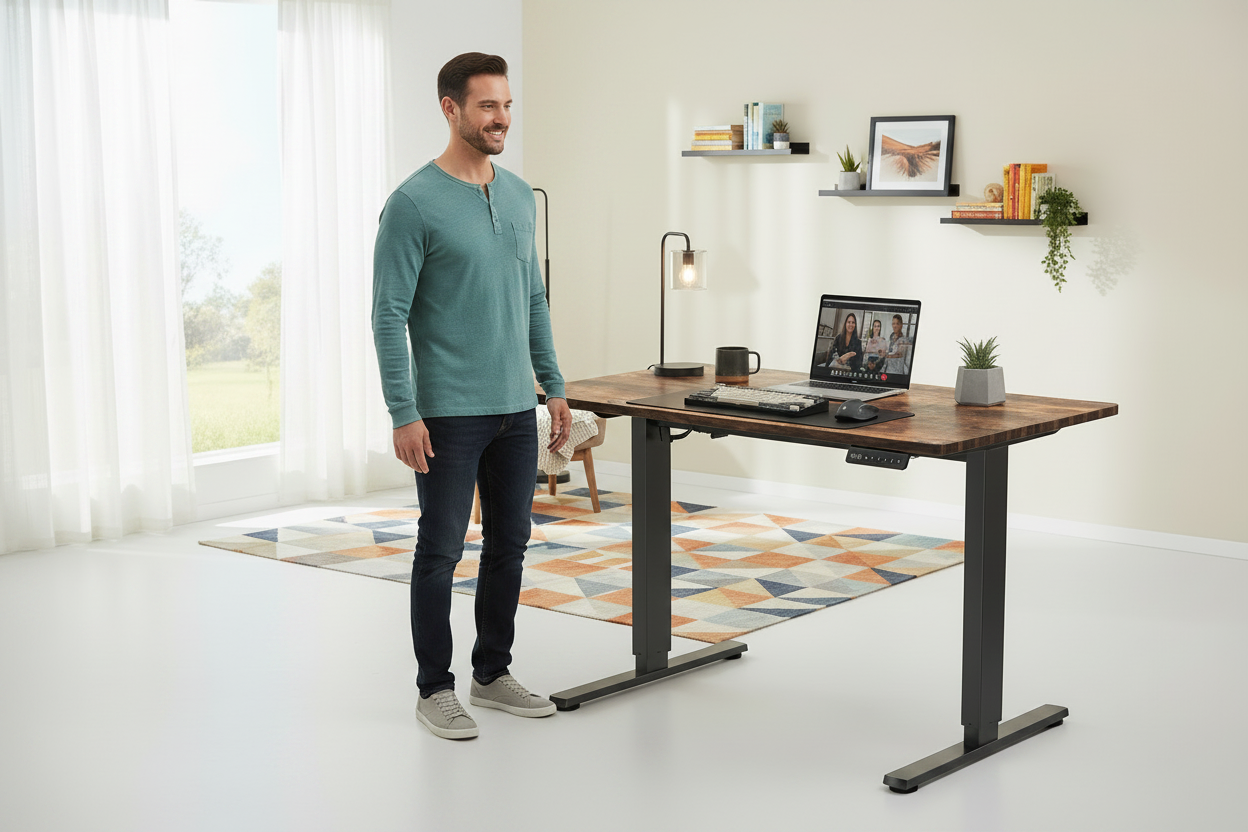
This is where the desk stops being furniture and starts being the workout equipment. An electric standing desk makes the switch a button press instead of a project, which is the entire difference between "I should stand more" and actually standing more. The 40×24 electric standing desk is $599.99, regularly $879.99, and its whole job is to make the sit-stand rhythm effortless: rise for the call, lower for the spreadsheet, rise again for the reading, all day, without thinking about it. The exercises in this guide slot into the rhythm at both heights, which is why the desk keeps coming up.
And let's be honest about what your desk is, because it's usually more than a desk. It's the study table in the morning, the work desk all day, and the gaming rig at night. If that's your setup, the sit-stand rhythm applies to all three shifts, and our study by day, game by night guide covers how to make one desk serve all of them without wrecking your posture in any of them. The rhythm doesn't care what you're doing on the desk. It just wants you out of the chair sometimes.
One practical note on building the habit: don't trust your memory, and don't trust "I'll feel like standing when I need to." You won't feel like it, that's the problem. Set a loose reminder, or better, use a natural anchor: stand for every call, stand when you refill your water, stand when you finish a task. Anchors beat alarms, because anchors don't get dismissed.
Why Desk Height Matters for All of This
Every exercise in this guide quietly assumes something: that your desk is at a height that lets you do it. It sounds obvious, but the assumption does real work, and it's worth making it explicit.
Start with the basic rule, the one that governs all of it. When you're typing, your elbows should be at about a right angle, your forearms roughly parallel to the floor, your wrists straight. That's the neutral position, and it's the target whether you're sitting or standing. When you're seated, the desk should meet your elbows at that angle. When you stand, the desk should rise so the same thing is true standing up. If the desk can't do that, you'll slump, or hunch, or hover, and every exercise in this guide is fighting a bad setup.
Now watch how the exercises depend on the desk. The chest opener needs the desk edge at a height you can lean into with straight arms; too low and you're bending over it, too high and you're pushing down instead of opening. The calf raises want you standing comfortably, which means the desk should already be at standing height, not sitting height with you bent over your keyboard. The hip flexor openers want a stable surface at roughly hip height to hold, which is exactly what a desk at standing height provides. Even the seated twist is better when the desk height lets your elbows rest at a right angle while you twist, instead of reaching up.
This is the quiet reason an adjustable desk isn't a luxury for this routine, it's a requirement for the standing half of it. With a fixed desk, you get the seated exercises, the wrist work, the shoulder rolls, and the walk, and that's genuinely a lot. But the calf raises, the full chest opener, and the hip openers all want standing height, and the sit-stand rhythm wants both. A desk that moves between the two, like the 40×24 electric standing desk, turns the whole guide into a single day of work instead of a compromise.
And here's the part people skip: when you raise the desk to standing height, the monitors have to go up with it. Standing with your screens at sitting height is its own neck injury, and it's the setup that makes people quit standing desks after a week. Set the screens at eye level when you stand, same as when you sit, and the standing half of your day becomes sustainable. Your neck and your exercises both depend on it.
FAQ
Do desk exercises actually work?
For what they're meant to do, yes. They won't build muscle or burn serious calories, and nobody should pretend otherwise. What they do is relieve the stiffness that sitting creates, keep your joints mobile, and give your body regular breaks from one position. They're maintenance, and maintenance works.
How often should I do them?
A couple of minutes most hours beats one long session on the weekend. Pick two or three movements, do them a few times a day, and let the sit-stand rhythm carry the rest. Consistency is the entire game here, and it doesn't take a schedule, just a loose reminder or a habit anchor.
Can I stretch during a video call?
Yes, and most of these are specifically chosen because they're invisible on camera. Shoulder rolls, chin tucks, calf raises, and the wrist work all happen below the frame or read as normal behavior. Save the lunge and the full chest opener for mute or between calls.
Will these fix my back pain?
They can relieve the kind of stiffness that comes from sitting all day, and for a lot of people that's the whole problem. But they're not a treatment. If your back hurts persistently, or the pain is sharp, or it's getting worse, see a doctor or a physical therapist instead of stretching harder.
Do I need a standing desk for these?
No. Every exercise here has a seated version except the calf raises and the walk, and those need nothing but floor space. A standing desk makes the standing versions and the sit-stand rhythm much easier, but you can start today at any desk.
What's the single best desk exercise?
The 60-second walk. It changes your whole position, gets blood moving through your entire body, and gives your eyes a break from the screen, which no stretch can do. Everything else on this list is a bonus on top of that one habit.
Can I overdo it?
Stretching shouldn't hurt, and if you feel sharp pain, you've pushed too far. Take it down a notch. These are gentle maintenance movements, not gym reps, and there's no prize for forcing a stretch.
Should I see a doctor for persistent pain?
Yes. If pain sticks around for more than a few weeks, or it's getting worse, don't self-treat with stretches. A professional can tell you what's actually going on, and that's worth more than any routine in this guide.
Desk exercise is maintenance, not a workout, and that's exactly why it works: it's small enough to actually do, often enough to actually matter. The stretches undo the worst of sitting, the 60-second walk is the one habit to keep no matter what, and the sit-stand rhythm is the real long-term win. None of it requires a gym, a mat, or a lunch hour, and all of it fits in the space your desk already takes up.
The easiest way to make it all stick is a desk that moves with you. The 40×24 electric standing desk is $599.99, regularly $879.99, and it turns the sit-stand rhythm from a resolution into a button press. It ships free anywhere in the US and comes with a 30-day money-back guarantee, so you've got a month to find out whether standing more feels as good as everyone says. Your body will let you know.
Your desk is where you spend a third of your day. It might as well be the healthiest part of it.
