Your Chair Is Making You Sweat — Here's the Science
It's 10 AM. You've been at your desk for two hours, the AC is running, and somehow your lower back is already damp. Sound familiar? If you're working through summer in a PU leather or bonded leather office chair, that's not a you problem — that's a physics problem.
The chair you sit in for 8, 9, or 10 hours a day has a direct impact on your core body temperature, your focus, and yes, your productivity. And yet most people pick a chair based on how it looks in a product photo, not how it performs when the mercury climbs past 85°F.
This guide is going to fix that. We're going to walk through the actual thermodynamics of why leather chairs trap heat, how mesh chairs dissipate it, and which Rackora models are worth your money if you run warm and work long hours.
No fluff. Just the facts — and a few honest recommendations at the end.
The Thermodynamics of Sitting: Why Your Chair Material Matters More Than You Think
Your body generates heat constantly. At rest, the average adult produces around 80 watts of thermal energy — roughly the same as an old incandescent light bulb. When you're focused, slightly stressed, or just warm from the season, that number climbs.
Your skin manages this through a combination of radiation, convection, and evaporation (sweat). The problem? When you're seated, roughly 40% of your body surface area is in direct contact with your chair. That contact zone becomes a thermal bottleneck.
What Happens Inside a Leather Chair
PU leather and bonded leather are essentially non-porous polymer films. They don't breathe. When your back and thighs press against the seat surface, you create a sealed microclimate between your skin and the chair. Heat accumulates. Moisture has nowhere to go. Within 20–30 minutes, the surface temperature at the contact zone can rise 5–10°F above ambient room temperature.
That's not speculation — it's basic heat transfer. A non-porous surface with low thermal conductivity acts as an insulator. It traps the boundary layer of warm, humid air against your skin. The result: you feel hotter than the room actually is, you sweat more, and your body has to work harder to regulate its core temperature.
Over an 8-hour session, this sustained thermal load contributes to fatigue, reduced concentration, and the kind of low-grade physical discomfort that makes you clock out early or reach for your third coffee by 2 PM.
What Happens Inside a Mesh Chair
Open-weave mesh is a fundamentally different material system. The woven structure — typically made from high-tenacity polyester or nylon — creates thousands of small air channels across the seat and backrest surface. These channels do two things simultaneously:
- Passive convection: Air circulates through the mesh as you shift position, carrying heat away from the contact zone.
- Evaporative assist: Moisture vapor from your skin can pass through the mesh rather than pooling against it, which dramatically improves the efficiency of your body's natural cooling system.
The result is a contact surface that stays much closer to ambient room temperature throughout the day. Studies on seating microclimate (the temperature and humidity directly at the skin-seat interface) consistently show that mesh seating maintains a 3–7°F lower contact temperature compared to foam-and-leather combinations under equivalent conditions.
That gap sounds small. But in thermal comfort terms, it's the difference between feeling fine at 3 PM and feeling like you need a shower.
Mesh vs. Leather Office Chair: Full Comparison
Let's put the two materials side by side across the dimensions that actually matter for a full workday.
| Category | PU / Bonded Leather | High-Quality Mesh |
|---|---|---|
| Breathability | Poor — non-porous surface traps heat and moisture | Excellent — open weave allows continuous airflow |
| Summer comfort (8h sessions) | Uncomfortable — back sweat common after 30–60 min | Comfortable — contact zone stays near ambient temp |
| Winter comfort | Good — retains warmth, feels warmer initially | Slightly cooler — may feel drafty in cold offices |
| Maintenance | Easy to wipe clean; prone to cracking after 2–3 years | Dust can collect in weave; very durable long-term |
| Lumbar support | Depends on foam padding quality | Mesh conforms dynamically to spine curvature |
| Long-session fatigue | Higher — heat buildup accelerates physical fatigue | Lower — cooler microclimate reduces thermal stress |
| Aesthetics | Executive look; suits traditional office settings | Modern, minimal; suits home office and open plans |
| Durability | PU leather peels and cracks; frame often outlasts upholstery | Quality mesh retains tension for 5–10 years |
| Price range | $150–$800+ | $200–$900+ |
| Best for | Cool climates, short sessions, aesthetic priority | Warm climates, long sessions, comfort priority |
Bottom line: If you're in a warm climate, work from home without industrial AC, or regularly log 6+ hour desk sessions in summer, mesh wins. It's not even close from a thermal comfort standpoint.
The "But Leather Looks More Professional" Argument
We hear this a lot. And honestly? It's a fair point — for certain contexts.
If you're in a client-facing executive office with strong central air conditioning running year-round, a leather chair can absolutely make sense. The aesthetic reads as authoritative, and the thermal disadvantage is partially offset by the controlled environment.
But for the vast majority of people reading this — remote workers, hybrid workers, home office setups, small business owners — that scenario doesn't apply. Your home office AC cycles on and off. Your room temperature fluctuates. You're sitting in that chair for 8 hours straight, not 2-hour meeting blocks.
In that context, choosing leather for aesthetics is like choosing dress shoes for a 10-mile hike because they look good. The form-over-function trade-off becomes very real, very fast.
Modern high-back mesh chairs — especially the ones we're about to show you — have closed that aesthetic gap considerably. They look sharp, they photograph well, and they don't make you feel like you've been sitting in a sauna by lunchtime.
What to Look for in a Breathable Mesh Chair for Summer
Not all mesh chairs are created equal. Here's what separates a genuinely breathable, long-session-ready mesh chair from a cheap knockoff that happens to have holes in the back:
1. Full Mesh Back AND Seat
Many budget mesh chairs use mesh only on the backrest and put a foam-padded seat underneath. That foam seat is still going to trap heat against your thighs. Look for chairs with mesh seating surfaces, or at minimum, a well-ventilated seat pan with minimal foam depth.
2. Adjustable Lumbar Support
Mesh conforms to your spine, but a good chair should also have a dedicated lumbar support mechanism — either a built-in lumbar pad or an adjustable lumbar bar — that you can position precisely at your L3–L5 vertebrae. This is what prevents the lower back fatigue that sets in after hour 4.
3. 3D or 4D Armrests
Your arms rest on the armrests. If those armrests can't adjust to your exact elbow height and shoulder width, you'll compensate with shoulder tension — which compounds fatigue regardless of how breathable the seat is.
4. Recline with Tension Control
Dynamic sitting — shifting between upright and slightly reclined positions throughout the day — is significantly better for spinal health than staying locked in one position. A good recline mechanism with adjustable tension lets you do this naturally without fighting the chair.
5. Weight Capacity and Frame Quality
A mesh chair that sags after 18 months isn't breathable — it's just broken. Look for chairs rated to at least 250–300 lbs with a reinforced aluminum or heavy-gauge steel frame. The mesh tension should feel firm and consistent, not loose or hammock-like.
Rackora's Top Breathable Mesh Chairs for Summer Work Sessions
We've built our chair lineup specifically for people who work long hours and take ergonomics seriously. Here are the models we'd recommend if heat buildup is your primary concern.
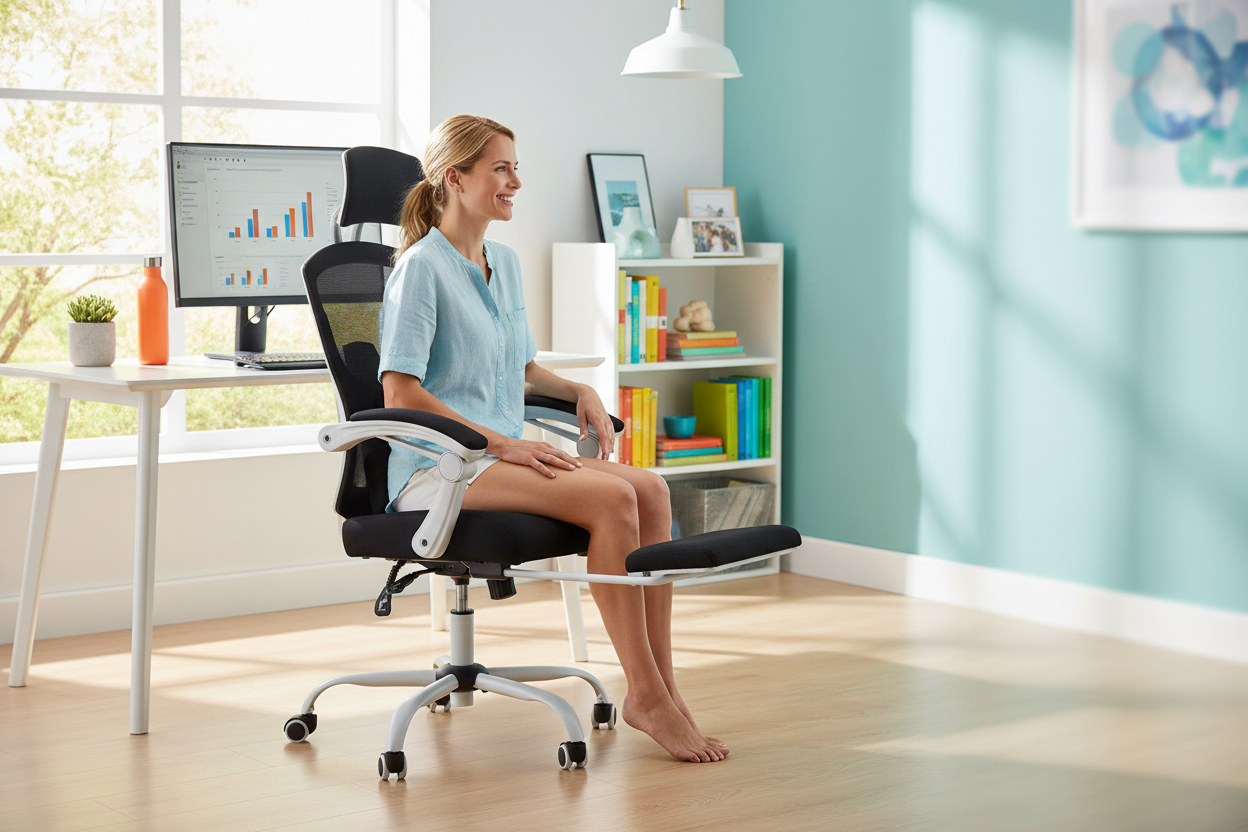
1. Ergonomic Office Chair – High Back Mesh with Lumbar Support & Footrest

Price: $241.00
This is our entry point into serious ergonomic mesh seating, and it punches well above its price. The high-back mesh design keeps airflow moving across your entire back — not just the lumbar zone — while the built-in lumbar support holds your lower spine in a neutral curve throughout the day.
The included footrest is a genuine differentiator at this price point. Elevating your feet slightly reduces pressure on the backs of your thighs, which improves circulation and — you guessed it — reduces heat buildup in the seat contact zone. It's a small thing that makes a noticeable difference after hour 5.
If you're coming from a leather chair and want to understand what breathable actually feels like without spending $400+, start here.
2. High Back Mesh Office Chair with Adjustable Armrests – Ergonomic Desk Chair

Price: $340.00
Step up to this model if adjustability is your priority. The multi-directional armrests let you dial in your exact elbow position, which takes the compensatory tension out of your shoulders and neck — the kind of tension that builds invisibly over a summer of long work sessions and shows up as a headache by 4 PM.
The mesh back on this chair has a slightly tighter weave than the entry model, which gives it better structural support for taller users while maintaining excellent airflow. If you're 5'10" or above, this is the one to look at.
3. Ergonomic Office Chair with 3D Armrests, Headrest & Reclining – 300lbs Capacity

Price: $459.00
This is the chair for people who are serious about their setup. The 3D armrests, adjustable headrest, and full recline function give you a level of customization that most chairs at twice the price don't offer. The 300 lbs weight capacity means the frame and mesh are built to handle sustained use without degrading.
The reclining function deserves a special mention in the context of summer heat: when you recline slightly, you reduce the total contact area between your body and the seat, which directly reduces heat accumulation. It's not just comfort — it's thermodynamics working in your favor.
4. L2 Ergonomic Office Chair with Footrest & 135° Recline

Price: $489.00
The L2 is our flagship ergonomic chair, and it earns that title. The 135° recline is the headline feature — it lets you shift into a genuine rest position during breaks without leaving your desk, which is something your body genuinely needs during long summer sessions. Sustained upright posture is fatiguing; controlled recline is restorative.
Combined with the integrated footrest and full mesh construction, the L2 is designed for people who treat their chair the way athletes treat their gear: as performance equipment, not furniture. If you're logging 9–10 hour days and heat is a consistent problem, this is the chair that solves it comprehensively.
Practical Tips to Stay Cooler at Your Desk This Summer
Even the best mesh chair works better with a few supporting habits. Here's what actually moves the needle:
Position Your Chair Away from Direct Sunlight
A south- or west-facing window can add 10–15°F of radiant heat to your immediate environment by early afternoon. If you can't reposition your desk, a UV-blocking window film is a $30 fix that makes a real difference.
Use a Small Desk Fan Aimed at Your Core
A USB desk fan pointed at your torso dramatically improves the convective cooling that mesh chairs are already facilitating. You're essentially turbocharging the passive airflow the mesh provides. A 6-inch fan on low is enough — you don't need a wind tunnel.
Take a 5-Minute Standing Break Every 90 Minutes
Standing up breaks the thermal seal between your body and the chair, allows your clothing to ventilate, and resets your circulation. It also happens to be good for your spine. Set a timer. Do it.
Wear Breathable Fabrics
Your chair can only do so much if you're wearing synthetic fabrics that trap heat against your skin. Lightweight cotton or moisture-wicking athletic fabric makes a measurable difference in how hot you feel at your desk, regardless of chair material.
Keep Your Hydration Up
Your body's primary cooling mechanism is evaporative — sweat. If you're even mildly dehydrated, that system becomes less efficient, and you feel hotter. A 32 oz water bottle on your desk, refilled twice a day, is not optional in summer.
The Leather Chair Isn't Dead — Here's When It Still Makes Sense
We've been pretty direct about the thermal disadvantages of leather, but let's be fair: there are legitimate use cases where leather still wins.
- Cold climates or heavily air-conditioned offices: If your office runs cold year-round, the insulating properties of leather become an advantage, not a liability.
- Short session use: If you're at your desk for 2–3 hours at a time with breaks in between, the heat buildup issue is much less pronounced.
- Client-facing executive settings: The aesthetic of a leather executive chair still carries weight in certain professional contexts where first impressions matter.
- Easy-clean requirements: Leather wipes down in seconds. If you eat at your desk or have kids who occasionally use your chair, that's a real practical advantage.
The key is matching the chair to your actual working conditions — not to what looks good in a showroom.
Frequently Asked Questions
Q: Do mesh chairs actually stay cooler than leather chairs?
Yes, measurably so. Research on seating microclimate consistently shows that mesh seating maintains a lower contact temperature and lower humidity at the skin-seat interface compared to foam-and-leather combinations. The difference is most pronounced after 30+ minutes of continuous sitting — exactly the conditions of a typical work session.
Q: Are mesh chairs durable enough for daily 8-hour use?
High-quality mesh chairs — like the Rackora models above — are built for exactly this use case. The mesh is typically high-tenacity polyester or nylon woven under tension, and quality chairs maintain that tension for 5–10 years of daily use. The key is buying from a brand that uses commercial-grade mesh, not the thin decorative mesh you'll find on budget chairs.
Q: Can I use a mesh chair in winter without getting cold?
Yes, though it's worth being realistic: mesh chairs are slightly cooler than leather in cold environments. Most people adapt quickly, and the ergonomic benefits outweigh the minor temperature difference. If your office is genuinely cold, a thin seat cushion can add warmth without significantly compromising breathability.
Q: What's the difference between cheap mesh chairs and premium ones?
Several things: mesh tension and weave density (cheap mesh sags quickly), frame material (aluminum vs. thin plastic), lumbar support quality (adjustable vs. fixed), and armrest range of motion. A $100 mesh chair and a $400 mesh chair are not the same product. The cheap one will feel fine for a week and frustrating for the next two years.
Q: Is a high-back mesh chair better than a mid-back for summer?
For most people, yes. A high-back chair supports your upper back and shoulders, which reduces the muscular tension that contributes to fatigue. More importantly, the extended mesh surface area means more of your back benefits from airflow — not just the lumbar zone.
Q: How do I clean a mesh office chair?
For routine maintenance, a vacuum with a brush attachment removes dust from the weave effectively. For deeper cleaning, a damp cloth with mild soap works well — just avoid soaking the mesh. Most quality mesh dries quickly and doesn't retain odors the way foam does.
Q: Does chair color affect how hot I feel?
Minimally. The color of the mesh has a negligible effect on radiant heat absorption in typical indoor lighting conditions. The material and weave structure matter far more than color when it comes to thermal comfort.
Q: What weight capacity should I look for in a mesh chair?
For daily long-session use, look for a minimum of 250 lbs capacity, even if you weigh significantly less. Higher-rated chairs use heavier-gauge frames and denser mesh that hold up better over time. Our 300 lbs capacity models are built to last regardless of user weight.
Q: Can a footrest really help with heat buildup?
Yes, indirectly. Elevating your feet reduces pressure on the backs of your thighs, which improves blood circulation in the lower body. Better circulation means your body manages heat more efficiently. It also reduces the contact area between your thighs and the seat, which directly reduces heat accumulation at that contact zone.
Q: Is it worth spending $400+ on a mesh chair?
If you're working 8+ hours a day, yes — without question. Divide the cost of a $459 chair by 365 days and you're looking at $1.26 per day for a chair that keeps you comfortable, supports your spine, and doesn't make you feel like you need a shower by noon. The ROI on a quality ergonomic chair is one of the clearest value propositions in home office equipment.
If you're working through summer in a leather chair and wondering why you're exhausted, distracted, and uncomfortable by mid-afternoon — now you know why. It's not the heat in the room. It's the heat at the contact zone between your body and a non-porous surface that has nowhere to send it.
Mesh chairs solve this problem at a fundamental level. They don't just feel cooler — they are cooler, by design, because of how heat transfer actually works.
The Rackora mesh lineup is built for people who take their work environment seriously. Whether you start with the $241 entry model or go straight to the L2 at $489, you're getting a chair that was designed for long sessions, not showrooms.
Your back will notice the difference by day two. Your productivity will notice it by week two.
