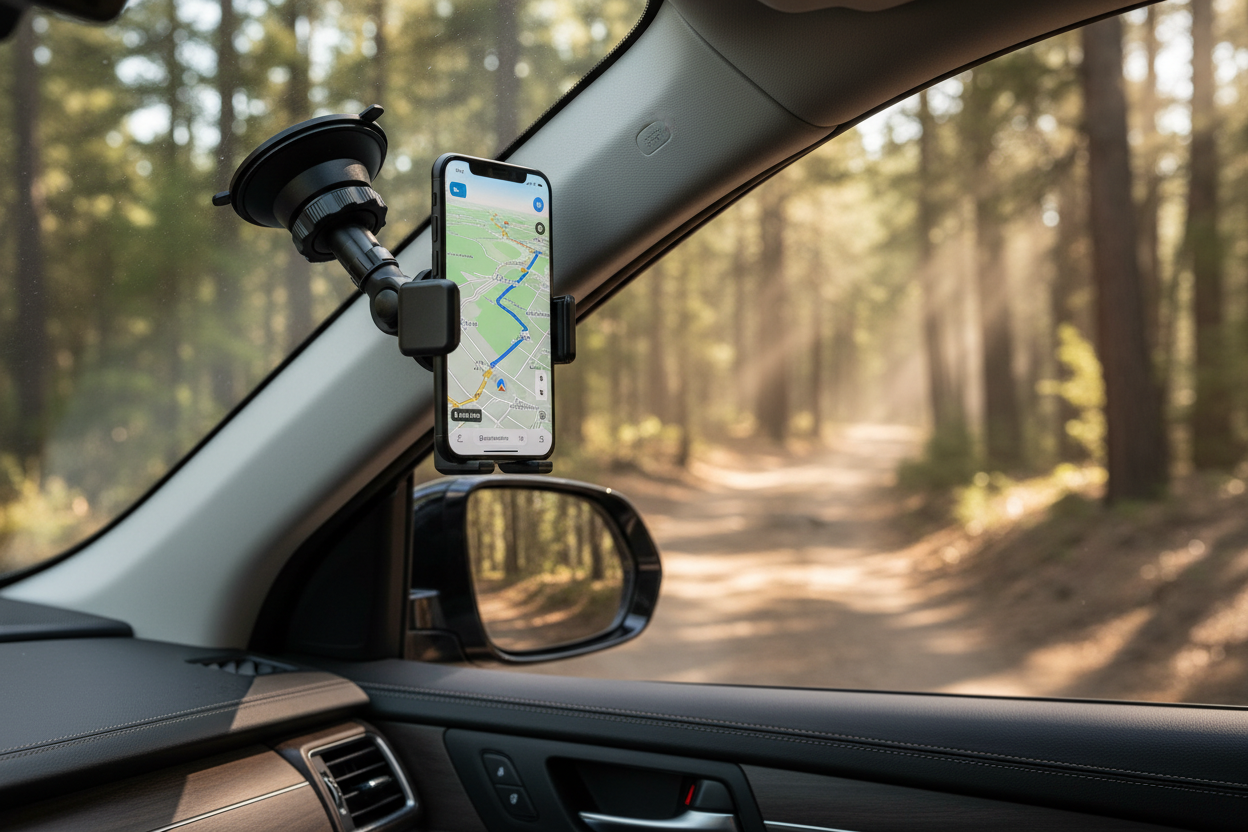
You've spent months planning the trip. The Jeep is prepped, the recovery gear is strapped down, and your trail map is loaded on your phone. You hit the first rocky section — and three seconds later, your phone is bouncing across the passenger floor mat.
If you've been off-roading for any length of time, that scene is painfully familiar. Standard phone mounts — the kind you grab at a gas station or order for $12 on Amazon — are engineered for smooth city streets. They were never designed for the kind of punishment that comes with real 4x4 terrain. And when your navigation disappears mid-trail, you're not just annoyed. You're potentially in a dangerous situation.
This guide breaks down exactly why cheap mounts fail, what to look for in a genuinely trail-worthy phone holder, and how the right gear can give you one less thing to worry about when the trail gets serious.
The Violent Reality of Off-Road Trail Dynamics
Most people underestimate how physically brutal off-roading is on every component inside the vehicle. We're not talking about a pothole on the highway. We're talking about sustained, multi-directional shock loads that repeat hundreds of times over the course of a single trail run.
Rock crawling at low speed generates sharp, unpredictable jolts as tires drop into crevices and climb over ledges. Washboard dirt roads — those corrugated surfaces that form on high-traffic trails — create a relentless, high-frequency vibration that resonates through the entire chassis. Steep descents shift your center of gravity dramatically, putting lateral stress on anything mounted to your dash or windshield. And river crossings? The sudden deceleration when you hit water can send unsecured items flying forward.
Your phone mount is experiencing all of this. Every single bump, every articulation, every hard landing. A mount that can't handle that environment isn't just inconvenient — it's a liability.
The forces involved are real. A moderate off-road impact can generate 3–5G of acceleration. A hard rock crawling hit can spike well beyond that. Standard suction cups are rated for maybe 1–2 lbs of holding force under ideal conditions. Your phone, in a case, weighs close to half a pound. The math isn't in your favor.
What Actually Happens When a Mount Fails on the Trail
The best-case scenario: your phone lands on the seat and you pull over to remount it. Annoying, but fine.
The realistic scenario: your phone hits the floor, slides under the seat, and you're navigating blind on an unfamiliar trail. Or it lands screen-down on a metal bracket. Or you reach for it while still moving and lose focus on the terrain ahead.
The worst-case scenario: you're on a narrow shelf road with a drop-off on one side, your navigation disappears, and you make a wrong decision because you're distracted.
None of these are hypothetical. They happen to off-roaders every season. The fix is straightforward — but it requires actually choosing a mount that was built for this environment.
Why Magnetic Brackets Aren't Enough for 4x4
Magnetic phone mounts have had a good run. They're clean, they're fast, and for daily driving they work reasonably well. But the off-road community has learned — often the hard way — that passive magnets have a fundamental limitation: they rely entirely on the static holding force of the magnet against a metal plate attached to your phone or case.
That holding force is fixed. It doesn't adapt. It doesn't compensate. When the force of an impact exceeds the magnetic attraction, the phone separates from the mount. Period.
The Physics Problem with Passive Magnets
Magnetic force follows an inverse square law — meaning the holding strength drops off rapidly as the distance between magnet and plate increases even slightly. On a smooth road, this isn't an issue. But off-road vibration causes micro-movements between the phone and the mount surface. Each micro-movement slightly reduces the effective magnetic contact. Over the course of a rough trail, those micro-movements accumulate, and the holding force degrades progressively.
Add to that the directional nature of magnetic force. A magnet holds well against direct pull-away force, but it's much weaker against lateral shear — the kind of sideways force that happens constantly when you're bouncing over rocks. Your phone doesn't just try to fall straight down; it gets thrown sideways, forward, and at angles that magnetic mounts simply aren't optimized for.
MagSafe and Its Off-Road Limitations
MagSafe-compatible mounts have become popular, and they're genuinely better than older magnetic designs. The alignment ring improves contact consistency. But MagSafe was designed by Apple for wireless charging and light-duty mounting — not for 4x4 trail use. The holding force is approximately 3–4 lbs under ideal conditions. That sounds like enough until you hit a hard rock ledge at speed and your phone experiences a 4G impact.
For casual driving, MagSafe mounts are great. For serious off-roading, you need something that actively holds your phone rather than passively attracting it.
What Active Suction Actually Means
Active suction — the kind used in the Rackora Vacuum-Enhanced Car Phone Holder — works on a completely different principle. Instead of relying on magnetic attraction, it creates a sealed low-pressure zone between the mount and the mounting surface. The atmospheric pressure differential is what holds the mount in place, and that force is dramatically higher than what any passive magnet can achieve.
The Rackora mount delivers 30x the holding strength of traditional suction cups. That's not a marketing number — it reflects the difference between a passive rubber cup that relies on surface tension and an engineered vacuum system that actively maintains pressure. The result is a mount that stays put when your Jeep drops into a two-foot rock crevice.

Aerospace-Grade Materials vs. Cheap Plastics: Why the Frame Matters
The suction mechanism is only half the story. The other half is structural integrity — what the mount is actually made of, and whether it can survive the mechanical stress of repeated off-road use without cracking, warping, or loosening at the joints.
Walk into any big-box store and look at the phone mounts on the shelf. Most of them are injection-molded ABS plastic. Some have a thin chrome coating to look premium. They're light, they're cheap to manufacture, and they work fine for the use case they were designed for: a commuter's cup holder or windshield on a smooth road.
Put that same mount through a season of off-roading and here's what happens. The plastic joints develop micro-fractures from repeated impact stress. The ball-and-socket adjustment mechanism loosens because the plastic can't maintain tight tolerances under vibration. The mounting arm flexes and bounces, which means your phone is moving even when the mount is technically still attached. And eventually — usually at the worst possible moment — something cracks.
What Anodized Aluminum Actually Does
The Rackora mount's structural frame is built from anodized aluminum. This isn't a cosmetic choice — it's an engineering one.
Aluminum has a strength-to-weight ratio that makes it the material of choice for aerospace, automotive racing, and high-performance equipment. It doesn't develop micro-fractures under cyclic stress the way plastic does. It maintains dimensional stability across temperature extremes — relevant when your Jeep sits in the summer sun and the interior hits 140°F before you even start driving. And anodizing — an electrochemical surface treatment — creates a hardened oxide layer that resists corrosion, scratching, and UV degradation.
In practical terms: the Rackora mount's frame won't flex, won't crack, and won't loosen at the joints after a hundred miles of rough trail. The tolerances stay tight. The adjustment holds its position. Your phone stays where you put it.
The Holding Capacity Difference
The Rackora Vacuum-Enhanced Car Phone Holder is rated for up to 5kg (approximately 11 lbs) of holding capacity. Your phone weighs less than half a pound. That's a safety margin of more than 20:1 — meaning the mount would need to experience forces more than twenty times your phone's weight before it would release. On even the most aggressive trail, that margin is more than sufficient.
Compare that to a standard suction mount rated for 1–2 lbs, with a phone that weighs 0.4–0.5 lbs. Your safety margin is 2–4x. One hard hit and you're at the limit.
360-Degree Rotation That Actually Stays Put
One underappreciated feature of a quality mount is the rotation mechanism. Cheap mounts use friction-based ball joints that feel stiff when new but loosen quickly. After a few weeks of vibration, the joint can no longer hold the phone at the angle you set — it slowly droops toward portrait or landscape depending on gravity.
The Rackora mount's 360-degree rotation mechanism is engineered to maintain its set position under sustained vibration. You set the angle once, and it stays there — whether you're on a flat highway or a 30-degree side slope.
Smart Auto-Suction Warning Indicators: The Feature That Changes Everything
Here's the scenario that keeps off-roaders up at night: you mount your phone, the suction looks good, you head out on the trail — and somewhere along the way, without you noticing, the suction starts to fail. Maybe the windshield got dusty. Maybe a temperature change affected the seal. Maybe a particularly hard hit partially broke the vacuum. You don't know, because there's no way to tell just by looking at it.
Until your phone is on the floor.
The Rackora Vacuum-Enhanced Car Phone Holder solves this with a smart LED indicator system that monitors the vacuum pressure in real time. If the pressure drops below the safe threshold — for any reason — the LED alerts you immediately. And the system doesn't just warn you; it automatically re-seals the mount, restoring full vacuum pressure without any action on your part.
How the Auto-Seal System Works
Traditional suction mounts are passive. You press them against the surface, create a seal manually, and hope it holds. If the seal degrades, nothing happens — you just lose your phone.
The Rackora system uses an active vacuum mechanism powered by a built-in battery (rated for 60 days of use on a single charge). The system continuously monitors the pressure differential between the sealed chamber and the atmosphere. When it detects a drop — even a small one — it activates the pump to restore the vacuum. The LED indicator gives you a visual confirmation that the seal is intact, or a warning if intervention is needed.
In practice, this means the mount is self-correcting. A bump that would partially break a traditional suction cup's seal gets compensated for automatically. You keep your eyes on the trail. Your phone stays mounted.
The 60-Day Battery Life
One concern with any battery-powered device is runtime. The Rackora mount's 60-day battery life addresses this directly. You're not charging this thing every weekend before a trail run. A single charge lasts through months of regular use — and the LED indicator will tell you when it's time to recharge, well before the system loses function.
For overlanders doing multi-day trips, this is particularly relevant. You don't want a mount that dies on day two of a five-day expedition.
Mounting Positions: Windshield vs. Dashboard for Off-Road Use
Where you mount your phone matters as much as what you mount it with. The two primary options — windshield and dashboard — each have trade-offs that become more significant in an off-road context.
Windshield Mounting
Windshield mounts put your phone in your direct line of sight, which is ideal for navigation. You don't have to look down or away from the trail. The downside in off-road use is that windshield glass flexes slightly under chassis stress, which can affect suction cup performance on lower-quality mounts. With the Rackora's active vacuum system, this isn't a concern — the auto-seal compensates for any flex-induced pressure changes.
Windshield mounting is also subject to state laws in the US. Most states allow mounting in the lower corner of the passenger side or a small area in the lower center. Check your state's regulations before mounting.
Dashboard Mounting
Dashboard mounts are lower in your field of view, which some drivers prefer because it keeps the phone out of the primary sightline. The dashboard surface is typically more rigid than glass, which can improve suction stability. The trade-off is that you need to glance down more to check navigation, which takes your eyes off the trail.
For rock crawling specifically, many experienced off-roaders prefer dashboard mounting because it keeps the phone more protected from direct sun glare and reduces the visual distraction of a phone at eye level when you're focused on precise wheel placement.
The Rackora Mount's Versatility
The Rackora Vacuum-Enhanced Car Phone Holder works on both windshield glass and smooth dashboard surfaces. The vacuum system is equally effective on both, giving you the flexibility to choose the position that works best for your rig and your driving style.
The Adventurer's Peace of Mind: 3-Year Risk-Free Guarantee
Gear that's built for extreme use should be backed by a warranty that reflects that confidence. A 90-day return window is fine for a kitchen gadget. For a mount that you're trusting with your navigation on a remote trail, you want to know the manufacturer stands behind it for the long haul.
The Rackora Vacuum-Enhanced Car Phone Holder comes with a 3-year risk-free guarantee that covers intense off-road trail activities. Not just normal use — actual off-road use. That's a meaningful distinction. Most electronics warranties explicitly exclude damage from "extreme conditions" or "misuse." Rackora's guarantee acknowledges that off-roading is exactly what this product is designed for.
What the 3-Year Guarantee Covers
The guarantee covers manufacturing defects, component failures, and performance issues that arise from normal off-road use. If the vacuum system fails, if the LED indicator malfunctions, if the structural frame develops a defect — Rackora will make it right. For three years.
For context: most off-road accessories carry 1-year warranties, and many budget options have no warranty at all. A 3-year guarantee on a product designed for trail use is a strong signal that the manufacturer has confidence in what they've built.
The Real Cost of Cheap Mounts
A $12 magnetic mount seems like a bargain until you factor in the replacement cycle. If it fails every season — and many do — you're spending $12–$25 per year, plus the cost of a cracked phone screen when it hits the floor. Over three years, a quality mount that actually works is almost always the more economical choice, to say nothing of the safety and convenience value.
The Rackora mount at $99.00 with a 3-year guarantee works out to $33/year — and that's assuming you replace it at the end of the warranty period, which you probably won't need to.
Complementary Gear for the Serious Off-Road Setup
A great phone mount is one piece of a well-organized trail rig. Here are a few other Rackora products worth considering for your setup:
Rackora Z118 Metal Magnetic Phone Case — $49.99
If you want the option to use magnetic mounting in lower-intensity situations (parking lot, campsite, casual driving), the Z118 Metal Magnetic Phone Case gives you a Z-frame design with a 120° adjustable flip stand. It's compatible with magnetic wireless charging and magnetic car mounts, and the metal frame adds structural protection to your phone. Use it with the Rackora vacuum mount on the trail, and switch to magnetic mounting when you're back on pavement.

Rackora Black Hole Plus 518 Carbon Fiber Phone Case — $76.00
For maximum phone protection on the trail, the Black Hole Plus 518 carbon fiber case pairs well with the vacuum mount. The 360-degree rotating magnetic stand gives you desktop flexibility at camp, while the carbon fiber construction provides serious drop protection for when things get rough. It's wireless charging compatible and works with magnetic car mounts for lighter-duty use.

Rackora Aromatherapy 588 Aluminum Alloy Phone Case — $52.00
Long trail days in a hot Jeep cab can be rough on your phone's thermals. The Aromatherapy 588 aluminum alloy case features active heat dissipation to keep your phone's temperature in check during extended navigation use. The aluminum construction also adds structural rigidity, and the aromatherapy tablet slots are a genuinely nice touch for long drives. It's a practical case that solves a real problem for off-roaders who use their phones heavily for navigation.

Setting Up Your Rackora Mount: A Quick Trail-Ready Guide
Getting the most out of your vacuum mount takes about two minutes of setup. Here's how to do it right:
1. Clean the mounting surface. This is the step most people skip, and it's the most important one. Dust, oil from your hands, and dashboard protectant products all reduce suction effectiveness. Use an isopropyl alcohol wipe on the windshield or dashboard surface before mounting. Let it dry completely.
2. Choose your position before you commit. Think about your sightlines, sun angle at the time of day you typically drive, and whether you need portrait or landscape orientation for your navigation app. The Rackora mount's 360-degree rotation means you can adjust after mounting, but it's easier to get the position right from the start.
3. Press firmly and activate the vacuum. Place the mount against the clean surface and press firmly to initiate the seal. The active vacuum system will engage and the LED indicator will confirm a secure seal.
4. Check the LED before you head out. Green means you're good. If you see a warning indicator, re-seat the mount on a cleaner section of surface.
5. Load your phone and set your angle. The 5kg holding capacity means you can load your phone in its case without any concern. Set your viewing angle and you're ready to roll.
Off-Road Navigation Tips to Use Alongside Your Mount
A secure mount is the foundation, but how you use your phone on the trail matters too. A few practices that experienced off-roaders swear by:
Download your maps offline. Cell service is unreliable on most serious trails. Apps like Gaia GPS, OnX Offroad, and Google Maps all support offline map downloads. Do this before you leave the trailhead parking lot, not when you're already deep in the backcountry.
Dim your screen in direct sunlight. Counterintuitively, maximum brightness isn't always the most readable setting in direct sun. Many off-roaders find that a slightly dimmed screen with high contrast mode enabled is easier to read than full brightness, and it extends battery life on long days.
Use a screen protector. If your phone does come loose — even with the best mount — a quality tempered glass screen protector is cheap insurance against a cracked display.
Keep a backup power source. Navigation is a battery drain. A small power bank or a 12V USB charger keeps your phone topped up on long trail days without relying on your vehicle's USB ports, which may not deliver enough current for simultaneous charging and navigation use.
Tell someone your route. This isn't phone-mount advice, but it's trail safety 101. Before you head out on a remote trail, share your planned route and expected return time with someone who isn't on the trip.
Frequently Asked Questions
Q: Will the Rackora vacuum mount work on a textured dashboard?
A: The vacuum system requires a smooth, non-porous surface to create an effective seal. It works best on glass windshields and smooth dashboard surfaces. Heavily textured or soft-touch dashboard materials may not provide a sufficient seal. When in doubt, the windshield is the more reliable mounting surface.
Q: How does the 60-day battery life work in practice?
A: The 60-day rating assumes typical daily use — mounting and unmounting your phone once or twice a day, with the vacuum system maintaining the seal during use. Heavy off-road use with frequent pressure fluctuations may reduce this somewhat, but most users report battery life well in excess of a month between charges.
Q: Can I use the Rackora mount with a thick phone case?
A: Yes. The mount's phone cradle accommodates phones in cases up to standard protective case thickness. The 5kg holding capacity means the added weight of a case is not a concern. For very large cases (like heavy-duty rugged cases), check the width specifications against your case dimensions.
Q: Is the 3-year guarantee valid for off-road use specifically?
A: Yes. The Rackora guarantee explicitly covers intense off-road trail activities — not just normal driving conditions. This is a meaningful distinction from most electronics warranties that exclude extreme use.
Q: What's the difference between the Rackora mount and a standard suction cup mount?
A: Standard suction cups rely on passive surface tension and typically provide 1–2 lbs of holding force. The Rackora system uses an active vacuum mechanism that delivers 30x the holding strength of traditional suction cups, with a maximum holding capacity of 5kg. The active system also monitors and maintains the seal automatically, which passive suction cups cannot do.
Q: Does the mount work in extreme temperatures?
A: The anodized aluminum frame is designed to maintain structural integrity across a wide temperature range. The vacuum system's performance can be affected by extreme cold (below freezing), which can reduce the flexibility of the sealing gasket. For winter off-roading, allow the mount to warm up to cabin temperature before relying on it fully.
Q: Can I mount this on my Jeep's aftermarket windshield?
A: The mount works on standard automotive glass. Aftermarket windshields made from standard laminated safety glass should work fine. Some specialty off-road windshields use polycarbonate or other materials — check the surface compatibility before mounting.
Q: How do I clean the suction surface to maintain performance?
A: Rinse the suction cup surface with clean water and allow it to air dry. Avoid soap or cleaning products, which can leave a residue that reduces suction effectiveness. Store the mount with the suction surface protected when not in use.
Q: Is the Rackora mount legal to use on windshields in the US?
A: Windshield mounting laws vary by state. Most US states permit mounting in the lower corners of the windshield or a small area near the rearview mirror. Check your specific state's vehicle code before mounting. Dashboard mounting is generally unrestricted.
Q: What phones does the Rackora mount support?
A: The mount supports landscape and portrait orientation and accommodates a wide range of phone sizes. It's designed for universal compatibility — check the product specifications for exact size ranges if you have an unusually large or small device.
The Bottom Line
Off-roading is one of those activities where the quality of your gear directly affects your safety and your experience. A $12 magnetic mount is fine for a grocery run. It's not fine for a rock crawling trail in the backcountry with no cell service and a 20-mile drive back to the trailhead.
The Rackora Vacuum-Enhanced Car Phone Holder at $99.00 is built for the environment you're actually driving in. Aerospace-grade anodized aluminum frame. Active vacuum system with 30x the holding strength of standard suction cups. Smart LED pressure monitoring with auto-seal. 60-day battery life. 5kg holding capacity. And a 3-year guarantee that covers off-road use.
That's not a list of marketing claims. That's a list of engineering decisions made by people who understood what a phone mount actually needs to do when the trail gets rough.
Your navigation is too important to trust to a passive magnet and a prayer. Get a mount that was built for where you're going.
