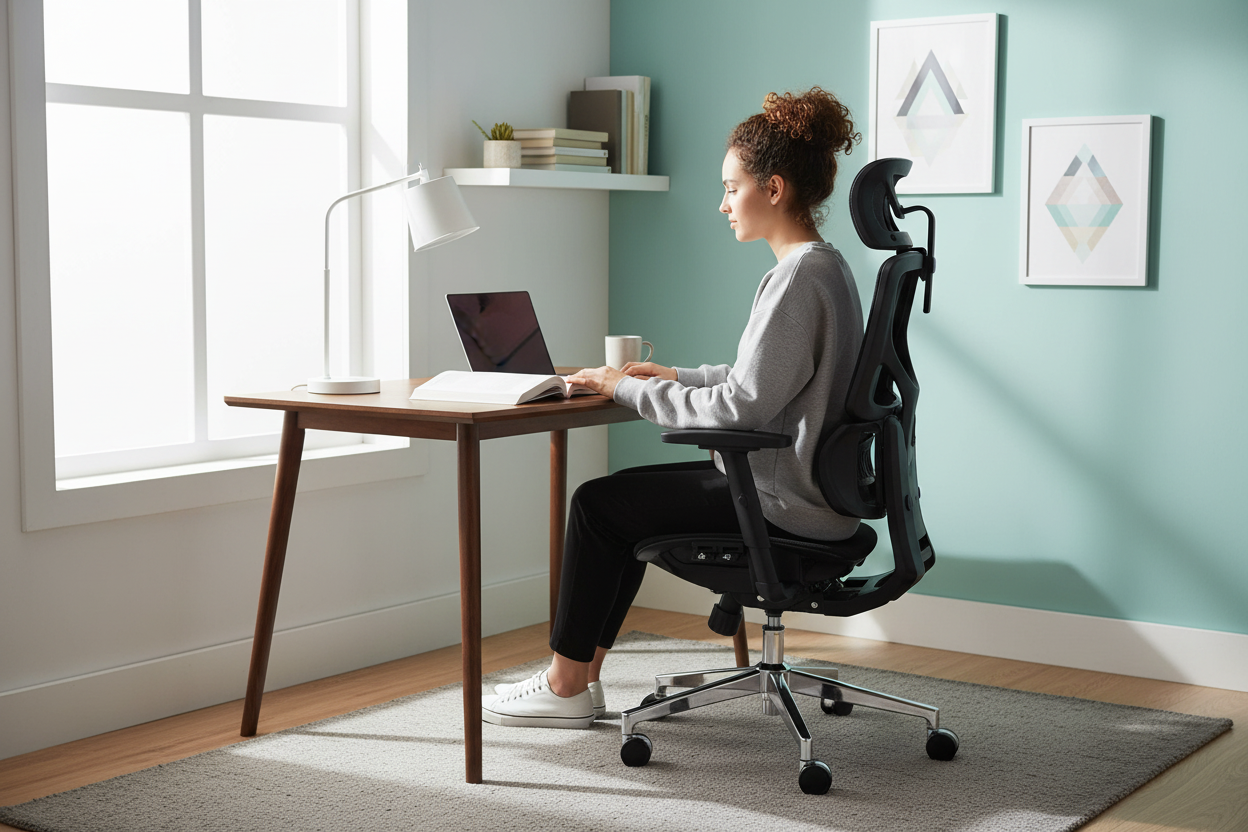
Every August, a specific kind of parent walks into my shop. They've just done move-in day at a college dorm. They've hauled a minivan's worth of bedding, lamps, and storage cubes up three flights of stairs, past the resident advisor, past the kid in the hallway who brought an entire espresso machine, and they've finally stood in the cinder-block room that came with exactly two pieces of furniture: a bed frame and a chair.
Not a good chair. Not even a desk chair. A wooden dining chair with a seat that could double as a cutting board, or one of those plastic stacking chairs that wobbles if you look at it funny. They look at that chair, then at their kid, who is already sitting on the bed with a laptop balanced on a pillow, and they do the math every parent does: four years of this. Four years of studying, and the school's contribution to spinal support is a chair that was last seen in a church basement.
Here's the honest version of what happens next, because I watch the endings play out every fall. Some students live with the dining chair and end up with a sore back by October. Some skip the chair entirely and study from the bed or the floor, which is its own kind of bad. And some buy a gaming chair because it looks great in the room tour video, and discover that a bucket seat with a lumbar pillow that slides down to the small of the back is not the same thing as an ergonomic chair. The gaming chair looks the part in the photo and fails the part by week two.
I run a furniture shop, so I get to see all three endings, and I get to hear the follow-up stories, the ones that start with my back has been hurting since September and end with can you help me pick a real chair. This article is the conversation I have with those parents at the counter, written down so you can read it while your kid is still choosing a roommate. We'll talk about what students actually sit in, what a chair has to do to survive four years, what to look for under $500, and which Rackora chairs are worth your money this year. And we'll do it in plain English, because you've already read enough marketing this month.
The Chair That Comes With the Room
Let's start with the free chair, because that's where most students begin, and because it fails at desk work in four specific ways.
No lumbar support. The backrest stops at the wrong place, or it's flat as a board, so the lower back gets nothing to push against and the spine rounds forward like a parenthesis. The whole weight of the upper body ends up hanging off the ligaments instead of resting on the seat, and the muscles of the lower back spend the whole study session quietly fighting a losing battle.
Fixed height. The seat doesn't adjust. If it's too low, the student's knees point up and the hips do all the bending. If it's too high, the feet dangle, and dangling feet load the backs of the thighs and start a chain reaction that travels all the way up the spine. Either way, the legs can't do their job of carrying their share of the load.
A hard seat. An hour on a wooden seat creates pressure points that make people shift and fidget constantly, and constant shifting is a sign the chair is losing, not the sitter. Nobody reads a chapter and thinks about their thighs. They just know they can't sit still, and they blame themselves instead of the chair.
No wheels, no swivel. Reaching for a book, a charger, or a coffee means twisting the spine, because the chair won't turn and won't roll. A task chair swivels and rolls so your body doesn't have to, which sounds like a luxury until you've spent a semester twisting to grab a notebook.
The dining chair's real problem is simple: it was designed for a twenty-minute meal, not a four-hour study session. You wouldn't run a marathon in dress shoes. The dining chair is the dress shoe of seating, and it has no business being the centerpiece of a dorm room.
What Students Actually Sit In (Bed, Floor, and the Gaming Chair)
Ask a college student where they study, and the honest answer is usually the bed. The bed is soft, warm, and already there, and the bed is a posture disaster. Propped against the headboard with a laptop on the knees, the neck craned down and the lower back slumped, that position is how freshman back pain is born. The headboard forces a choice between sitting bolt upright, which nobody does for long, and sliding down, which everyone does. There's also the nap problem: the bed is one pillow away from ending the study session entirely.
The floor is second. Sitting cross-legged with a laptop on a low table or a stack of books is flexible and social and terrible for the spine. The pelvis tips back, the lower back rounds, and the neck folds forward to reach a screen that's sitting at shin height. Study groups love the floor. The floor does not love them back. It's fine for twenty minutes of hanging out. It's a disaster for three hours of organic chemistry.
Then there's the gaming chair, which deserves its own paragraph because it's the most common upgrade parents buy and the most common disappointment. It looks like a race car seat, and that's the problem: racing buckets are designed to hold a driver in place against lateral forces, not to support a spine that leans forward over a textbook for three hours. The lumbar pillow is a pillow, the seat is often narrow, and the word ergonomic is doing a lot of marketing. I wrote a full comparison of ergonomic chairs versus gaming chairs if you want the detailed breakdown, but the short version is this: a gaming chair is for gaming, and an ergonomic chair is for sitting. A student needs a sitting chair.
The 4-Year Math
Here's the calculation that settles most debates in my shop, and it's the one I want you to hold onto for the rest of this article. Four years of college, roughly 1,460 days, each one with at least a couple of hours of sitting at a desk. The L1 Ergo Upgrade 518 costs $329.00. Spread across four years, that's about $82 a year, which comes to about 22 cents a day. That's less than the price of one textbook, less than a month of the premium meal plan, less than what the student will spend on energy drinks in a single finals week.
Now run the same math on the alternative. A $90 chair from a big-box store, the kind that feels okay in the aisle and gives up by spring semester. Four years of replacing a chair like that, because it breaks, or the gas cylinder dies, or the fake leather peels, costs more than the L1 and feels worse the whole time. The cheap chair isn't cheap. It's expensive in installments, and every installment comes with a side of backache.
The math isn't only about dollars, either. A chair that keeps a student comfortable through a three-hour study session is a chair that extends the study session, and a chair that doesn't hurt is a chair the student actually uses. The dining chair costs nothing and gets abandoned by October. The right chair costs $329.00 and gets used for four years. When you put it that way, the right chair is the cheap option, and the free chair is the expensive one.
What to Look For Under $500
Under $500, you can get a genuinely good chair, but you have to know what to check, because the market is full of chairs that look like ergonomic chairs and feel like lawn furniture. Here are the four things that matter most, in order of importance.
Lumbar support. This is the non-negotiable. The lower back needs something to push against, or the spine rounds and the neck follows, and suddenly the chair problem becomes a neck problem too. Adjustable lumbar is better than fixed, because students come in all heights and so do their desks, and the same chair that supports a 5-foot-4 freshman needs to support a 6-foot-2 junior. If the lumbar support moves, the chair fits more than one body, which matters if the chair is shared or the student is still growing.
Seat depth. The seat pan should leave a couple of finger widths between the back of the knees and the front edge of the seat. Too deep, and the front edge presses into the backs of the thighs and cuts off circulation. Too shallow, and the thighs lose support and the hips do all the work. This is the spec most people skip, and it's the one that decides whether a chair is comfortable at minute thirty, which is the minute that matters.
Armrests. Students type, read, and take notes for hours, and arms need a place to rest at roughly ninety degrees. Height-adjustable armrests are worth the upgrade, because a fixed armrest is either too high, which hikes the shoulders up toward the ears, or too low, which does nothing at all. Adjustable armrests let the chair match the student, instead of the student matching the chair.
Warranty. Nobody checks the warranty, and it's the cheapest way to see how a company feels about its own product. A chair with a real warranty is a chair the maker expects to last. A chair with no warranty is a chair the maker is hoping you forget about, and the difference shows up in the materials and the build long before it shows up in the paperwork.
And two things under the radar. The seat height range, which needs to go low enough for a short student and high enough for a tall one, and the base, because a five-star base with smooth casters rolls better on dorm carpet than the alternatives. Everything else, the colors, the name, the marketing, is decoration.
The L1 Ergo Upgrade 518 at $329.00: The Value Pick for Students
If I had to send one chair to college with one student, it's the L1. The L1 Ergo Upgrade 518 is $329.00, regularly $399.00, and it's the chair I point parents to first, because it does the whole job without pretending to be anything else.
What you're actually getting at $329.00: real lumbar support that adjusts to the student, a seat pan that fits, armrests that move, and a build that's meant for daily use, which is exactly what four years of college means. It's not the flashiest chair in the catalog, and it doesn't need to be. It's the one that survives, the one that still looks and feels right at the end of junior year, the one you're not replacing halfway through.
The L1 also happens to be the answer to the most common objection I hear, which is that $329.00 is a lot of money. It is a lot of money, until you run the four-year math and it becomes 22 cents a day. It's also a lot less than a semester of chiropractic visits, and a lot less than replacing a cheap chair every year. The parents who do the math in the shop almost always leave with the L1. The ones who skip the math come back in October.
If your student will spend four years studying at a desk, the L1 is the honest budget pick. It's the chair I'd buy for my own kid, and I say that knowing I sell the fancier ones too.
The L2 Ergo Pro 633 at $379.00: The Footrest That Fixes the Dorm

The L2 Ergo Pro 633 is $379.00, regularly $449.00, and it's the chair I recommend when the student is short, or the desk is tall, or the room is missing the one thing every dorm lacks: a place to put your feet.
The headline feature is the built-in footrest, and in a dorm room it earns its keep immediately. Dorm furniture is built for an average adult, and a student whose feet don't reach the floor when the seat is at the right height will either dangle, which loads the backs of the thighs, or perch on the edge of the seat, which rounds the spine. A footrest solves both in one move: feet flat, thighs supported, pelvis stacked, spine happy. It's the difference between sitting and perching.
The footrest also matters for the study-from-bed problem. When the chair becomes the reading chair, the student can kick back, put their feet up, and keep studying with a straight spine instead of migrating to the bed with a laptop and a pillow. It turns the chair into a second, better bed, one that doesn't wreck the neck.
If the student is on the shorter side, the L2 is the chair. If they're tall, the L1 handles it. If they're somewhere in between, either works, but the L2's footrest is the difference between a chair and a throne, and dorm rooms don't offer many thrones. It's a small feature that changes the whole sitting experience, and for a shorter student it's not a luxury, it's the difference between a chair that fits and a chair that doesn't.
The L3 FlexBreath at $429.00: Auto-Tracking Lumbar for Long Sessions

The L3 FlexBreath is $429.00, regularly $499.00, and it's the chair for the student who pulls marathon sessions: the pre-med who studies until the library closes, the engineering student who lives in their chair, the one who sits down at noon and looks up at midnight.
The feature that earns the price is the auto-tracking lumbar support. A fixed lumbar pad supports your back in one position, and only one. Auto-tracking means the support follows you as you shift, leaning forward to type, sitting back to read, slouching a little when the third hour hits, and that matters more than it sounds. Long sessions aren't one position. They're a slow parade of positions, and a lumbar support that moves with the spine is a support that's always in the right place, whether the student is hunched over a problem set or leaning back to reread a chapter.
The FlexBreath name points at the other half of the long-session problem, which is heat. Mesh breathes, and a back that breathes is a back you can sit in for hours without feeling like you're in a sauna. For a student who runs hot, or a dorm room with iffy air conditioning, that's not a luxury. It's the difference between the chair being used and the chair becoming a clothes rack by Thanksgiving.
If the student lives in their chair, the L3 is the one. It's the most expensive of the three, and for a four-year investment it's still under 30 cents a day, which is the cheapest tuition-adjacent purchase you'll make all year.
Dorm Logistics: Delivery, Assembly, and Size
Before you order, let's talk about the practical stuff, because a great chair that doesn't fit the room is a great chair in the hallway, and a chair that can't get into the building is a great chair on the loading dock.
Delivery. Chairs ship in big boxes, and big boxes have to go somewhere. Check the dorm's package rules before you order: some schools have a mailroom that holds packages, some have a receiving dock, some make students haul everything from a central location at the end of a very long walk. If you're shipping to the dorm, know the rules. If you're driving your kid to school, shipping the chair home and bringing it in the car is often easier than fighting the mailroom on move-in day.
Assembly. The pieces are the standard set, base, casters, seat, back, and armrests, and the tools come in the box. Plan for about half an hour, most of it reading the directions and finding a clean patch of floor to work on. Most students handle it solo between loads of laundry, and the roommate usually appears by the time the casters go on, because roommates are physically incapable of ignoring a chair being assembled.
Size. Measure before you order, not after. Check the height of the desk opening, the width of the corner where the chair will live, and the distance between the desk and the bed, which in some dorms is approximately nothing. A standard ergonomic chair with a five-star base fits where a typical office chair fits, but dorms are not typical rooms, so measure anyway. The two measurements that actually matter are the desk clearance and the floor space, and both take thirty seconds with a tape measure.
One more logistics note: caster type. Dorm floors are usually carpet, and standard casters roll fine on carpet, but if the room has hard floors, softer casters roll quieter and don't mark the floor. It's a small detail that can save a damage fee at the end of the year and a roommate argument in October.
Shipping Timing: Order Before Move-In
The single biggest mistake I see isn't buying the wrong chair. It's buying the right chair at the wrong time.
Chairs travel by ground freight, which means they take days, not hours, and move-in week is also the week when every parent in America simultaneously realizes their kid needs a chair, which means shipping delays compound exactly when you can least afford them. The kid who orders a chair on move-in day is the kid sitting on the floor for the first week of classes.
The rule of thumb: order at least two to three weeks before move-in day. That gives the chair time to arrive, gives the student time to assemble it, and gives you time to test it inside the 30-day money-back window. If something's wrong, you find out before the semester starts, not during finals week, when there's no time to deal with it and the student is sitting on the floor anyway.
There's a second, sneakier reason to order early, and it's the one I mention to parents who are still deciding: the dining chair does its damage fast. A week of studying hunched over a wooden chair is enough to make the back complain, and the back's complaints are hard to unhear. If the good chair is waiting in the room on day one, the bad habits never get a chance to start. Order early, arrive early, sit well from day one.
What a Chair Can't Do (And the Habits That Finish the Job)
Here's the honest footnote to every chair recommendation in this article: the chair does about 80 percent of the work, and the student does the other 20 percent. A great chair can't fix a screen that's sitting on the lap, a laptop that's three inches below eye level, or a study marathon with no breaks. The chair sets the stage, and the student still has to play the part.
The three habits that finish the job are simple enough to fit on a sticky note, which is exactly where they should go. Feet flat. In a dorm, that often means a footrest or a box under the desk, which is why the L2's built-in footrest earns its keep. Screen at eye level. The laptop needs a riser or a stack of books so the top of the screen sits around eye line, or the neck pays for every hour of studying. And a break every hour. Stand up, walk to the water fountain, come back. Ninety seconds of movement resets the whole system, and it's the cheapest study aid on the market.
There's one more piece of the dorm puzzle that students rarely think about until it's too late: the desk itself. If the desk is too low or too high, no chair can fully compensate, because the chair and the desk have to work as a team. That's where a standing desk, or a simple desk riser, earns its place in the room. Our guide to back-to-school dorm desk setups covers the whole corner, chair, desk, and screen heights together, because they only work as a team, and a team that doesn't communicate loses by October.
Buy the chair. Set up the desk. Teach the habits. All three together is what actually gets a student through four years of studying without a backache, and the chair is the part you can buy in advance, which is the point of this whole article.
FAQ
What's the best budget ergonomic chair for a dorm?
The L1 Ergo Upgrade 518 at $329.00 is the pick for most students. It covers the essentials, adjustable lumbar support, proper seat depth, height-adjustable armrests, and a real warranty, at a price that fits the four-year math. If the student is short and needs a footrest, the L2 at $379.00 with its built-in footrest is the better fit.
Will a $329 chair last four years?
At $329.00 for four years of use, you're at about $82 a year, and a chair built for daily office use is built for exactly that kind of schedule. The warranty tells you a lot: a company that guarantees a chair for years expects it to last. Treat it like furniture instead of a dorm accessory, and it will still be sitting straight when the cap and gown come out.
Is mesh or cushion better for students?
Mesh wins for students who study in warm rooms or run hot, because it breathes and doesn't hold heat the way foam does. Cushion is more forgiving for shorter sessions and heavier users, but it wears down over four years. For a four-year chair, look for a quality mesh back with a comfortable seat pan, and match the cushion density to the student's size.
How long does assembly take?
Plan for about half an hour, most of it finding the right socket and reading the directions. The pieces are the standard set, base, casters, seat, back, armrests, and the tools come in the box. Most students handle it solo between unpacking boxes.
Will the L1 fit a small dorm room?

Ergonomic chairs are built to fit under standard desks, but dorm rooms vary, so measure your space before ordering. Check the height of the desk opening and the width of the corner where the chair will live. The L1 uses a standard five-star base like most task chairs, so if a typical office chair fits the space, it fits.
What if my kid is tall?
Check the seat height range and the backrest height before you commit, and don't be shy about asking with your student's height. A taller student needs a chair whose seat goes high enough that their knees sit at ninety degrees with feet flat. Most chairs in this range adjust tall enough, but it's worth confirming instead of assuming.
Do students need a footrest?
If their feet don't reach the floor when the seat is at the right height, yes, absolutely. Dangling feet load the back of the thighs and pull the pelvis out of position, and then the whole spine follows. That's exactly what the built-in footrest on the L2 is for, and it's why we mention it so often for dorm rooms.
When should I order before move-in?
Order at least two to three weeks before move-in day. Chairs ship in big boxes and travel by ground freight, and move-in week is when every parent in America discovers they need a chair at the same time. Ordering early also means the chair is set up and tested before the semester starts, inside the 30-day window, so you have time to swap it if anything's wrong.
If you take one thing from this article, take the four-year math. A good chair isn't an expense. It's the cheapest furniture you'll buy, spread across the four years your student sits in it.
The L1 Ergo Upgrade 518 is $329.00, regularly $399.00, and it's the value pick for most students: real lumbar support, adjustable armrests, a seat that fits, and a warranty that says the company expects it to last. If the student is short, the L2 Ergo Pro 633 at $379.00, regularly $449.00, adds the built-in footrest that fixes the dangling feet problem. If they live in their chair through marathon sessions, the L3 FlexBreath at $429.00, regularly $499.00, brings auto-tracking lumbar support that follows them through every position of a long study night.
All three ship free anywhere in the US and come with a 30-day money-back guarantee, so the risk is a box you can send back, not a gamble. Order two to three weeks before move-in, measure the room, and let the dining chair retire to its natural habitat, the dining hall.
Your kid is going to sit in this chair for four years. That's about 1,460 days, and about 22 cents a day, and it's the easiest math problem they'll do all semester. Get the chair right, and the rest of the room can be chaos.
