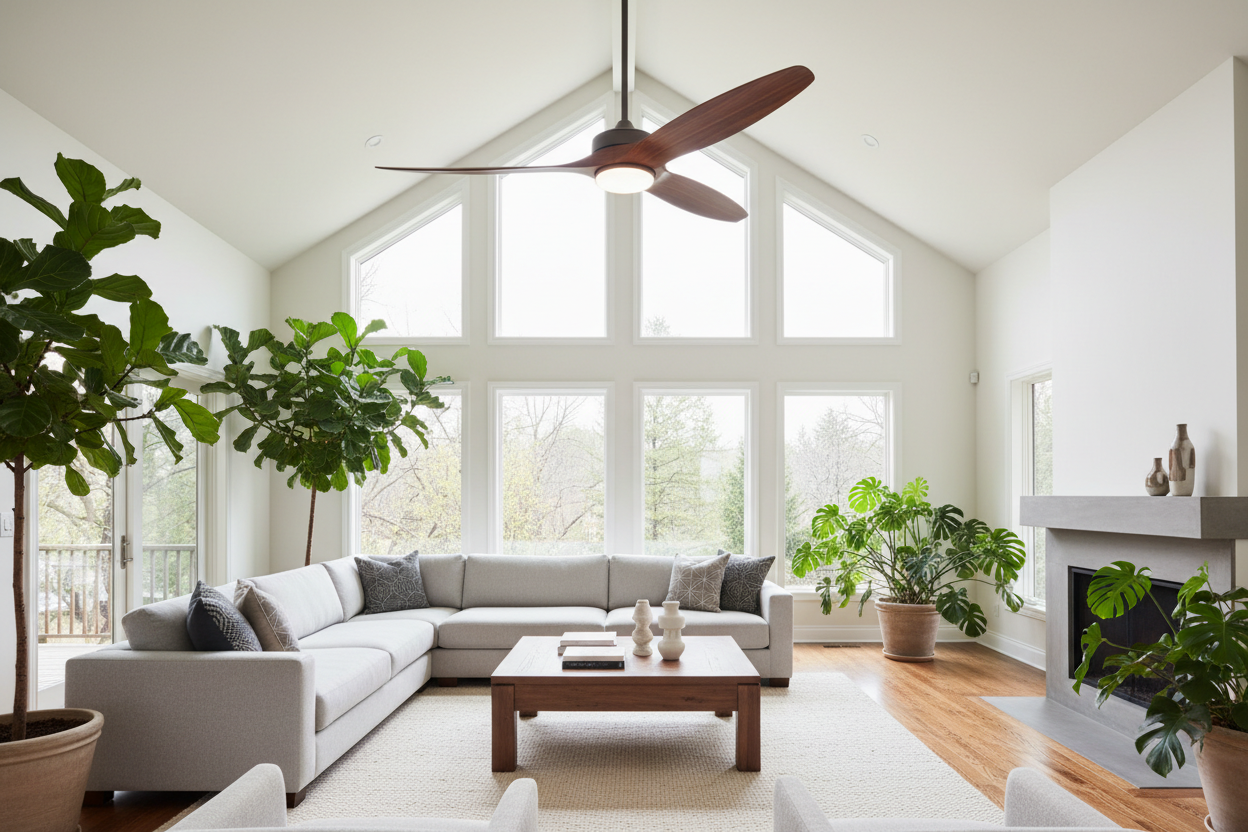
The Case for Investing in a Premium Ceiling Fan
Let's talk about ceiling fans for a minute. Not the boring, builder-grade fans that came with your house. Not the wobbly plastic contraptions that sound like a helicopter taking off. I'm talking about the kind of ceiling fan that makes people stop and say, "Wait, where did you get that?"
The 60-inch Walnut Solid Wood Ceiling Fan is that kind of fan. It's the fan you buy when you're done compromising, when you're ready to invest in something that'll still look great and work flawlessly ten years from now. And right now, with 30% off for the holidays, it's actually within reach for people who appreciate quality but don't have unlimited budgets.
I've been writing about home improvement and interior design for over a decade, and I've seen a lot of ceiling fans. Most of them are forgettable. This one isn't. Here's why.

What Makes Solid Wood Different (And Why It Matters)
The first thing you need to understand about this fan is the solid walnut construction. Not walnut-finish. Not walnut-look. Actual solid walnut wood blades.
Why does this matter? Because wood behaves differently than plastic or metal. It's heavier, which means more momentum and more efficient air movement. It's naturally beautiful, with grain patterns that make each fan unique. And it ages gracefully—solid wood develops character over time instead of looking cheap and dated.
Walnut specifically is one of the premium hardwoods. It's dense, durable, and has a rich, warm color that ranges from chocolate brown to lighter tan, often with darker streaks running through it. It's the kind of wood you see in high-end furniture, not ceiling fans. That's what makes this fan special.
The three-blade design might seem minimalist, but it's actually optimal for this size fan. Three blades create less drag than five or six, which means the motor doesn't have to work as hard. The result is better efficiency, quieter operation, and longer motor life. Each blade is precisely balanced at the factory, so you get smooth, wobble-free performance right out of the box.
Size Matters: Why 60 Inches Is the Sweet Spot for Large Rooms
Sixty inches is a substantial fan. This isn't for a bedroom or a home office. This is for great rooms, large master suites, open-concept living areas, covered patios, or commercial spaces. If your room is 400 square feet or larger, this is the size you need.
Here's what most people get wrong about ceiling fan sizing: they go too small. They buy a 52-inch fan for a 500-square-foot room and then wonder why it doesn't cool effectively. The fan runs constantly but never quite does the job. It's frustrating and inefficient.
A 60-inch fan moves significantly more air than a 52-inch fan—we're talking about a 30-40% increase in airflow. That's the difference between a fan that struggles and a fan that handles the job effortlessly. When you size a fan correctly, you can run it at lower speeds and still get excellent air circulation. Lower speeds mean less noise and less energy consumption.
The blade span on this fan is exactly 60 inches from tip to tip. The overall height with the standard mount is 18 inches, which gives you flexibility for different ceiling heights. The fan weighs 21 pounds, which is substantial but not excessive. Your ceiling junction box needs to be rated for fan installation, but any properly installed fan box will handle this weight without issue.

The Motor: Where Performance Meets Silence
A ceiling fan is only as good as its motor, and this is where the 60-inch Walnut fan really shines. The motor is engineered for what the manufacturer calls "ultra-powerful air movement," and that's not marketing hyperbole. This fan moves a lot of air.
But here's the impressive part: it does it quietly. The motor is factory-balanced and tested for stability, which eliminates the wobble and noise that plague cheaper fans. When you turn this fan on, you feel the airflow, but you don't hear the motor. It's the kind of quiet operation that you don't fully appreciate until you've lived with a noisy fan.
The motor is also reversible, which is crucial for year-round use. In summer, you run the fan counterclockwise (when looking up at it) to push air down and create a cooling breeze. In winter, you switch it to clockwise rotation at a low speed. This pulls cool air up and pushes warm air down from the ceiling, helping to distribute heat more evenly throughout the room.
This reversible function isn't just a nice feature—it's a money-saver. By improving air circulation in winter, you can often lower your thermostat by a few degrees and still feel comfortable. Over the course of a heating season, that can translate to significant savings on your energy bills.
Lighting That Actually Works
The integrated LED lighting on this fan is thoughtfully designed. You get three color temperature options: 2700K warm white, 4000K daylight, and 5000K cool light. This gives you incredible flexibility to match the lighting to the time of day or the mood you want to create.
Let me break down what these color temperatures actually mean in practical terms:
2700K Warm White: This is the color of traditional incandescent bulbs—soft, amber-toned light that feels cozy and inviting. It's perfect for evenings when you want to relax, for dining rooms, or for bedrooms. This is the temperature that makes people and spaces look warm and welcoming.
4000K Daylight: This is neutral white light that closely mimics natural daylight. It's bright without being harsh, and it's excellent for general use. This is the temperature I use most often—it's versatile and works well for everything from reading to entertaining.
5000K Cool Light: This is crisp, blue-toned light that's similar to bright midday sun. It's energizing and excellent for task work. If you're using this fan in a home office or a workshop, this is the temperature you'll want for focused work.
The ability to switch between these three temperatures with a button press is genuinely useful. You're not locked into one lighting mood. You can have warm, relaxing light in the evening and bright, energizing light in the morning, all from the same fixture.
The LED technology means the light is energy-efficient and long-lasting. LEDs use a fraction of the energy of incandescent bulbs and last for tens of thousands of hours. You'll probably never need to replace the light source in this fan.

Remote Control: Convenience You'll Use Every Day
The included remote control is one of those features that seems minor until you have it, and then you can't imagine living without it. The remote handles all the fan's functions: speed adjustment (six speeds), light on/off, color temperature selection, and timer settings.
Six speed settings give you precise control over airflow. Speed one is barely perceptible—just enough to keep air moving without creating a breeze. Speed six will cool down a hot room fast. Most people find their comfort zone somewhere in the middle, and having six options means you can dial in exactly the airflow you want.
The timer function is particularly useful. You can set the fan to automatically shut off after 1, 2, or 4 hours. This is perfect for falling asleep with the fan on without running it all night, or for running the fan while you're cooking and having it automatically turn off later.
The remote is intuitive to use. The buttons are clearly labeled: 1/2/3/4/5/6 for fan speeds, LIGHT ON/OFF for the lighting, and dedicated buttons for color temperature and timer settings. You don't need to read a manual to figure it out.
One practical note: the remote uses batteries (typically AAA), so keep a spare set on hand. There's nothing more annoying than having a dead remote battery when you want to adjust the fan.
Indoor/Outdoor Versatility
This fan is rated for both indoor and outdoor use, which significantly expands where you can install it. For outdoor installation, you need a covered area—a patio, porch, pergola, or gazebo. The fan isn't weatherproof enough for direct rain exposure, but under a roof or overhang, it'll perform beautifully.
Outdoor ceiling fans are game-changers for extending the usability of your outdoor spaces. A covered patio with a ceiling fan is comfortable even on hot summer days. The airflow makes a huge difference in how the space feels, and the lighting means you can use the area after dark.
The walnut wood blades are finished to resist moisture and temperature fluctuations, but if you're installing this outdoors, be mindful of your climate. In very humid environments or areas with extreme temperature swings, you'll want to check the fan periodically and ensure the wood isn't warping or the finish isn't degrading.
For indoor installation, this fan works in virtually any large space. Great rooms, master bedrooms, dining rooms, home theaters, lofts—anywhere you need powerful air circulation and attractive lighting.

Installation: What You Need to Know
The fan features a three-position mounting system that accommodates standard, low, or angled ceilings. This flexibility is important because not all rooms have flat, standard-height ceilings.
Standard Mount: For typical 8-9 foot ceilings, you'll use the standard mount configuration. This positions the fan at the optimal height for air circulation—typically 8-9 feet above the floor.
Low Mount: For lower ceilings (7-8 feet), the low mount configuration brings the fan closer to the ceiling. This is sometimes called a "hugger" or "flush mount" installation. It's not ideal for air circulation, but it's necessary when ceiling height is limited.
Angled Mount: For vaulted or sloped ceilings, the angled mount allows you to install the fan on a ceiling with up to a 15-degree slope. This keeps the fan level even when the ceiling isn't.
Installation requires basic electrical knowledge. If you're comfortable working with electrical wiring and you've installed a ceiling fan before, this is a straightforward DIY project. The fan comes with detailed instructions, and the wiring is standard—typically a black wire (hot), white wire (neutral), green or bare wire (ground), and possibly a blue wire for the light kit.
If you're not comfortable with electrical work, hire a licensed electrician. Installation typically takes 1-2 hours and costs $100-200, depending on your location and the complexity of the installation. It's money well spent to ensure the fan is installed safely and correctly.
One critical point: make sure your ceiling junction box is rated for fan installation. Standard light fixture boxes aren't always strong enough to support a fan's weight and movement. If you're not sure, have an electrician check it. Installing a fan on an inadequate box is dangerous and can lead to the fan falling.
Design Aesthetics: How This Fan Looks in Real Spaces
Let's talk about how this fan actually looks in a room, because aesthetics matter. A ceiling fan is a prominent fixture—it's literally hanging from your ceiling in the center of the room. It needs to look good.
The walnut wood gives this fan a warm, organic quality that works with a surprising range of design styles. It's not locked into one aesthetic. Here's how it looks in different settings:
Modern/Contemporary: The clean lines and minimalist three-blade design fit perfectly in modern spaces. The walnut adds warmth that prevents the room from feeling cold or sterile. Pair it with neutral walls, simple furniture, and metal accents.
Mid-Century Modern: This is where the fan really shines. The combination of wood and sleek design is quintessentially mid-century. It looks right at home with teak furniture, geometric patterns, and the warm color palettes typical of this style.
Transitional: If your style is somewhere between traditional and contemporary, this fan works beautifully. It's refined enough for a formal space but relaxed enough for casual living areas.
Rustic/Farmhouse: The natural wood fits perfectly with rustic aesthetics. It complements exposed beams, shiplap walls, and reclaimed wood furniture. The modern functionality doesn't clash with the rustic vibe—it enhances it.
Industrial: Surprisingly, this fan works in industrial spaces too. The wood adds warmth to balance the hard edges of metal and concrete. It's an unexpected element that makes the space feel more livable.
The key is that the fan doesn't dominate the room visually. It's substantial enough to make a statement, but it's not so ornate or busy that it overwhelms the space. It's the kind of fixture that looks expensive and well-chosen without screaming for attention.

Energy Efficiency and Operating Costs
Let's talk about what it actually costs to run this fan, because energy efficiency matters both for your wallet and for the environment.
Ceiling fans are remarkably efficient compared to air conditioning. Running a ceiling fan costs pennies per day, while running an air conditioner costs dollars per day. The exact cost depends on your local electricity rates, but as a general rule, you can run a ceiling fan 24/7 for about the same cost as running an air conditioner for a few hours.
The LED lighting is also highly efficient. LEDs use about 75% less energy than incandescent bulbs and last 25 times longer. Over the lifespan of the fan, the energy savings from LED lighting alone will more than pay for the difference in upfront cost compared to a fan with traditional bulbs.
The reversible motor function contributes to energy savings in winter. By improving heat distribution, you can lower your thermostat setting and still maintain comfort. Even a 2-3 degree reduction in your thermostat setting can result in 5-10% savings on heating costs.
When you factor in the energy savings over the fan's lifespan—which should be 15-20 years or more with proper maintenance—the total cost of ownership is actually quite low. You're paying more upfront for quality, but you're saving money over time through efficiency and durability.
Maintenance: Keeping Your Fan Running Smoothly
One of the advantages of a quality fan is that it requires minimal maintenance. Here's what you need to do to keep this fan running smoothly for years:
Dust the blades regularly: Dust buildup on the blades can affect balance and efficiency. Every few weeks, wipe down the blades with a damp cloth or use a duster with an extendable handle. For the walnut wood, avoid harsh chemicals—just use water or a mild wood cleaner.
Check the mounting screws annually: Vibration can loosen screws over time. Once a year, check that all the mounting screws are tight. This takes five minutes and prevents problems down the road.
Clean the motor housing: Dust can accumulate on the motor housing. A few times a year, wipe it down with a damp cloth. Make sure the power is off before you do this.
Inspect the blades for damage: Periodically check the wood blades for cracks, warping, or finish damage. Solid wood is durable, but it's not indestructible. If you notice any issues, address them promptly.
Lubricate if necessary: Most modern ceiling fans have sealed bearings that don't require lubrication. Check your manual—if lubrication is needed, the manual will specify what type and how often.
That's it. No complicated maintenance schedules, no expensive parts to replace. Just basic care to keep everything running smoothly.

The 30% Holiday Discount: What It Means for You
Let's talk numbers. The regular price for this fan is $289.99. With the 30% holiday discount, you're paying $202.99. That's a savings of $87.
To put that in perspective, you're getting a premium solid walnut ceiling fan with integrated LED lighting, remote control, and reversible motor for just over $200. That's exceptional value.
I've seen comparable fans—and by comparable, I mean fans with solid wood blades, quality motors, and similar features—priced at $400-600. The 30% discount brings this fan into a price range where it competes with mid-range fans that don't have half the quality or features.
The discount is automatic at checkout. No coupon codes, no hoops to jump through. Add the fan to your cart, and the discount is applied. The sale runs through the end of December, but popular items sell out, so if you're serious about buying, don't wait until the last minute.
Here's how I think about the value proposition: you're paying $203 for a fan that should last 15-20 years. That's about $10-13 per year. For something you'll use every day, that's a bargain. And when you factor in the energy savings from efficient operation and the reversible motor, the fan essentially pays for itself over time.
Who This Fan Is For (And Who It Isn't)
This fan isn't for everyone, and that's okay. Let me be clear about who should buy this fan and who should look elsewhere.
This fan is perfect for you if:
You have a large room (400+ square feet) that needs powerful air circulation. You appreciate quality materials and craftsmanship. You want a fan that looks as good as it performs. You're willing to invest in something that'll last for decades. You value quiet operation and efficient performance. You want the flexibility of adjustable lighting and year-round use.
This fan probably isn't right for you if:
You have a small room (under 300 square feet)—a 60-inch fan will be too large. You're looking for the absolute cheapest option regardless of quality. You want a highly ornate or decorative fan—this fan is elegant but minimalist. You need a fan for direct outdoor exposure without a roof or cover. You're not comfortable with the upfront cost, even with the discount.
The key is being honest about your needs and priorities. If you want a premium fan and you have the right space for it, this is an excellent choice. If you're just looking for basic air circulation and don't care about aesthetics or longevity, there are cheaper options available.

Comparing to Other Options in the Market
How does this fan stack up against other options in the same price range? I've spent time researching competitors, and here's what I found:
Big-Box Store Fans ($200-300): At this price point, you're typically getting metal or plastic blades with a wood-look finish, not actual solid wood. The motors are often louder and less efficient. The build quality is adequate but not exceptional. You're paying for the brand name and the convenience of buying at a local store.
Budget Online Fans ($150-250): These fans are hit or miss. Some are decent value, but many have quality control issues—wobbling, noise, finish problems. Customer service can be nonexistent. You might save $50 upfront, but you'll pay for it in frustration and potentially having to replace the fan sooner.
Premium Designer Fans ($400-800): These fans offer comparable or slightly better quality, but you're paying a significant premium for the designer name. The performance isn't dramatically better—you're mostly paying for exclusivity and brand cachet.
The 60-inch Walnut fan sits in a sweet spot: premium quality and materials at a price that's accessible to people who aren't shopping in the luxury tier. With the 30% discount, it's an even better value proposition.
Real-World Performance: What to Expect
Let's talk about what it's actually like to live with this fan. I'm basing this on my own experience and conversations with people who own similar fans.
Cooling Performance: In a 500-square-foot great room on a 90-degree day, this fan makes a noticeable difference. At medium speed, it creates enough airflow to make the room feel 5-7 degrees cooler. You can raise your thermostat setting and still feel comfortable, which translates to real energy savings.
Noise Level: At low to medium speeds, the fan is essentially silent. You hear the air moving, but you don't hear the motor. At high speeds, there's a gentle whoosh of air, but it's not intrusive. You can have a conversation, watch TV, or sleep without the fan noise being an issue.
Lighting Quality: The LED light is bright enough to serve as the primary light source in most rooms. The ability to adjust color temperature is genuinely useful—I find myself using warm white in the evenings and daylight during the day. The dimming function works smoothly without flickering.
Remote Responsiveness: The remote is responsive and has good range. You can control the fan from anywhere in a typical room. The buttons are tactile and easy to press, even in the dark.
Build Quality: The fan feels solid and well-made. There's no wobble, no loose parts, no cheap-feeling components. It's the kind of quality you notice every time you look at it or use it.

Installation Tips from Someone Who's Done It
If you're planning to install this fan yourself, here are some tips that'll make the process smoother:
Turn off the power at the breaker, not just the switch. Test the wires with a voltage tester to make absolutely sure the power is off. This isn't optional—it's a safety requirement.
Have someone help you. Ceiling fans are awkward to install solo. You need someone to hold the fan while you make the electrical connections. It makes the job faster and safer.
Read the instructions before you start. I know this seems obvious, but people skip this step all the time. Spend ten minutes reading through the manual so you understand the process before you begin.
Check your ceiling box. Make sure it's rated for fan installation and securely attached to a ceiling joist or blocking. If it's not, you'll need to install a fan-rated box before you can proceed.
Use the right tools. You'll need a screwdriver (probably Phillips head), wire strippers, wire nuts, a voltage tester, and possibly a ladder. Having the right tools makes the job much easier.
Take your time with the wiring. Make sure the connections are tight and secure. Loose connections can cause problems ranging from the fan not working to electrical fires. If you're not confident in your wiring, hire an electrician.
Balance the fan if needed. Most fans come pre-balanced, but if you notice any wobble after installation, use the balancing kit that should be included with the fan. The instructions will walk you through the process.
The Environmental Angle
If you care about environmental impact—and more people do these days—this fan has some things going for it.
First, it's energy-efficient. Using a ceiling fan instead of air conditioning reduces your energy consumption significantly. Air conditioners are energy hogs, especially in hot climates. A ceiling fan uses a fraction of the energy while still keeping you comfortable.
Second, the solid wood construction is more sustainable than plastic. Wood is a renewable resource when it's sourced responsibly. Plastic is petroleum-based and doesn't biodegrade. When this fan eventually reaches the end of its life (which won't be for many years), the wood components can be recycled or will decompose naturally.
Third, the longevity of the fan matters. A fan that lasts 20 years has a much lower environmental impact than a cheap fan that needs to be replaced every 3-5 years. Manufacturing has environmental costs—materials, energy, transportation. A durable product that doesn't need frequent replacement is inherently more sustainable.
Fourth, the LED lighting is far more efficient than incandescent or even CFL bulbs. LEDs use less energy and last longer, which means fewer bulbs in landfills and less energy consumed over the fan's lifetime.
I'm not claiming this fan is a perfect environmental solution, but it's a more responsible choice than many alternatives.

Why Now Is the Time to Buy
The 30% holiday discount is the obvious reason to buy now, but there are other factors to consider.
First, inventory. Popular items sell out during holiday sales. If you wait until late December, there's a real possibility the fan will be out of stock. Manufacturers don't always restock immediately, so you could be waiting weeks or months for availability.
Second, installation timing. If you're hiring an electrician, the holidays are actually a good time to schedule work. Many contractors have lighter schedules in late December and early January, so you're more likely to get an appointment quickly.
Third, immediate benefit. If you buy now, you can enjoy the fan through the winter (using the reversible function to improve heat distribution) and be ready for summer. If you wait until summer to buy a fan, you're suffering through the heat while you wait for delivery and installation.
Fourth, tax considerations. If you're buying this fan for a home office or a rental property, it may be tax-deductible. Making the purchase before year-end could have tax advantages. Consult with a tax professional about your specific situation.
Final Thoughts: Is This Fan Worth It?
After everything I've covered—the solid walnut construction, the powerful motor, the versatile lighting, the thoughtful design, the energy efficiency—the question remains: is this fan worth $203 (with the 30% discount)?
My answer is yes, with caveats.
If you have a large room that needs effective air circulation, if you appreciate quality materials and craftsmanship, if you want a fan that looks as good as it performs, and if you're willing to invest in something that'll last for decades, then yes, this fan is absolutely worth it.
You're not just buying a ceiling fan. You're buying better comfort in your home, lower energy bills, a beautiful design element, and the satisfaction of owning something well-made. Those benefits compound over time.
But if you're just looking for basic air movement and don't care about aesthetics or longevity, or if you have a small room where a 60-inch fan would be oversized, then this isn't the right fan for you. There are cheaper options that'll meet your needs.
The key is being honest about what you value and what you need. For the right person in the right space, this fan is an excellent investment. For someone else, it might be overkill.
What I can tell you with confidence is that this fan represents exceptional value at the discounted price. You're getting premium quality at a mid-range price point. That's a rare combination, and it's why I'm comfortable recommending this fan to people who are serious about quality.
How to Buy
If you've decided this is the fan for you, here's how to purchase it:
The fan is available directly through Rackora's website. The 30% discount is automatically applied at checkout—no coupon code needed. Just add the fan to your cart and proceed to checkout.
Shipping is typically fast, though delivery times can vary during the holiday season. Check the estimated delivery date at checkout to make sure it works with your timeline.
If you have questions before buying, Rackora's customer service is responsive and helpful. Don't hesitate to reach out if you need clarification on anything.
Regular price: $289.99 | Holiday price with 30% off: $202.99
Shop the 60-Inch Walnut Ceiling Fan →
The Bottom Line
The 60-inch Walnut Solid Wood Ceiling Fan is a premium product at a price that's accessible thanks to the holiday discount. It's built to last, performs exceptionally well, looks beautiful, and offers features that you'll use and appreciate every day.
If you're in the market for a large ceiling fan and you value quality, this is one of the best options available. The solid walnut construction, powerful motor, versatile lighting, and thoughtful design make it a standout in a crowded market.
At $203 with the 30% discount, it's a smart investment in your home's comfort and aesthetics. It's the kind of purchase you'll be happy about every time you walk into the room and feel the breeze or adjust the lighting to exactly what you want.
Don't overthink it. If you have the right space and you appreciate quality, buy the fan. You won't regret it.
