It's 2:47 on a Wednesday afternoon and Maya hasn't really moved in three hours. She's reached for her coffee, crossed and uncrossed her legs, leaned left to grab a pen. But her spine hasn't changed position since she sat down after lunch. Her phone lights up with a group chat from her sister: an article about how sitting is the new smoking, complete with a stock photo of a skeleton slumped in an office chair.
Maya looks at the article. Then at her kitchen-table desk setup. Then back at the article. She feels a little guilty, a little scared, and mostly confused. Does she need to stand up right now? Is her chair slowly doing something terrible to her? Is she supposed to stand for eight hours a day from now on? And why does everyone online sound so sure about all of it?
We hear some version of Maya's story almost every week at Rackora. People come to us saying "I need a standing desk because sitting is killing me," and honestly, we get the feeling. But after years of helping people set up home offices, we've learned that the honest version of this conversation is more useful than the headline. That's what this article is: where the phrase came from, what research actually shows, what standing desks genuinely fix, and how to use one without turning it into an expensive way to stand still.
Where "Sitting Is the New Smoking" Actually Came From
Here's the thing about that phrase: it was never a medical diagnosis. It was a rhetorical move, and it worked almost too well.
The comparison is usually traced back to a researcher who studies how much energy daily life burns, the small movements that add up over a day without us noticing them. Around a decade ago, in talks and papers aimed at getting people to think about sedentary behavior, he compared our increasingly still lives to smoking. It was a provocation, a way of saying "this thing we treat as completely harmless is not as harmless as we think." The line got picked up, compressed into a slogan, and turned into the kind of headline that makes people forward articles to their sisters on a Wednesday afternoon. The internet did what the internet does with a good line: it repeated it until nobody remembered where it came from.
So let's be honest about what the phrase actually did. It was designed to shock, and it succeeded. It also named something real. Anyone who has worked from home for a year knows the feeling of a stiff lower back at four in the afternoon, the strange ache between the shoulder blades, the realization that you haven't stood up since breakfast. The phrase gave that feeling a villain, and a villain is satisfying. The problem is that satisfying is not the same as accurate.
And here's the part that almost never gets told: the researcher himself has spent years clarifying that the comparison was never meant literally. Sitting is not smoking. Cigarettes are a toxin with a death toll; chairs are furniture you sit on while your food digests. The useful idea hiding inside the slogan is smaller and more boring, which is why it never became a headline: we are more still than our bodies are built for, and that stillness has a cost. That idea is true. It just doesn't fit on a t-shirt as well as the scary version.
So the next time someone tells you sitting is the new smoking, you can nod along and also know the truth: it's an exaggeration with a kernel of real science inside, and the science is about movement, not about chairs being dangerous. Once you see it that way, the whole conversation gets a lot less scary and a lot more practical.
What the Research Actually Shows (and What It Doesn't)
Let's be straight about the science, because the internet is full of confident claims, and most of them outrun the evidence by a mile.
Researchers generally agree on one thing: long, uninterrupted sitting is associated with health risks. Studies have looked at everything from metabolic markers to cardiovascular outcomes to back pain, and the pattern that keeps showing up is that prolonged, unbroken stillness correlates with worse outcomes across a range of measures. That part is about as solid as this literature gets, and it's worth taking seriously.
But here's the part that rarely makes it into the headlines: the research doesn't actually say sitting is the problem and standing is the cure. Over and over, the more interesting finding is that people who sit a lot but break it up with movement tend to show fewer of the negative associations than people who sit for hours without interruption. The enemy is not the chair. The enemy is the unbroken stretch. A person who gets up every thirty minutes, walks to the kitchen, stretches, and sits back down is doing something meaningfully different from a person who stays planted for four hours, even though both of them are technically "sitting all day." Same label, different bodies.
And the mirror image matters just as much. Standing all day is not the answer, and the research is clear that it isn't. People with standing jobs have their own catalog of complaints: leg fatigue, aching feet, varicose veins, stiff knees, lower back strain from leaning over counters. If you replaced every hour of sitting with an hour of standing, you wouldn't be healthier. You'd just move the problem to a different part of your body and pick up a few new ones on the way. The studies point in the same direction over and over: the goal is variety and movement, not a winner-takes-all contest between sitting and standing.
One more honest note, and this one is about how to read health headlines in general. The "new smoking" framing quietly suggests there's a single bad behavior to eliminate, and that if you fix that one thing, you're off the hook. Real life doesn't work that way, and the research doesn't either. Dozens of small behaviors matter more than any single one: walking, stretching, sleeping enough, drinking water, changing posture, taking actual breaks instead of "just finishing this email." A standing desk is one lever among many. It's a good lever, and it's the one we sell, so we're not neutral on it. But it's not the whole machine, and pretending otherwise is how people end up disappointed three weeks in.
Here's the practical translation of the research, in one sentence: your body wants to be moved and changed, not held in one position for eight hours. Everything else in this article is just figuring out how to do that inside a normal workday.

What a Standing Desk Genuinely Fixes
Now the part we can actually speak to, because we've watched thousands of people set up home offices and live with the results for years. A standing desk does not fix your back. It does not fix your health. What it does is change your options, and that turns out to matter more than it sounds like it would.
It fixes your posture default. When you sit in a soft chair that's slightly too low, your body finds the path of least resistance, which is usually a slump: shoulders rolling forward, head drifting toward the screen, lower back letting go of the backrest entirely. That's not a moral failing, it's physics. Your muscles are doing what muscles do, which is taking the day off whenever they can get away with it. When you stand, gravity works differently. Your head stacks over your shoulders, your shoulders over your hips, without you having to think about it. Standing doesn't give you perfect posture, but it gives you a better default, and a better default beats constant self-correction. You don't have to remember to stand up straight; you just are. We have customers who tell us they didn't realize how hunched they'd gotten until they stood up and their shoulders were suddenly... back. That's the whole trick of it.
If you've ever caught yourself craning forward at a laptop with your neck stretched toward the screen, you know the pattern. It's the same craned-forward posture people write about when they talk about text neck, just aimed at the other end of your body. Standing won't undo years of that overnight, but it stops adding to the bill every single afternoon.
It fixes your focus, for a while. Customers tell us the first twenty minutes or so of a standing block feel sharper, more on. There's something about being on your feet that changes your state, the same way standing up to take a phone call makes you sound more awake than you feel. And the act of adjusting the desk is itself part of the benefit. It's a small physical ritual: you press a button, the desk hums, your whole workspace changes level, and your brain registers that something has changed. It's a reset button you can press with one finger. You're not just changing height; you're changing your situation, and our brains respond to that more than we give them credit for.
It fixes the afternoon slump, sometimes. The three o'clock fog is real, and a short standing block genuinely helps some people push through it. We have customers who swear by a ten-minute stand after lunch, and customers who tell us it does nothing for them, and both of them are telling the truth. Energy is complicated, and a desk is not a coffee machine. But when it works, it works in a way that feels like an actual solution rather than another hack, because you're not adding caffeine to your system, you're adding blood flow and a change of position to your afternoon.
That's the honest list. Posture, focus, and afternoon energy, with real caveats on each one. A standing desk doesn't fix you. It makes the better choice dramatically easier, and over a year of workdays, easier is what wins. That's the sales pitch, and it's also just the truth.

The Sit-Stand Rhythm That Actually Works
Here's a sentence you'll see on a hundred blogs: "Stand for fifty minutes, sit for ten." It sounds scientific, and it is completely made up. There is no magic ratio hiding in the research, and anyone telling you there is, is selling certainty they don't have. What the research actually supports is boring and flexible: change position regularly, and don't turn it into a second job.
What we see work in real home offices looks more like this. Sit for twenty-five to forty-five minutes. Stand for five to ten. That's a range, not a law, and the point of the range is that it gives your body variety without turning your workday into a gymnastics routine. Start small: two or three standing blocks a day is plenty for the first week. Some people build to six or eight blocks comfortably by the end of a month. Some people settle at two forever. Both are fine, and both are infinitely better than zero.
Don't over-engineer the timing. The best cue is a natural one: the end of an email, the end of a video call, a coffee refill, the moment you finish a task and your brain needs a reset anyway. Those are the moments when changing position feels good, and feeling good is what makes a habit stick. Timers work for some people and annoy others, and both groups are normal. If a timer makes you stand up in the middle of a flow state, ditch the timer. The goal is interruption, not arithmetic. You're not trying to hit a daily standing quota like it's a step count; you're trying to keep your body from freezing in one position.
Here's our honest advice, the same thing we tell people in person at the shop: treat the first week as an experiment, not a fitness program. You will probably stand too long on day two and get sore feet. That's data, not failure. Write down what felt good and what didn't, and adjust. The rhythm that survives is the one that fits your day, not the one that fits a chart, and you're the only person who can find it. We can tell you what works for most people, but the last twenty percent is always personal. That's not a cop-out, it's the truth about bodies.
A typical day on this rhythm looks like: morning coffee sitting, first deep-work block sitting, then stand for the "clearing emails" stretch where you don't need deep focus. Stand through a phone call, because nobody can tell you're standing and your legs will thank you. Sit for the afternoon project. Stand again for the last twenty minutes of the day, the wind-down tasks, the organizing, the "what's on for tomorrow" list. Before you know it, you've changed position five or six times without once thinking about a timer. That's the whole game. (And if you're setting this up in a dorm room or a small apartment, our guide to back-to-school standing desk setups covers the space-planning side of the same habit, including where to put the desk so it can actually go up and down.)
Avoid the Standing Desk Honeypot
We should warn you about the honeypot, because we've watched people fall into it for years, and it's the most common way a standing desk goes from investment to regret.
The honeypot looks like this. You buy a standing desk, feel extremely virtuous, and decide that the point is to stand for as long as possible. Four hours into day three, your feet ache, your knees are complaining, and your lower back has decided to join the mutiny. You conclude that standing desks are a scam and go back to sitting forever, $599.99 lighter and twice as annoyed.
Standing for hours is not the goal. It's its own problem, and honestly, it's a more obvious one than sitting is, because the discomfort shows up faster. The tool you bought is not "standing." The tool is change. If you never change position, it doesn't matter whether you're sitting or standing; you're still still, and stillness is the exact thing your body has been asking you to interrupt all along. A person who stands for five hours straight has missed the point just as completely as a person who sits for eight.
A few practical rules that keep people out of the honeypot, learned from watching real customers succeed and fail:
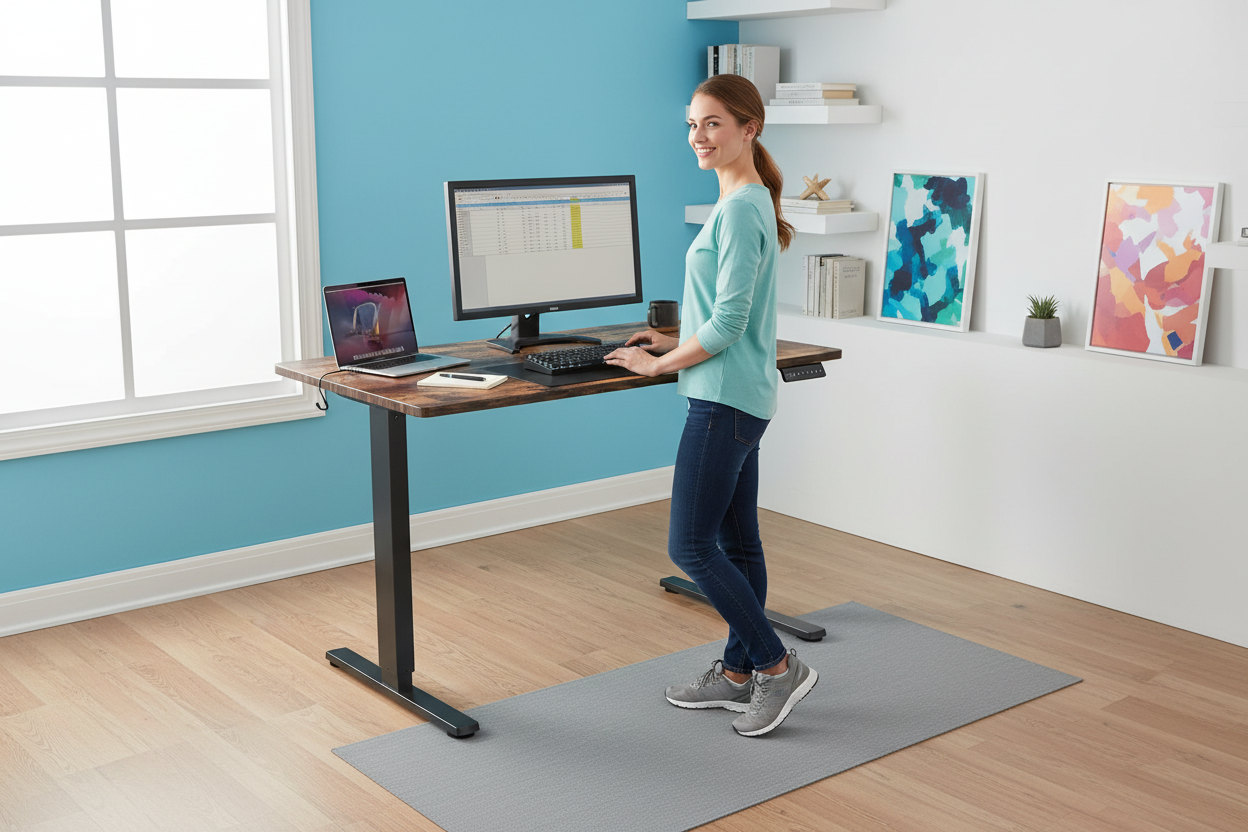
Get an anti-fatigue mat. Seriously, this one is non-negotiable if you plan to stand more than fifteen minutes at a time. Hardwood, tile, and concrete will punish you at minute twenty, and a mat changes the math completely. It's the difference between standing feeling like an option and standing feeling like a punishment. We've seen customers write off standing desks entirely because they tried standing on a concrete floor in a pair of worn-out slippers and concluded their bodies were broken. Their bodies weren't broken. They were missing a mat and a real pair of shoes.
Wear real shoes. Cushioned, supportive shoes beat bare feet for anything past a quick stretch. Bare feet on a good mat are fine for a while, and some people genuinely love it. Bare feet on hard flooring is how you talk yourself out of standing by Friday. Your feet are doing the standing; treat them like they matter, because they're the part of you that complains first.
Set the height right. When you stand, your elbows should be around ninety degrees with your keyboard at forearm level, and the top of your screen should sit at roughly eye level. A desk that's too high makes your shoulders climb toward your ears, which trades a sitting hunch for a standing shrug. A desk that's too low puts you right back in the forward lean you were trying to escape. The height setting is the whole ballgame, and most people set it wrong the first time. Give yourself a week to fine-tune it, and don't be shy about adjusting mid-day.
Move while you stand. Rock from foot to foot. Shift your weight. Do a calf stretch. Take three steps to the window and back. Standing perfectly still for ten minutes is only slightly better than sitting perfectly still for ten minutes, and this is the part of the standing-desk routine that most guides skip. The standing part of your day should include micro-movement; that's where a meaningful share of the benefit actually lives.
What $599.99 Actually Buys You
Let's talk about the desk we sell, because a standing desk is only as good as its weakest detail, and that's exactly where cheap ones fall apart.
The Rackora 40×24 electric standing desk, currently $599.99 and regularly $879.99, is the desk we recommend to most people, and here's why, spec by spec.
Electric adjustment. Press a button and the desk moves, smoothly and quietly, to whatever height you've chosen. No cranking, no wobbling while you crank, no "I'll just leave it at this height because adjusting is annoying." The friction of a manual crank is real, and friction is the enemy of the habit this whole article is about. A desk you have to work to adjust is a desk you don't adjust.
Memory presets. You set your sitting height once, set your standing height once, and after that it's one press to move between them. This sounds like a small convenience until you've done it six times in a day, and then it feels like the most obvious feature in the world. It's the thing our customers mention most when they tell us about their desks, and it's the difference between a desk that gets used and a desk that gets ignored. You're not going to fiddle with a lever six times a day; you will press a button six times a day.
A 28-46 inch height range. That span covers almost every sitting and standing combination for adult bodies, from a petite person whose feet barely touch at sitting height to a tall person who's never had a desk that went high enough. Shorter users aren't stuck hovering above their sitting height, and taller users don't run out of range at the top. If you've ever used a desk that maxed out too low, or a riser that put your screen in your chin, you know exactly why this matters.
Stability at any height. A wobbly desk at standing height is a six-hundred-dollar regret, and it's the most common failure of budget desks. The 40×24 stays planted at full extension, even with a monitor, a laptop, and a coffee mug all in play at once. You shouldn't have to brace the desk to type, and you shouldn't watch your screen shiver every time you hit the spacebar. That's a test worth doing on any desk you're considering, and it's the reason this one doesn't shake at standing height. The engineering that goes into "doesn't wobble" is invisible, but you feel it the first time you stand up and type.
The 40×24 top. A monitor, a keyboard, a mouse, a notebook, and a coffee all fit without playing Tetris. For a home office, that footprint is the sweet spot: enough room to actually work, small enough to fit a bedroom corner or a studio apartment, and shaped to sit against a wall without dominating the room.
If you want the whole picture, here's the Rackora 40×24 electric standing desk product page. And if you're wondering whether the memory preset is really worth paying for: yes. Because the entire game of a standing desk is making the adjustment effortless enough that you actually do it, and a button beats a crank every single time.
Price Honesty
Let's be straight about money, because you deserve better than a sales pitch, and this is the part where furniture companies usually start tap-dancing.
$599.99 is a real price for a real electric desk, and yes, the regular price is $879.99, which is the price it carries when it's not on sale. You can also buy a manual crank desk for around $200, or a riser that sits on top of your existing desk for around $150, and if either of those genuinely works for you, we mean this sincerely: great. We've said that to people in our shop more times than we can count, and we'll say it here. A desk you'll actually use is worth more than a desk you won't, at any price point.
What the extra money buys on the 40×24 is the set of details above: electric motors that don't strain, memory presets that make the habit effortless, a height range that fits your body, and stability engineered so the desk doesn't shimmy at standing height. Those are exactly the details that decide whether you use the desk or leave it at sitting height forever. The $200 crank desk that you never crank because it's annoying isn't a bargain; it's a table with extra steps. The $150 riser that you have to lift your whole monitor rig onto and off of every time you switch positions? Same story. The cheapest thing in the world is the thing you don't use, and the most expensive thing in the world is the thing you buy twice.
Here's the honest math we use with customers, and you can steal it: a desk you adjust daily is worth more than a desk you never move, at any price. And in our experience, most people who buy a standing desk do use it. That's what our customers tell us, week after week, and it's consistent enough that we trust it. The ones who don't are almost always the ones who bought the cheapest possible option and then blamed the concept instead of the hardware. If you're going to try this, try it with a desk that removes every excuse not to use it. That's what $599.99 is buying: the excuses are gone, and all that's left is the habit.
When a Standing Desk Is NOT the Answer
This is the section almost nobody writes, and it might be the most useful one in this article. A standing desk is a good tool for a specific job, and it is not the answer to everything. Knowing when not to buy one will save you money and disappointment, and we'd rather you know it before you click than after.
If your chair is the problem, a standing desk won't save you. If you're sitting on a dining chair or a worn-out office chair with a pancaked cushion, your back will still hurt when you sit, no matter how nice the desk is. The desk and the chair are a team, and you can't fix the team by upgrading one player. Fix the chair first, or you'll have spent $599.99 to stand next to a bad seat. If you're in the market for a chair and wondering whether a racing-style gaming seat counts, our guide to ergonomic vs gaming chairs covers why the "race car" aesthetic is a trap for people who sit eight hours a day. The short version: cars have harnesses; desks don't.
If standing hurts, don't stand. Plantar fasciitis, knee problems, certain circulatory conditions: for some people, standing makes things worse, and no desk in the world changes that. If you have a condition that makes standing painful, talk to your doctor before you spend money on a standing desk, not after. The desk is a tool, not a treatment, and it cannot override what your body is telling you. We've had customers with chronic foot pain buy standing desks, use them exactly once, and learn this lesson the expensive way. Don't be that customer.
If you won't change your habits, it's wasted money. The desk doesn't make you move. It makes moving easier, and those are two different things. If your plan is to buy the desk and keep doing exactly what you did before, exactly as often, the $599.99 is better spent on a pair of walking shoes and a commitment to take actual breaks. We've seen people buy standing desks and never raise them once, and we've also seen people buy $30 risers and use them every single day for years. The habit matters more than the hardware, and no piece of furniture can substitute for the decision to get up. That's not us being philosophical; that's us being honest about what we've watched happen in real offices.
If your space can't fit it, measure first. A 40×24 footprint needs actual floor space, plus room to raise and lower without hitting a shelf, a light fixture, a window sill, or a ceiling fan. We have a rule at the shop: measure before you buy, and measure again with the desk at its highest setting. The worst standing desk in the world is the one that can't reach its own standing height in your room. Measure the ceiling height, measure the clearance, and if the room won't cooperate, the room wins.

And one more, the one nobody likes to hear: if you're buying it to fix a specific pain and expecting it to do the fixing. A standing desk is part of a system that also includes a decent chair, regular movement, and probably some walking. If your back hurts and your plan is "buy desk, done," the desk will let you down. If your plan is "buy desk, stand more, walk more, sit better," the desk will be the best purchase you make this year. The desk amplifies your effort; it doesn't replace it.
FAQ
Is sitting really the new smoking?
No, not literally. The phrase came from a widely-cited researcher who used the comparison to grab attention over a decade ago, and it stuck because it names a real discomfort. Long, uninterrupted sitting is linked to real health risks, but it is not comparable to smoking, and the researcher himself has spent years saying so.
How long should I stand?
Most people do best starting with five to ten minutes at a time, a few times a day. There's no magic ratio that works for everyone. Start with two or three standing blocks a day, let your body adjust over a week or two, and build from there if it feels good.
Do standing desks help back pain?
Many people find that changing position regularly reduces the stiffness that comes from staying in one position for hours. A standing desk is one tool for that, and it works best alongside a properly fitted chair and regular movement throughout the day.
Will I burn more calories?
Standing burns a little more energy than sitting for the same amount of time, but the difference is modest, and we're not going to pretend otherwise. The bigger win is that a standing desk encourages you to move and change position, and movement throughout the day is what matters most.
Do I need an anti-fatigue mat?
If you plan to stand for more than fifteen or twenty minutes at a stretch, yes. Hard floors make standing uncomfortable quickly, and a mat is the difference between standing feeling sustainable and standing feeling like punishment. It's not optional gear; it's the gear.
Can I use it as a regular desk?
Absolutely. The Rackora 40×24 works perfectly at a fixed sitting height if that's how you use it most days. The adjustability is there when you want it, and it never forces you to stand. It's a desk first and a standing desk second.
What height should it be?
When standing, your elbows should be around ninety degrees at the keyboard and the top of your screen at roughly eye level. When sitting, your feet should rest flat on the floor with your knees near ninety degrees. Give yourself a week to fine-tune it.
Is $599.99 worth it?
For an electric desk with memory presets, a 28-46 inch range, and stability at full height, $599.99 (regularly $879.99) is a fair price. Whether it's worth it to you comes down to one thing: whether you'll actually adjust it. If you will, it pays for itself in better workdays.
Sitting isn't the new smoking, and standing isn't the cure. The truth is more boring and more achievable: your body wants variety, and the real enemy is stillness, not chairs. The research points there, our years of watching customers point there, and your own body probably does too if you've ever noticed that the best part of a long meeting is standing up at the end of it.
A standing desk is one of the best tools we know for building that variety into a workday, because it makes the better choice effortless. Not perfect. Not automatic. Just easier, and easier is what wins over a year of workdays. Pair it with a chair that fits, a mat under your feet, and a habit of getting up, and you've built the system the research actually supports.
If you're ready to try it, the Rackora 40×24 electric standing desk is $599.99, regularly $879.99, with free US shipping and a 30-day money-back guarantee. Set your sitting height, set your standing height, and let the memory preset do the remembering. Give it two honest weeks, standing a few times a day, moving while you stand, and listening to your body instead of the headlines. Your body will tell you what works, and that conversation is the whole point of the thing.
