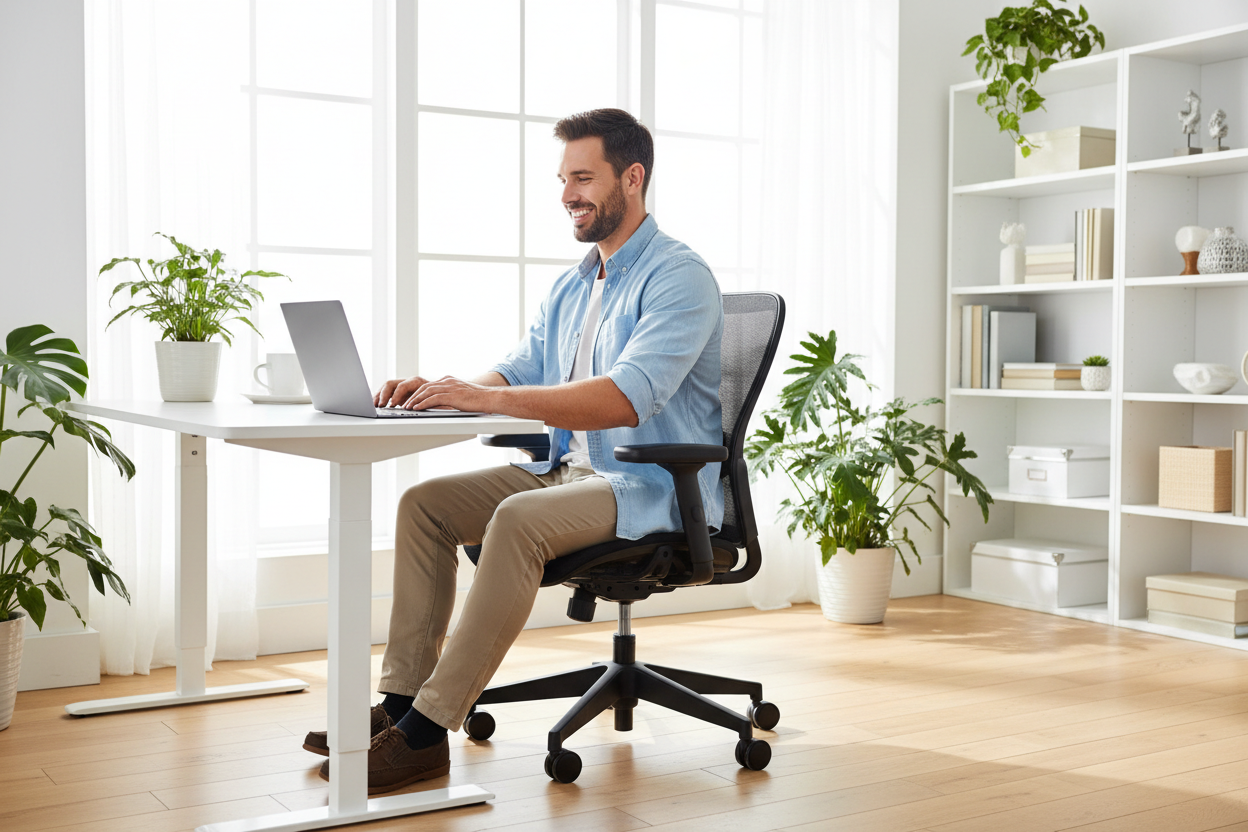
It's July. Your AC is doing its best. But somehow, two hours into your workday, you're already shifting in your seat, peeling your shirt off the backrest, and losing the thread of whatever you were supposed to be focused on. Sound familiar?
Here's the thing most people don't realize: your chair might be the problem — not the weather.
The material your office chair is made from has a direct, measurable impact on your body temperature, your comfort, and ultimately, your ability to get things done. And in the middle of a summer heatwave, that difference between mesh and leather isn't just about comfort. It's about whether you can actually work.
This guide breaks down the real science behind sitting in the heat, why breathable mesh chairs are the clear winner for summer home office setups, and exactly what to look for when you're shopping for a chair that won't turn your workday into a sauna session.
The Thermal Trap: What Actually Happens When You Sit in a Leather Chair in Summer
Let's start with the basics. When you sit down, your body is constantly generating heat — roughly 80 watts at rest, more when you're mentally engaged. That heat needs somewhere to go. In a well-designed chair, it dissipates through airflow around your back, seat, and thighs. In a poorly designed one, it gets trapped.
Leather — and its cheaper cousin, PU (polyurethane) faux leather — is essentially a non-porous surface. It doesn't breathe. When you sit on it, you're creating a sealed contact zone between your body and the chair. Your skin can't release moisture effectively. Heat builds up at the contact points: your lower back, your thighs, the backs of your knees.

Within 20–30 minutes on a warm day, you'll notice:
- A warm, clammy feeling across your lower back and seat
- Visible sweat marks on the chair surface
- Increased fidgeting and repositioning as your body tries to find relief
- The beginning of what dermatologists call miliaria — heat rash — in areas of prolonged skin contact
Heat rash isn't just uncomfortable. It's a sign that your sweat glands are blocked and your body's cooling system is being overridden. For people who sit 6–10 hours a day, this is a real occupational health concern, not just a minor annoyance.
The physics here are straightforward: leather has a thermal conductivity that causes it to absorb and retain heat rather than allow it to pass through. Mesh, by contrast, is an open-weave structure that allows convective airflow — meaning heat and moisture move through the material rather than accumulating at the surface.
The Productivity Cost of Sitting Hot: It's More Than You Think
Here's where it gets interesting — and a little alarming if you work from home and care about your output.
Thermal discomfort doesn't just make you feel bad. It actively degrades your cognitive performance. Research from the Lawrence Berkeley National Laboratory found that worker productivity peaks at around 71–72°F (22°C) and drops measurably as temperatures rise. At 77°F (25°C), productivity falls by roughly 2%. By 86°F (30°C), you're looking at a 9% drop. And that's ambient temperature — not accounting for the microclimate your leather chair is creating right against your body.
A widely cited study found that thermal discomfort in office environments correlates with approximately a 13% reduction in work efficiency. That's not a rounding error. If you're billing by the hour or trying to hit a deadline, that's nearly an hour of lost productive work in an eight-hour day.
The mechanism is well understood. When your body is thermally stressed, your autonomic nervous system kicks in — increasing heart rate, redirecting blood flow to the skin for cooling, and triggering the release of stress hormones like cortisol. Your prefrontal cortex — the part of your brain responsible for focus, decision-making, and complex problem-solving — gets less blood flow and less cognitive bandwidth.
The result? You feel irritable. You lose your train of thought more easily. Tasks that normally take 20 minutes stretch to 35. You make more errors. You take more breaks. And you probably don't connect any of it to the fact that your chair is slowly cooking you from behind.
The fix isn't always cranking the AC lower (though that helps). Sometimes it's as simple as sitting in a chair that doesn't trap heat in the first place.
Why High-Tenacity Mesh Is the Engineering Answer to Summer Sitting
Not all mesh is created equal. This is worth saying clearly, because there's a lot of cheap mesh on the market that sags, tears, or provides uneven support within a year of regular use.
Industrial-grade, high-tenacity mesh — the kind used in serious ergonomic chairs — is a different material entirely. Here's what sets it apart:
Open-Weave Airflow Architecture
High-quality mesh is engineered with a specific weave density that balances structural support with airflow. The gaps in the weave allow air to circulate continuously across your back and seat. As you shift position — even slightly — you're essentially pumping fresh air through the mesh. This passive ventilation keeps the contact zone between your body and the chair significantly cooler than any solid-surface material.
Moisture Wicking Without Absorption
Unlike foam padding covered in fabric, mesh doesn't absorb sweat. Moisture passes through the weave and evaporates. This is critical for long sitting sessions — you're not sitting in accumulated moisture, which means less skin irritation and a more consistent comfort level throughout the day.
Tensioned Support That Distributes Pressure
High-tenacity mesh is tensioned across a rigid frame, which means it distributes your body weight across a larger surface area than a foam seat. This reduces pressure points — particularly under the thighs and at the ischial tuberosities (your sit bones). Less pressure means better circulation, which also contributes to thermal regulation.
Durability Under Daily Load
The "high-tenacity" designation refers to the tensile strength of the mesh fibers. Cheap mesh stretches and deforms under body weight over time, losing its support properties. High-tenacity mesh maintains its tension and shape through years of daily use — which matters when you're investing in a chair you'll sit in for 2,000+ hours a year.
Meet the Chairs Built for Summer: Rackora's Mesh Lineup
Ergonomic High Back Mesh Chair with 3D Armrests — $459

This is the chair for people who take their home office seriously. The full high-back mesh design means airflow from your lumbar region all the way up to your shoulder blades — no foam panels, no leather inserts, no heat traps. The 3D armrests adjust in four directions (height, width, depth, and angle), so you can dial in a position that keeps your shoulders relaxed without compromising your posture.

The adjustable headrest supports your cervical spine during reclined work sessions, and the lumbar support system is independently adjustable — you can position it exactly where your lumbar curve needs it, rather than accepting a one-size-fits-all pad. Rated to 300 lbs, with a reclining function that lets you decompress during breaks without leaving your desk.

Shop the High Back Mesh Chair — $459 →
L2 Ergonomic Office Chair with Footrest and 135° Recline — $429

The L2 is built for people who work long hours and need their chair to do more than just support their back. The integrated footrest is a game-changer for summer: elevating your legs improves circulation, reduces the heat buildup under your thighs, and takes pressure off your lower back simultaneously. The 135° recline lets you shift into a more relaxed position during calls or reading sessions — reducing the static load on your spine and giving your back muscles a genuine break.

The mesh back keeps airflow consistent regardless of your recline angle, and the adjustable lumbar support travels with you as you shift positions. If you're someone who tends to sit for 6+ hours without thinking about it, the L2's combination of footrest, recline, and breathable mesh makes it one of the most complete summer work chairs available at this price point.

Shop the L2 Ergonomic Chair — $429 →
Also Worth Considering
Ergonomic High Back Mesh Chair with Lumbar Support and Footrest — $241

A strong entry-level option if you want full mesh breathability and a footrest without the premium price tag. Solid lumbar support, high back coverage, and the same open-weave airflow principles — at a price point that's hard to argue with.
High Back Mesh Office Chair with Adjustable Armrests — $340

A mid-range mesh chair with adjustable armrests and high back support. Good for people who want more adjustability than a basic chair without jumping to the premium tier.
The Ergonomics of Staying Cool: Seat Depth, Lumbar Support, and the S-Curve
Buying a mesh chair is step one. Setting it up correctly is step two — and most people skip it entirely.
Here's the thing: even the best mesh chair will cause discomfort if it's adjusted wrong. And poor adjustment doesn't just hurt your back — it creates pressure points that restrict circulation and trap heat. Let's walk through the key adjustments that matter most in summer.
Seat Depth: The Overlooked Setting
Seat depth is the distance from the front edge of the seat to the backrest. Most people never touch this setting. They should.
The correct seat depth leaves 2–3 fingers of space between the front edge of the seat and the back of your knees. If the seat is too deep, it presses into the back of your thighs, compressing the popliteal artery and restricting blood flow to your lower legs. This creates a warm, heavy feeling in your legs — and in summer, it accelerates heat buildup under your thighs significantly.
Adjust your seat depth so your thighs are fully supported without any pressure at the knee crease. This single adjustment can meaningfully reduce the heat you feel in your legs during long sitting sessions.
Lumbar Support: Position It, Don't Just Have It
Your lumbar spine has a natural inward curve — the lordotic curve. When you sit without support, this curve tends to flatten or reverse, causing your pelvis to tilt backward and your upper back to round forward. This is the classic "slouch," and it's both a posture problem and a heat problem.
When you slouch, you increase the contact area between your back and the chair. More contact means less airflow, which means more heat. Proper lumbar support keeps your spine in its natural S-curve, which naturally reduces the surface area of your back that's in contact with the chair — allowing more air to circulate.
Position your lumbar support so it sits in the curve of your lower back, roughly at belt level. You should feel gentle, consistent pressure — not a hard poke, not nothing. If your chair has height-adjustable lumbar support (like both Rackora chairs above), take the time to dial it in. It makes a bigger difference than most people expect.
Seat Height and Hip Angle
Your hips should be at or slightly above knee level, with your feet flat on the floor (or on a footrest). This position opens the hip angle to around 100–110°, which reduces compression on the lumbar discs and keeps your pelvis in a neutral tilt.
A neutral pelvis also means your lower back maintains its natural curve without muscular effort — which means less muscle tension, less fatigue, and less heat generated by your postural muscles working overtime.
Armrest Height: Shoulders Down, Elbows Supported
Your armrests should support your forearms with your shoulders in a relaxed, neutral position — not shrugged up, not dropped down. When your shoulders are elevated (because armrests are too high) or unsupported (because they're too low), your upper trapezius muscles engage continuously. This generates heat in your upper back and neck — exactly where you don't want it in summer.
The 3D armrests on the Rackora High Back Mesh Chair are particularly useful here because you can adjust not just height but also the inward/outward angle and forward/backward position — letting you find a truly neutral shoulder position regardless of your desk setup.
Leather vs. Mesh: A Direct Comparison for Summer Use
| Feature | Leather / PU Leather | High-Tenacity Mesh |
|---|---|---|
| Airflow | None — sealed surface | Continuous passive ventilation |
| Moisture handling | Traps sweat at surface | Wicks and evaporates |
| Heat buildup | Significant within 20–30 min | Minimal — heat dissipates continuously |
| Skin comfort (summer) | Clammy, sticky, heat rash risk | Dry, consistent, comfortable |
| Pressure distribution | Foam-dependent, can compress | Tensioned across full surface |
| Durability | PU cracks within 2–3 years | High-tenacity mesh holds shape for years |
| Cleaning | Wipe-clean but shows wear | Spot clean, odor-resistant |
| Winter comfort | Warmer (can be a plus) | Cooler (layer up if needed) |
The one honest caveat: leather chairs are warmer in winter, which some people prefer. If you live somewhere with genuinely cold winters and work in an unheated space, a leather chair might feel more comfortable from November through February. But for the 6–8 months of the year when temperatures are moderate to hot — and especially during July and August heatwaves — mesh wins decisively on every thermal metric.
Practical Summer Home Office Tips to Pair With Your Mesh Chair
Your chair is the foundation, but it's not the whole picture. Here are a few additional strategies that work well alongside a breathable mesh chair:
1. Position Your Desk Away From Direct Sunlight
Direct sun through a window can raise the temperature at your workstation by 10–15°F compared to the ambient room temperature. If you can't move your desk, use blackout or solar-filtering blinds during peak sun hours (typically 10am–3pm). A mesh chair won't help much if you're sitting in a sunbeam.
2. Use a Small Desk Fan for Directed Airflow
A small USB or desktop fan positioned to blow across your torso — not directly at your face — can significantly enhance the cooling effect of a mesh chair. The mesh allows the airflow to pass through the backrest, creating a genuine cross-ventilation effect. This is something you simply can't replicate with a solid-back chair.
3. Hydrate Proactively, Not Reactively
By the time you feel thirsty, you're already mildly dehydrated. Even mild dehydration (1–2% of body weight) measurably impairs cognitive performance — compounding the productivity losses from thermal discomfort. Keep a water bottle at your desk and aim for 8–10 oz every hour during summer work sessions.
4. Take Micro-Movement Breaks Every 45–60 Minutes
Standing up and moving for 2–3 minutes every hour does two things: it resets your postural muscles (reducing fatigue and heat buildup from sustained muscle tension) and it allows your chair to ventilate fully before you sit back down. The L2's footrest makes it easy to shift positions without fully standing — useful for calls or focused work sessions where you don't want to break your flow.
5. Consider a Breathable Seat Cushion for Transition Periods
If you're not ready to replace your chair yet, a gel or mesh seat cushion can provide some thermal relief at the seat pan — the area with the most sustained body contact. It's not a complete solution, but it's a meaningful improvement over a solid foam seat in summer conditions.
Who Should Buy a Mesh Chair Right Now

You're a strong candidate for upgrading to a mesh chair this summer if:
- You work from home 4+ hours a day and your current chair has a leather or PU leather back or seat
- You've noticed yourself sweating, fidgeting, or feeling uncomfortable within the first hour of sitting
- Your home office doesn't have great AC, or you're trying to keep energy costs down by running it less
- You've experienced heat rash, skin irritation, or persistent lower back discomfort during summer months
- You've noticed your focus and output declining in the afternoon, when ambient temperatures peak
If any of those describe you, the ROI on a quality mesh chair is straightforward. At $429–$459, the Rackora mesh chairs cost less than a month of lost productivity at most professional hourly rates. And unlike a temporary fix like a fan or a cooling towel, a good chair solves the problem at the source — every day, for years.
Shop the High Back Mesh Chair — $459 →
Shop the L2 Ergonomic Chair — $429 →
Frequently Asked Questions
Q: Are mesh chairs actually cooler than leather chairs, or is it just marketing?
It's not marketing — it's physics. Leather and PU leather are non-porous materials that trap heat and moisture at the contact surface. Mesh is an open-weave structure that allows continuous airflow through the backrest and seat. The temperature difference at the skin-chair interface can be 5–10°F in warm conditions. That's a real, measurable difference that you'll feel within the first 30 minutes of sitting.
Q: Will a mesh chair feel uncomfortable in winter?
Mesh chairs are cooler than leather chairs, but they're not cold. In a normally heated indoor environment, most people find mesh chairs perfectly comfortable year-round. If you work in a very cold space or run your heat low, you might want to layer up or use a light blanket across your lap in winter — but for the vast majority of home office setups, this isn't an issue.
Q: What's the difference between cheap mesh and high-tenacity mesh?
Cheap mesh uses lower-grade fibers that stretch and deform under body weight over time. Within 12–18 months of daily use, you'll notice the mesh sagging, losing its tension, and providing uneven support. High-tenacity mesh uses stronger fibers tensioned across a rigid frame — it maintains its shape and support properties through years of daily use. The difference is significant for long-term comfort and durability.
Q: How do I know if my current chair is causing my back pain?
A few signs: your back pain is worse after sitting than after other activities; you feel relief when you stand up or walk around; the pain is concentrated in your lower back or between your shoulder blades; and it tends to worsen as the day goes on. If your chair doesn't have adjustable lumbar support, or if the lumbar support isn't positioned correctly for your body, it's very likely contributing to your discomfort.
Q: What's the correct way to adjust lumbar support?
Sit all the way back in your chair so your back is fully in contact with the backrest. The lumbar support should sit in the natural inward curve of your lower back — roughly at belt level, or about 6–10 inches above the seat. You should feel gentle, consistent pressure that encourages your lower back to maintain its natural curve. If it's poking you or creating a sharp pressure point, it's too high or too firm. If you feel nothing, it's too low or not extended far enough.
Q: Can I use a mesh chair if I weigh over 250 lbs?
Yes — the Rackora High Back Mesh Chair with 3D Armrests is rated to 300 lbs. The high-tenacity mesh and reinforced frame are designed to support larger body weights without sagging or deforming. Always check the weight capacity rating before purchasing any chair, and look for chairs that specify their capacity rather than using vague terms like "heavy duty."
Q: How long does a quality mesh chair last?
A well-made mesh chair with high-tenacity mesh and a quality frame should last 7–10 years with regular use. The mesh itself is typically more durable than foam padding, which compresses and loses its support properties over time. The main wear points on mesh chairs are the adjustment mechanisms — look for chairs with metal adjustment components rather than all-plastic mechanisms.
Q: Is it worth spending $400+ on an office chair?
If you sit for 6–8 hours a day, five days a week, you're spending roughly 1,500–2,000 hours a year in your chair. At $429–$459 amortized over 7 years, that's about $60–$65 per year, or roughly $0.03–$0.04 per hour of use. The productivity gains from eliminating thermal discomfort alone — estimated at 13% efficiency improvement — far exceed that cost for most knowledge workers. It's one of the highest-ROI investments you can make in your home office.
Q: Do mesh chairs require any special maintenance?
Mesh chairs are actually lower maintenance than leather chairs. The mesh can be spot-cleaned with a damp cloth and mild soap. Unlike leather or PU leather, mesh doesn't crack, peel, or require conditioning. Periodically check and tighten any bolts or adjustment mechanisms, and lubricate the gas cylinder and caster wheels annually if they start to feel stiff or squeaky.
Q: What's the return policy if the chair doesn't work for me?
Check the product page for current return policy details. Generally, we recommend giving any new ergonomic chair at least 2 weeks of daily use before making a final judgment — your body needs time to adjust to a new sitting position, especially if you're coming from a chair with different support characteristics. Initial discomfort in the first few days is normal and usually resolves as your posture adapts.
The Bottom Line
Summer heat is going to happen whether you're ready for it or not. The question is whether your chair is working with your body or against it.
Leather and PU leather chairs trap heat, block moisture, and create a microclimate at your back and seat that compounds the discomfort of warm weather. High-tenacity mesh chairs do the opposite — they allow continuous airflow, wick moisture, and distribute pressure in a way that keeps you cooler and more comfortable through long work sessions.
The productivity research is clear: thermal discomfort costs you roughly 13% of your working efficiency. For a home office worker putting in 8-hour days, that's nearly an hour of lost output every single day. A quality mesh chair doesn't just feel better — it pays for itself in recovered productivity faster than most people expect.
If you're ready to stop sweating through your workday, the Rackora High Back Mesh Chair ($459) and the L2 Ergonomic Chair ($429) are both built for exactly this problem. Full mesh construction, adjustable lumbar support, and the ergonomic features you need to stay comfortable and focused — even when July is doing its worst.
Shop High Back Mesh Chair — $459 → Shop L2 Ergonomic Chair — $429 →
