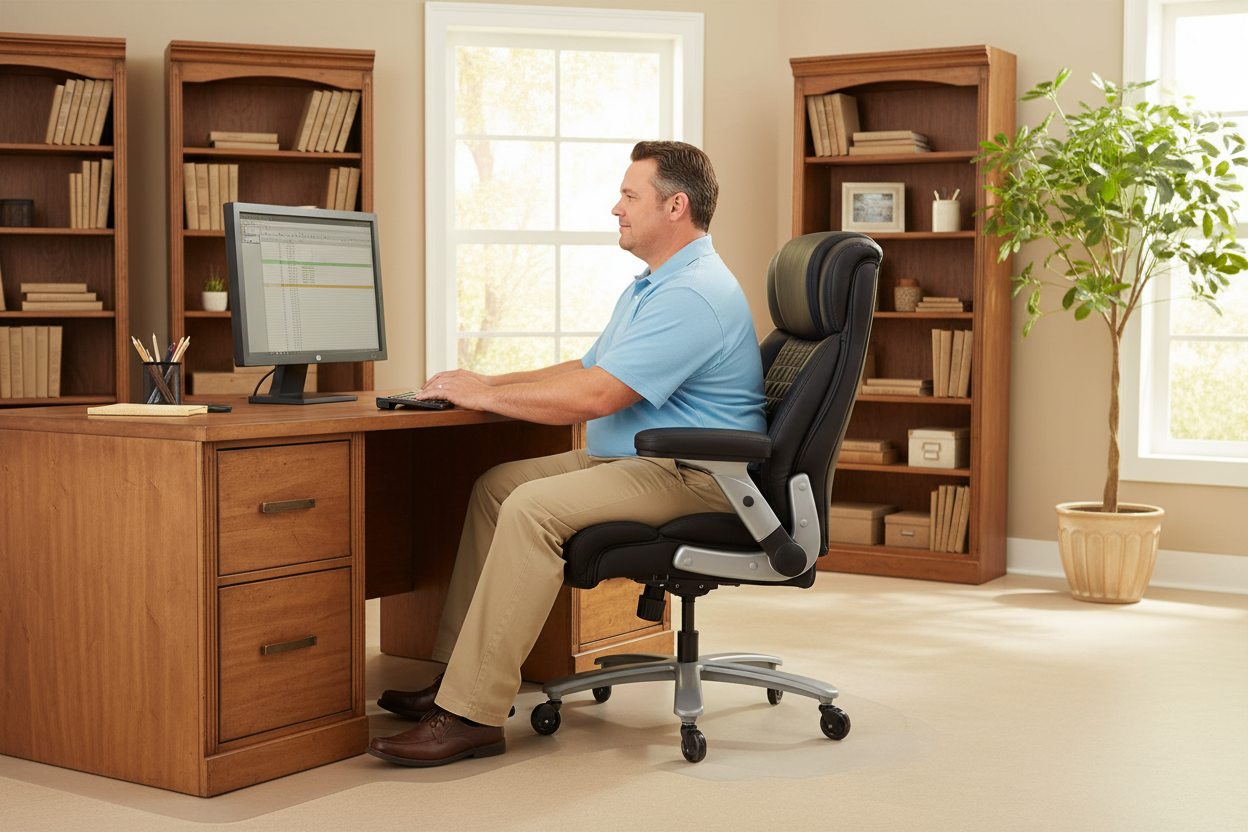
Let's Be Honest: Most Office Chairs Weren't Built for You
If you're a bigger person — whether that means you're carrying extra weight, you're 6'3" with long legs, or both — you already know the frustration. You sit down in a "standard" office chair and within an hour, you're shifting around trying to find a comfortable position. The seat is too narrow. The armrests dig into your hips. The lumbar support hits you in the wrong spot. And by mid-afternoon, you're sweating through your shirt because the chair traps heat like a greenhouse.
This isn't a comfort issue. It's an engineering issue. Standard office chairs are designed for a 250lb average, and when you exceed that — or even approach it — the structural and ergonomic assumptions built into those chairs start to break down. The gas lift compresses unevenly. The foam cushion bottoms out. The backrest loses its angle. And you're left sitting in something that's actively working against your body instead of supporting it.
The good news? The ergonomic chair market has finally started catching up. In 2026, there are chairs genuinely engineered for big and tall users — chairs with 500lb weight capacities, extra-wide seats, reinforced bases, and breathable mesh that actually keeps you cool. This guide is going to walk you through everything you need to know to find the right one.
We'll cover the real physiological challenges heavy users face, the engineering specs that actually matter (and the ones that are just marketing), and why mesh — not thick foam, not leather — is the material you want if you're sitting through a hot summer workday.
And yes, we'll show you exactly which chair we recommend and why.
The Real Problem: Heat, Pressure, and Structural Failure
Why Heavy Users Run Hotter
Here's something that doesn't get talked about enough: body mass and heat retention are directly related. Larger bodies generate more metabolic heat, and when you're sitting in a chair that presses a solid foam-and-leather surface against your back and thighs for hours at a time, that heat has nowhere to go.
Standard chairs — especially executive-style leather chairs — create a sealed contact surface. Your back presses against the leather, air can't circulate, and you start sweating within 20-30 minutes. For a 150lb person, this is mildly uncomfortable. For someone at 300, 400, or 500lbs, the contact surface area is larger, the pressure is greater, and the heat buildup is significantly worse.
This isn't just about comfort. Prolonged heat and moisture at the contact points between your body and the chair can cause skin irritation, increase fatigue, and make it genuinely harder to focus. If you've ever found yourself getting up every 45 minutes just to cool down, this is why.

The Structural Collapse Problem
Beyond heat, there's the structural issue. Most office chairs are rated for 250-300lbs. When you consistently sit at or above that rating, several things happen over time:
- The gas lift cylinder compresses unevenly and eventually fails to hold height
- The seat foam compresses permanently (called "foam fatigue") and loses its cushioning
- The chair base — typically a five-star plastic base — develops micro-fractures and can crack suddenly
- The backrest loses its recline tension and starts flopping backward
None of these failures happen dramatically on day one. They happen gradually, over weeks and months, until one day you realize your chair is sitting 2 inches lower than it used to, your back hurts more than it did when you bought it, and the armrests are wobbling. At that point, you've already been sitting in a compromised chair for months.
The solution isn't to buy a more expensive version of the same chair. It's to buy a chair that was actually engineered for your weight from the ground up.
What "Heavy Duty" Actually Means in Engineering Terms
The phrase "heavy duty" gets thrown around a lot in product listings. Here's what it actually needs to mean in practice if you're a big or tall user.
SGS-Certified Class-4 Gas Lift
The gas lift cylinder is the hydraulic component that lets you adjust your seat height. In a standard chair, this is a Class-3 cylinder rated for around 250-300lbs. In a genuinely heavy-duty chair, you need a Class-4 cylinder — and ideally one that's been SGS-certified.
SGS is an independent testing and certification organization. When a gas lift carries SGS certification, it means it's been independently tested for load capacity, cycle durability (how many times you can adjust it before it fails), and safety. It's not a manufacturer's self-reported spec — it's a third-party verification.
Why does this matter? Because a gas lift failure isn't just inconvenient — it can be sudden and dangerous. A certified Class-4 lift gives you confidence that the component has been tested to handle real-world loads at the weight capacity advertised.
Our Heavy Duty Office Chair 500lbs uses an SGS-certified 4-level gas lift — one of the few chairs in this price range that can make that claim with documentation behind it.
The 30.4-Inch Wide Base: Why Width Matters More Than You Think
Seat width is one of the most overlooked specs in office chair shopping. Standard chairs have seats that are 18-20 inches wide. For a larger person, that means your hips are either compressed against the armrests or hanging over the edge of the seat — both of which create pressure points that cause pain and restrict circulation.
A 30.4-inch wide seat changes the geometry entirely. Your weight distributes across a larger surface area, which reduces peak pressure at any single point. You're not being squeezed. You're not perching on the edge. You're actually sitting in the chair the way it was designed to be used.
The base footprint matters too. A wider seat needs a wider base to remain stable. A narrow five-star base under a wide seat creates a top-heavy chair that's prone to tipping — especially when you lean to reach something or shift your weight. A reinforced iron base with an appropriate footprint keeps the chair stable regardless of how you're sitting.
Flip-Up Armrests: A Feature That's Actually Functional
This one sounds minor but makes a real difference in daily use. Fixed armrests on a wide chair can make it awkward to get in and out — especially if you're working at a desk where you need to pull the chair close. Flip-up armrests let you raise them out of the way when you're sitting down or standing up, then lower them into position once you're seated.
For bigger users, this isn't a luxury feature. It's a practical necessity that makes the chair usable in real office environments.
The Mesh vs. Foam vs. Leather Debate (And Why Mesh Wins in Summer)
This is where a lot of people get tripped up, because there's a persistent myth in the heavy-duty chair market: that only thick foam or leather can support heavy weights. Let's break that down.
The Foam Argument
High-density foam does provide good initial support. The problem is foam fatigue. Under continuous pressure — especially at higher weights — foam compresses over time and doesn't fully recover. A foam seat that feels great on day one will feel noticeably flatter after six months of daily use at 400lbs. After a year, you're essentially sitting on a compressed block that's lost most of its cushioning properties.
High-density foam is better than standard foam, but it's not immune to this problem. It just takes longer.
The Leather Argument
Leather (and PU leather) looks premium and is easy to clean. But from a thermal perspective, it's one of the worst materials you can sit on for extended periods. Leather doesn't breathe. It creates a sealed surface that traps heat and moisture. For heavy users who already run warmer, a leather chair in summer is genuinely uncomfortable — and that discomfort compounds over an 8-hour workday.
There's also the durability question. PU leather — which is what most "leather" office chairs actually use — tends to crack and peel after 2-3 years of heavy use. The cracking usually starts at the seat edges and the backrest where the material flexes most.
Why High-Tensile Mesh Is the Right Answer
Modern high-tensile mesh fabrics are a different animal from the cheap mesh you might have seen on budget chairs. The key properties:
- Tensile strength: High-quality mesh is woven from materials that resist stretching and deformation under load. Unlike foam, it doesn't compress permanently — it flexes and returns to its original shape.
- Air circulation: Mesh allows air to flow through the backrest continuously. Your back isn't pressed against a sealed surface — it's supported by a breathable structure that lets heat escape.
- Weight distribution: A properly tensioned mesh backrest distributes pressure across the entire contact surface rather than concentrating it at specific points. This reduces the hot spots and pressure points that cause discomfort during long sessions.
- Durability: High-tensile mesh doesn't crack, peel, or develop the kind of surface degradation that PU leather does. It maintains its structural properties over years of use.
For heavy users specifically, the combination of breathability and structural resilience makes mesh the clear winner — especially in summer when heat retention is at its worst.
Meet the Chair: Heavy Duty Office Chair 500lbs

Let's get specific. Here's what you're actually getting with the Heavy Duty Office Chair 500lbs - Big and Tall Ergonomic Executive Chair — currently priced at $520.00 (with $129 in savings off the original retail price).
The Specs That Matter
- Weight Capacity: 500 lbs — genuinely rated, not aspirationally listed
- Seat Width: 30.4 inches — extra-wide for real comfort at larger sizes
- Overall Dimensions: 30.4"W × 30.4"D × 48.8"H
- Chair Weight: 50.6 lbs — substantial construction, not a lightweight frame
- Gas Lift: SGS-certified Class-4 — independently tested for load and durability
- Base: Reinforced iron — not plastic, not composite, iron
- Recline Range: 90° to 120° with rocking function
- Armrests: Flip-up design for easy entry and exit
- Wheels: Quiet-glide rubber — floor-safe and smooth on hard floors and carpet

The Lumbar Support System
This is worth its own section because lumbar support is where a lot of heavy-duty chairs cut corners. The common failure mode: a lumbar pad that's positioned for an average-sized person, made from foam that flattens under sustained pressure, and fixed in place so you can't adjust it to your actual spine.
The lumbar system on this chair is adjustable — you can position it to hit your lower back where you actually need support, not where the manufacturer assumed you'd need it. The backrest itself reclines from 90° to 120°, which means you can shift between an upright working position and a more relaxed reclined position without losing lumbar contact.
Critically, the support structure is designed to maintain its position and resilience under continuous 500lb pressure. It doesn't flatten out over the course of a workday. It doesn't lose its angle. It stays where you set it.
The Waterfall Seat Edge
One detail that's easy to overlook: the waterfall seat edge design. A standard seat has a flat or slightly curved front edge that presses directly into the back of your thighs when you sit. Over hours, this creates pressure on the femoral artery and can cause numbness, tingling, and circulation issues — more pronounced in larger users because the weight pressing down on that edge is greater.
A waterfall edge curves downward at the front of the seat, reducing that pressure point and promoting better circulation in your legs. It's a small design detail that makes a significant difference over an 8-hour workday.
→ Get the Heavy Duty 500lbs Chair — $520.00
The Lumbar Support Deep Dive: Why "Adjustable" Isn't Enough
We need to spend more time on lumbar support because it's the most misunderstood feature in ergonomic chair marketing. Every chair claims to have lumbar support. Very few chairs have lumbar support that actually works for heavy users over extended periods.
The Problem With Static Lumbar Pads
A static lumbar pad — the kind that's just a fixed foam bump on the backrest — has two problems. First, it's positioned for an average body, which means it probably hits you in the wrong spot. Second, it's made from foam, which means it compresses under sustained pressure and loses its effectiveness over the course of a day.
For a 150lb person sitting for 4 hours, a static lumbar pad might be fine. For a 400lb person sitting for 8 hours, that same pad will be compressed flat by mid-morning and providing essentially no support by afternoon.
What Dynamic Lumbar Support Actually Does
Dynamic lumbar support means the support system responds to your movement rather than staying fixed in one position. When you lean forward to type, the lumbar support maintains contact with your lower back. When you recline, it adjusts to keep supporting the curve of your spine. When you shift your weight, it moves with you.
This matters enormously for heavy users because larger bodies tend to shift position more frequently — partly to manage discomfort, partly because the physics of sitting at higher weights creates more pressure variation. A lumbar system that only works when you're sitting perfectly still isn't actually doing its job.
Resilience Under Continuous Pressure
The other critical factor is material resilience. The lumbar support needs to maintain its structural properties under continuous 500lb pressure — not just when you first sit down, but at hour 6 and hour 8 of a workday. This is where foam-based lumbar systems consistently fail heavy users, and why the structural design of the backrest matters as much as the lumbar component itself.

Summer-Specific Considerations: Staying Cool at Your Desk
Summer changes the ergonomic equation for heavy users in ways that don't get enough attention. When ambient temperatures rise, your body is already working harder to regulate its temperature. Add a chair that traps heat, and you're fighting a two-front battle: staying cool and staying comfortable.
The Air Circulation Math
Here's a simple way to think about it. A solid foam-and-leather backrest creates roughly 100% contact between your back and the chair surface. No air moves through that contact zone. Your body heat accumulates at the contact surface, and the only way it dissipates is through the edges — which is slow and inefficient.
A mesh backrest creates maybe 30-40% contact between your back and the chair structure (the frame and weave), with 60-70% open space for air to move through. Your body heat dissipates continuously through that open space. The difference in perceived temperature at the contact surface is significant — often 10-15°F cooler in practice.
For heavy users who already run warmer, that temperature difference is the difference between a productive afternoon and a miserable one.
Moisture Management
Heat retention also means moisture retention. When you sweat against a leather or foam surface, that moisture has nowhere to go. It accumulates at the contact surface, which is uncomfortable and can cause skin irritation over time. Mesh allows moisture to evaporate rather than accumulate — another reason it's the right material for summer use at any weight, but especially at higher weights where the contact pressure is greater.
How This Chair Compares to the Alternatives
Let's look at what else is available in the big-and-tall chair market and where this chair fits.
Budget Heavy-Duty Chairs ($150-$250)
In this range, you'll find chairs that claim 400-500lb capacities but use plastic bases, non-certified gas lifts, and standard foam cushioning. The weight capacity claim is often aspirational rather than tested. These chairs may hold up for a year or two of moderate use, but they're not built for daily heavy-duty use over the long term. The gas lift is usually the first thing to fail.
Mid-Range Heavy-Duty Chairs ($300-$500)
This is where you start finding chairs with genuine engineering behind the weight capacity claims. Reinforced bases, better gas lifts, wider seats. The tradeoff is usually in the lumbar system and the material quality — you might get a reinforced frame but still end up with a foam-and-leather seat that traps heat.
The $520 Sweet Spot
At $520 (with $129 in savings), the Heavy Duty Office Chair 500lbs sits at the intersection of genuine heavy-duty engineering and practical pricing. You're getting the SGS-certified gas lift, the reinforced iron base, the 30.4-inch wide seat, and the adjustable lumbar system — without paying $800+ for a premium brand name.
For most big and tall users, this is the range where you get everything you actually need without paying for features that don't matter to your use case.
→ Shop the Heavy Duty 500lbs Chair Now
Other Chairs Worth Considering
Depending on your specific needs, here are a few other options from our lineup that might be a better fit.
If You Want a Full Recline with Footrest

The Beige Big and Tall Executive Leather Office Chair with Footrest ($599.99) is designed for users who want a full reclining experience with an integrated footrest. If you're using your office chair for extended reading, video calls, or periods where you want to fully recline, this is worth a look. The high-back design provides full spinal support in the reclined position.
If You Want Pure Mesh Breathability at a Lower Weight Capacity

The High Back Mesh Office Chair with Adjustable Armrests ($340.00) is a strong option if you're under the 300lb range and prioritize maximum breathability. Full mesh construction front and back, adjustable armrests, and a high-back design that supports your entire spine. At $340, it's a solid value for users who don't need the 500lb capacity.
If You Want Inflatable Lumbar Customization

The Reclining Office Chair with Footrest — Inflatable Lumbar Support, 300lbs Capacity ($429.00) features an inflatable lumbar system that lets you dial in the exact amount of lower back support you want. If you have specific lumbar issues and need precise control over the support level, this is worth considering — though note the 300lb weight capacity.
Setting Up Your Chair for Maximum Ergonomic Benefit
Buying the right chair is step one. Setting it up correctly is step two — and a lot of people skip this part.
Seat Height
Your feet should be flat on the floor with your knees at approximately 90°. If your feet are dangling, the seat is too high. If your knees are above your hips, the seat is too low. For taller users, you'll typically want the seat at its maximum height; for shorter users, minimum height. The Class-4 gas lift on this chair gives you a meaningful range of adjustment to find the right position.
Lumbar Position
The lumbar support should sit in the curve of your lower back — typically around the L3-L5 vertebrae, which is roughly at belt level. Adjust the lumbar height until you feel it making contact with your lower back without pushing your spine forward. You want support, not pressure.
Armrest Height
Your arms should rest on the armrests with your shoulders relaxed — not shrugged up, not drooping down. If the armrests are too high, you'll hunch your shoulders. If they're too low, you'll lean to one side. With the flip-up design, you can also raise them completely out of the way if you prefer to work without armrest contact.
Recline Tension
The rocking function on this chair lets you recline from 90° to 120°. For active work (typing, writing), stay closer to 90-100°. For reading, video calls, or thinking time, recline further. The key is to use the recline — sitting rigidly upright for 8 hours is actually harder on your spine than varying your position throughout the day.

Assembly: What to Expect
At 50.6 lbs, this chair ships in a box and requires assembly. The good news: it's designed for straightforward setup. Most users complete assembly in 20-30 minutes with the included tools and instructions. The main steps are attaching the base to the cylinder, connecting the seat to the mechanism, and attaching the backrest.
A few practical tips:
- Assemble on carpet or a soft surface to avoid scratching the base or wheels
- Have a second person help when attaching the backrest — it's manageable solo but easier with help
- Don't fully tighten any bolts until all components are connected — this makes alignment easier
- Test the gas lift and recline before considering assembly complete
The Long-Term Investment Argument
$520 is a real number. We're not going to pretend it isn't. But here's the math worth doing before you decide.
The average budget office chair costs $150-$200 and lasts 1-2 years under heavy use before the gas lift fails, the foam bottoms out, or the base cracks. That's $75-$200 per year in chair costs — plus the time and hassle of replacing it.
A properly engineered heavy-duty chair at $520, maintained correctly, should last 5-7 years of daily use. That's $74-$104 per year — roughly the same or less than the budget option, with significantly better comfort and support throughout.
There's also the health cost to consider. Sitting in a chair that doesn't support your weight correctly contributes to back pain, poor circulation, and fatigue. Those aren't abstract concerns — they affect your productivity, your mood, and your long-term health. A chair that actually works for your body is an investment in your ability to work effectively, not just a furniture purchase.
→ Invest in the Right Chair — Shop Now
Frequently Asked Questions
Q: Is 500lbs really the actual weight limit, or is that a marketing number?
A: The 500lb capacity on this chair is backed by an SGS-certified Class-4 gas lift — meaning it's been independently tested, not just self-reported by the manufacturer. The reinforced iron base and structural design are also engineered for this load. That said, like any weight-rated product, the rating assumes normal use — sitting, adjusting, reclining — not standing on the chair or using it in ways it wasn't designed for.
Q: I'm 6'5". Will this chair fit me?
A: The chair's maximum height is 48.8 inches assembled, with the seat height adjustable via the gas lift. For very tall users, the key measurements to check are seat height range and backrest height. At 6'5", you'll want to confirm the seat height at maximum lift puts your knees at 90° with feet flat on the floor. The wide seat and high backrest are designed to accommodate taller frames, but we recommend measuring your seated height before purchasing if you're at the upper end of the height range.
Q: How does the chair hold up after 6-12 months of daily use at high weights?
A: The SGS-certified gas lift is rated for thousands of adjustment cycles, so height adjustment durability isn't a concern. The PU leather and high-density foam seat is the component most likely to show wear over time — foam compression is a normal characteristic of foam seating. The reinforced iron base and structural frame are designed for long-term durability at the rated weight capacity.
Q: Is the lumbar support adjustable for height?
A: Yes. The lumbar support is adjustable so you can position it to hit your lower back at the right height for your body. This is important for taller users especially, since a fixed lumbar pad designed for average height will typically hit too low on a 6'+ frame.
Q: Can I use this chair on hardwood floors without damaging them?
A: The chair uses quiet-glide rubber wheels that are designed to be floor-safe on hard surfaces including hardwood, tile, and laminate. If you're particularly concerned about floor protection, a chair mat is always a good additional measure — but the rubber wheels are significantly gentler on floors than standard hard plastic casters.
Q: How long does assembly take, and do I need special tools?
A: Most users complete assembly in 20-30 minutes. All necessary tools are included in the box, and the instructions are designed for straightforward setup. You don't need any tools beyond what's provided.
Q: What's the return policy if the chair doesn't work for me?
A: Please refer to our store's return policy page for current terms. We recommend reviewing the return window and conditions before purchasing, especially for large items like chairs where return shipping logistics can be a factor.
Q: Is this chair suitable for someone who is tall but not heavy — say, 6'4" at 220lbs?
A: Absolutely. The 500lb capacity is the maximum, not a minimum. The extra-wide seat and high backrest benefit tall users regardless of weight — you get more seat depth, more backrest coverage, and a more comfortable fit than a standard-sized chair. The chair works well for big users, tall users, and users who are both.
Q: How does this compare to chairs from brands like Herman Miller or Steelcase?
A: Herman Miller and Steelcase make excellent chairs, but their flagship models typically run $1,200-$2,000+. For that price, you get premium materials, extensive customization options, and long warranty coverage. The Heavy Duty 500lbs Chair at $520 doesn't match that level of material refinement, but it delivers the core engineering requirements — certified gas lift, reinforced base, wide seat, adjustable lumbar — at a fraction of the price. For most heavy users, the functional difference doesn't justify a 3-4x price premium.
Q: Does the chair come with a warranty?
A: Please check the product page for current warranty terms. Warranty coverage and duration can vary, and we recommend confirming the specific terms before purchasing.

If you're a bigger or taller person who spends serious time at a desk, you've probably been making do with chairs that weren't built for you. The result is familiar: discomfort that builds through the day, heat and sweat that makes afternoon sessions miserable, and chairs that start failing within a year or two of regular use.
The Heavy Duty Office Chair 500lbs is built differently. The SGS-certified gas lift, the reinforced iron base, the 30.4-inch wide seat, the adjustable lumbar system — these aren't marketing features. They're engineering decisions that make a real difference for users at the upper end of the weight range.
And in summer, when heat retention turns a mediocre chair into an actively unpleasant one, the breathable design of this chair matters more than ever.
At $520 with $129 in savings, it's a serious investment. But it's the kind of investment that pays off every single workday — in comfort, in focus, and in a chair that's still doing its job years from now.
