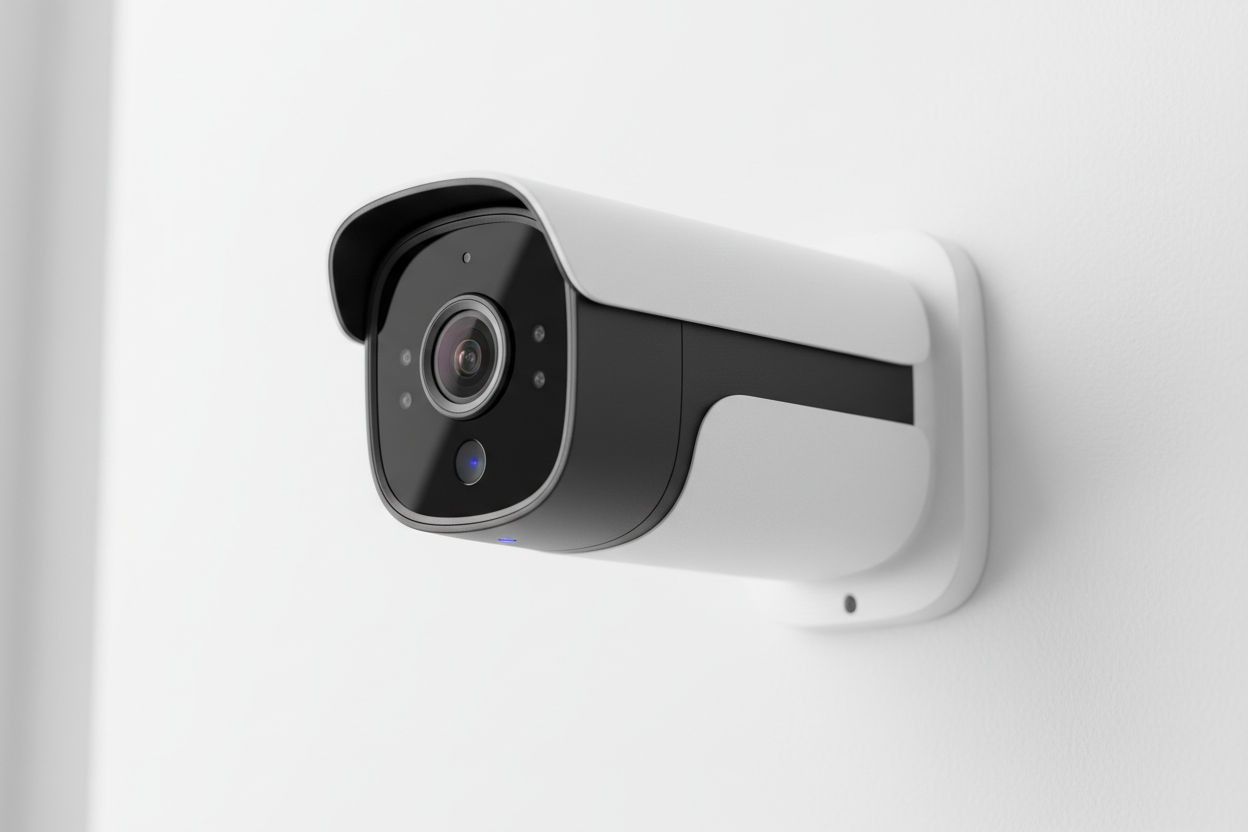
False alarms from security cameras waste time, drain resources, and create alert fatigue. Every homeowner knows the frustration of checking their phone only to find their camera triggered by a swaying tree branch, passing car headlights, or neighborhood cat. Traditional motion sensors can't tell the difference between genuine threats and harmless movement, leading to dozens of unnecessary notifications daily.
AI human detection technology changes this equation completely. By using advanced algorithms trained on millions of images, these cameras distinguish between humans and other moving objects with remarkable accuracy. The result? Up to 95% fewer false alarms, meaning you only get notified when it actually matters.
Understanding the False Alarm Problem
Traditional security cameras rely on basic motion detection that triggers whenever pixels change in the frame. This primitive approach creates serious problems for property owners. A study by the Security Industry Association found that false alarms account for 94-98% of all security system alerts, with the average homeowner receiving 15-20 false notifications per day.
The consequences extend beyond mere annoyance. Repeated false alarms lead to "alert fatigue" where users start ignoring notifications entirely, defeating the camera's purpose. Some municipalities even fine property owners for excessive false alarms from security systems, with penalties ranging from $50 to $500 per incident after the first few warnings.
Weather conditions amplify the problem significantly. Rain creates moving reflections, snow triggers motion sensors, and wind moves vegetation constantly. Insects flying near the camera lens, especially at night when attracted to infrared LEDs, generate countless false triggers. Shadows from passing clouds or vehicles create pixel changes that basic systems interpret as threats.
The financial impact adds up quickly. Cloud storage plans charge based on the number of recorded events, meaning false alarms directly increase monthly costs. Users waste hours reviewing irrelevant footage, and the constant notifications drain smartphone batteries faster. For businesses, security personnel spending time investigating false alarms represents a measurable productivity loss.
How AI Human Detection Works
AI human detection uses convolutional neural networks trained on massive datasets containing millions of labeled images. These networks learn to recognize the distinctive characteristics of human shapes, movements, and proportions regardless of clothing, posture, or environmental conditions.
The process happens in multiple stages. First, the camera's processor analyzes each frame for movement using traditional motion detection. When movement is detected, the AI algorithm examines the moving object's characteristics including height-to-width ratio, movement patterns, thermal signature, and edge detection profiles.
Advanced systems like the Triple-Lens Solar Security Camera ($199.00) use dedicated AI chips that process this analysis in real-time without cloud connectivity. The onboard processor compares detected objects against trained models, assigning confidence scores to each detection. Only when the confidence level exceeds the threshold (typically 85-95%) does the system trigger an alert.

The machine learning models continuously improve through exposure to diverse scenarios. They learn to recognize humans in various positions including standing, walking, running, crouching, and even crawling. The algorithms account for perspective distortion, partial occlusion, and varying lighting conditions from bright sunlight to complete darkness.
Modern AI detection systems also incorporate temporal analysis, examining how objects move across multiple frames. Humans exhibit characteristic movement patterns including gait, arm swing, and acceleration profiles that differ fundamentally from animals, vehicles, or wind-blown objects. This temporal dimension adds another layer of accuracy to the detection process.
Key Benefits of AI Human Detection
The primary advantage is dramatic false alarm reduction. Systems with AI human detection typically achieve 90-95% fewer false alerts compared to traditional motion sensors. This means instead of 20 notifications per day, you receive 1-2 genuine alerts about actual human presence on your property.
Battery life improves substantially when cameras aren't constantly recording false triggers. The 600W Solar CCTV Camera System ($699.00) demonstrates this advantage with its 15-day runtime on solar power alone, achieved partly through intelligent recording that activates only for verified human detection.

Storage efficiency increases proportionally to false alarm reduction. Recording only relevant events means your SD card or cloud storage lasts 10-20 times longer. A 128GB card that might fill up in 3-4 days with traditional motion detection can store 30-40 days of AI-filtered footage.
Response time improves when you're not overwhelmed by false alerts. Users who receive only genuine notifications respond faster and take threats more seriously. This psychological factor proves crucial during actual security incidents where every second counts.
Privacy protection benefits from AI detection as well. Systems can be configured to ignore certain zones or only record when humans enter specific areas, reducing unnecessary footage of family members in private spaces while maintaining security coverage of entry points and perimeters.
Shop AI Detection Cameras Now and experience the difference intelligent monitoring makes.
Choosing the Right AI Detection Camera
Resolution matters significantly for AI accuracy. Higher resolution provides more pixel data for the algorithm to analyze, improving detection reliability at longer distances. 4MP cameras can reliably detect humans at 30-40 feet, while 6MP models extend this range to 50-60 feet with maintained accuracy.
Processing power determines how quickly the camera analyzes footage and how sophisticated the AI algorithms can be. Dedicated AI chips outperform general-purpose processors, delivering faster detection with lower power consumption. Look for cameras specifically advertising AI processors or neural processing units rather than relying on software-only solutions.
Field of view affects coverage area and detection effectiveness. The WiFi/4G Solar Street Light Camera ($399.00) combines wide-angle coverage with PTZ capabilities, allowing comprehensive monitoring of large areas while maintaining detailed AI detection across the entire field of view.

Power source considerations impact placement flexibility and ongoing costs. Solar-powered cameras with AI detection offer the best combination of wire-free installation and sustainable operation. The solar panel charges the battery during the day while the AI processor ensures the battery isn't drained by false alarm recordings at night.
Connectivity options determine how you receive alerts and access footage. WiFi models work well for properties with strong wireless coverage, while 4G cameras provide reliable connectivity in remote locations or areas with WiFi dead zones. Dual WiFi/4G capability offers the best reliability with automatic failover.
Weather resistance is non-negotiable for outdoor installations. IP66 or IP67 ratings ensure the camera withstands rain, snow, dust, and temperature extremes without performance degradation. The AI processing components must function reliably across the full temperature range your location experiences.
Installation Best Practices
Camera height significantly impacts AI detection accuracy. Mount cameras 8-10 feet high for optimal human recognition. This height provides a good angle for the AI to analyze body proportions while remaining difficult for intruders to tamper with. Avoid mounting too high (above 12 feet) as steep downward angles make human detection less reliable.
Angle the camera slightly downward at 15-20 degrees from horizontal. This positioning captures faces and upper bodies clearly while maintaining good coverage of the ground level where humans walk. Extreme angles either upward or downward reduce AI accuracy by distorting the human silhouette.
Consider lighting conditions throughout the day and night. Position cameras to avoid direct sunlight or bright lights shining into the lens, which can create glare and reduce AI detection effectiveness. For night coverage, ensure the camera's infrared or color night vision illuminates the area adequately without creating harsh shadows.
Test the detection zone thoroughly after installation. Walk through the coverage area at different speeds and angles to verify the AI triggers consistently. Adjust sensitivity settings if you experience missed detections or occasional false alarms. Most systems allow fine-tuning the confidence threshold to match your specific environment.
Advanced Features to Consider
Auto-tracking capabilities allow PTZ cameras to follow detected humans automatically. When the AI identifies a person, the camera pans and tilts to keep them centered in the frame, capturing detailed footage of their movements and appearance. This feature proves invaluable for large properties where a single camera must cover extensive areas.
Two-way audio enables real-time communication with people in the camera's view. Combined with AI human detection, this feature lets you speak to delivery drivers, warn off potential intruders, or communicate with family members. The 600W Solar CCTV System includes high-quality two-way audio with noise cancellation for clear conversations.
Color night vision provides significantly more detail than traditional infrared. While IR cameras show only grayscale images, color night vision captures clothing colors, vehicle colors, and other identifying details that prove crucial for security purposes. Some systems use ambient light amplification while others employ white LED spotlights triggered by human detection.
Smart alerts with image previews show you what triggered the detection before you open the app. Instead of generic "motion detected" notifications, you receive a thumbnail image of the detected person, allowing instant assessment of whether the alert requires immediate attention.
Real-World Performance Scenarios
Residential driveways present unique challenges with vehicles, pets, and delivery drivers creating constant motion. AI human detection excels here by ignoring cars pulling in and out while alerting you to people approaching your door. Users report 85-90% reduction in driveway false alarms after upgrading to AI cameras.
Backyard monitoring involves trees, bushes, and wildlife that trigger traditional sensors constantly. AI systems distinguish between swaying branches and actual intruders, even in windy conditions. The technology recognizes humans partially obscured by vegetation, maintaining security without alert overload.
Front porch coverage requires detecting package deliveries, visitors, and potential porch pirates while ignoring passing pedestrians on public sidewalks. Properly configured AI cameras with detection zones accomplish this balance, alerting only when people enter your property rather than merely walking past.
Business entrances need reliable detection of customers and employees while filtering out vehicle traffic and weather effects. Commercial-grade AI cameras handle high-traffic scenarios by distinguishing between authorized personnel and potential security threats based on entry patterns and timing.
Upgrade Your Security with AI Detection and join thousands of satisfied customers who've eliminated false alarm frustration.
Cost-Benefit Analysis
Initial investment in AI detection cameras ranges from $150 for basic models to $700+ for advanced systems with solar power, PTZ, and premium features. While this exceeds traditional motion-sensor cameras by $50-200, the benefits justify the premium for most users.
Cloud storage savings accumulate monthly. Traditional cameras recording every motion event might require $15-30/month for adequate cloud storage, while AI-filtered cameras often operate effectively on free tiers or $5-10/month plans. Over a 3-year period, this saves $180-720 per camera.
Time savings prove harder to quantify but equally valuable. Eliminating 15-20 false notifications daily saves 10-15 minutes of checking your phone and reviewing footage. For business owners, this translates to measurable productivity gains for security personnel.
Battery and power costs decrease with AI detection. Solar cameras that might need battery replacement annually with constant recording can operate 3-5 years on the original battery when recording only AI-verified events. This saves $30-50 per year in battery costs or electricity for wired cameras.
Frequently Asked Questions
How accurate is AI human detection compared to traditional motion sensors?
AI human detection achieves 90-95% accuracy in distinguishing humans from other moving objects, compared to traditional motion sensors which trigger on any movement regardless of source. This translates to 10-20 times fewer false alarms in typical residential settings. The technology works by analyzing multiple characteristics including shape, size, movement patterns, and thermal signatures rather than simply detecting pixel changes.
Do AI detection cameras work in complete darkness?
Yes, AI human detection functions effectively in complete darkness when paired with infrared or color night vision. The AI algorithms analyze the illuminated image from IR LEDs or white light spotlights, detecting humans based on their shape and movement patterns regardless of ambient lighting. Some advanced cameras use thermal imaging combined with AI for detection in zero-light conditions without any visible illumination.
Can AI cameras distinguish between adults, children, and pets?
Most AI human detection systems are trained to recognize humans of all sizes including children, though some may have adjustable sensitivity for detecting smaller individuals. Pet detection requires separate AI models, and not all cameras include this capability. Advanced systems offer multiple detection modes allowing you to enable human-only detection, pet detection, or both simultaneously with different alert types.
How much internet bandwidth do AI cameras use?
AI cameras with local processing use significantly less bandwidth than cloud-based systems. Cameras that perform AI analysis on-device only upload verified human detection events, typically using 2-5GB monthly compared to 20-50GB for cameras uploading all motion events. Live viewing adds bandwidth based on resolution and duration, with 1080p streams using approximately 2-4 Mbps.
What happens if the internet connection fails?
Cameras with local AI processing and SD card storage continue recording and detecting humans during internet outages, storing footage locally for later review. You won't receive real-time alerts during the outage, but all events are recorded and available when connectivity restores. Some cameras buffer alerts and send them once internet returns.
How long do solar-powered AI cameras operate without sunlight?
Quality solar AI cameras include batteries sized for 10-15 days of operation without any solar charging, assuming normal detection activity. The Triple-Lens Solar Camera achieves 15-day runtime through efficient AI processing that only records verified human detections rather than constant motion events. Actual runtime varies based on detection frequency, night vision usage, and temperature.
Can I adjust the sensitivity of AI human detection?
Yes, most AI cameras offer adjustable sensitivity settings that control the confidence threshold required to trigger alerts. Higher sensitivity settings detect humans at greater distances or in challenging conditions but may increase false alarms slightly. Lower sensitivity reduces false alarms but might miss detections in some scenarios. Many systems also allow detection zone configuration.
Do AI cameras require subscription fees?
Camera functionality varies by manufacturer. Many AI cameras operate fully without subscriptions, performing all detection locally and storing footage on SD cards. Cloud storage and advanced features often require subscriptions ranging from $3-10 monthly per camera. The cameras featured here function completely without subscriptions, including AI detection, local recording, and mobile app access.
How do AI cameras handle multiple people in the frame?
Advanced AI detection systems identify and track multiple individuals simultaneously, generating separate alerts or tracking boxes for each detected person. This capability proves valuable for monitoring busy areas or detecting multiple intruders. The algorithms distinguish between individuals based on their positions and movement patterns, maintaining tracking even when people temporarily overlap.
What's the difference between AI detection and smart motion zones?
Smart motion zones let you define specific areas where motion triggers recording, but they still activate on any movement within those zones including animals, vehicles, and weather effects. AI human detection analyzes what caused the motion, triggering only when humans are detected regardless of where they appear in the frame. The technologies complement each other for the most precise control.
Conclusion
AI human detection transforms security cameras from frustrating false-alarm generators into reliable security tools that alert you only when it matters. The technology's ability to filter 90-95% of false alarms while maintaining comprehensive coverage makes it essential for modern security systems.
The investment in AI-enabled cameras pays dividends through reduced cloud storage costs, eliminated false alarm fines, improved battery life, and most importantly, peace of mind knowing you'll be alerted to genuine security concerns. Solar-powered options combine wire-free installation with intelligent detection for comprehensive property protection.
Whether securing a residential property, monitoring a business, or protecting remote locations, AI human detection cameras deliver the accuracy and reliability that traditional motion sensors cannot match. The technology continues advancing with regular firmware updates and improving algorithms, ensuring your investment remains effective for years to come.
Shop AI Detection Security Cameras today and experience security monitoring that works with you, not against you.
