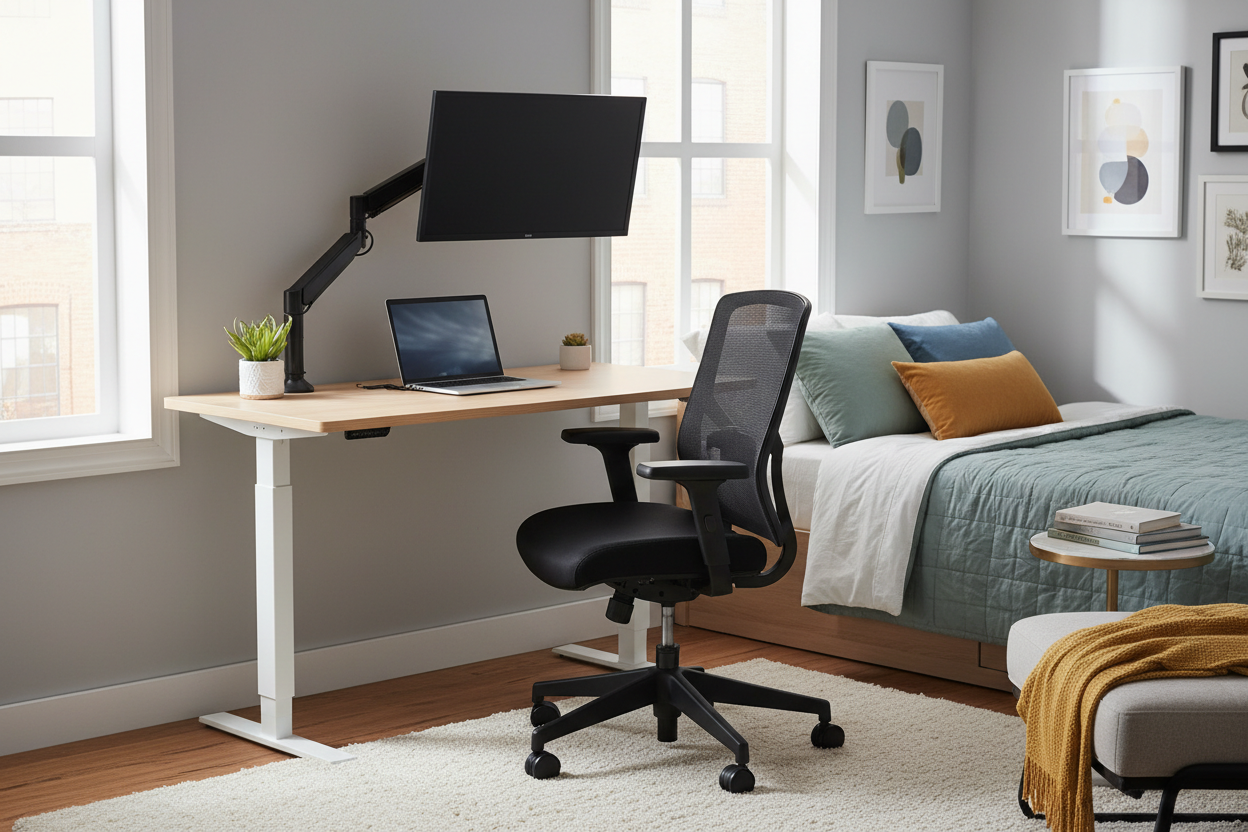
Working from home doesn't mean you need a spare room. Plenty of people are running full-fledged businesses, managing remote careers, and creating content from nothing more than a bedroom corner. The trick isn't about having more space—it's about using what you've got in a way that actually works.
If you've been staring at that awkward corner in your bedroom wondering how to turn it into a real workspace, you're in the right place. We're going to walk through exactly how to build a functional, comfortable studio office in a small footprint—without sacrificing your bedroom or your sanity.
Why Bedroom Corner Offices Actually Work
Let's be honest: not everyone has the luxury of a dedicated home office. But here's the thing—a corner setup can actually be better than a full room in some ways. You're forced to be intentional about what you bring in, which means less clutter and more focus. Plus, corners naturally create boundaries, giving you a psychological separation between work and rest even when they're in the same room.
The key is treating that corner like real workspace, not just a laptop on a nightstand. That means proper furniture, good lighting, and a setup that supports how you actually work—not how you think you should work.
Start With the Right Desk (Size Really Does Matter)
Your desk is the foundation of everything, and in a small space, you can't afford to get this wrong. Too big and it dominates the room. Too small and you're constantly fighting for elbow room.
For most bedroom corners, you're looking at somewhere between 27 to 48 inches wide. That's enough for a laptop or monitor, a notebook, and maybe a coffee cup without feeling cramped.

The Manual Height Adjustable Desk - 27.5" Compact Standing Desk ($229.00) is purpose-built for exactly this scenario. At just over two feet wide, it fits into tight corners without overwhelming the space. The manual height adjustment means you can switch between sitting and standing throughout the day—something your back will thank you for after a few months of working from home.
What makes this desk work in a bedroom is the clean profile. It doesn't scream "office furniture." It looks intentional, not like you dragged in a cubicle desk from a surplus store.
If you've got a bit more room to work with—say, a corner that's closer to four feet wide—the 40'' x 24" Ergonomic Electric Height Adjustable Standing Desk ($599.99) gives you electric height adjustment and more surface area. The electric motor is quieter than you'd think, which matters when your bedroom doubles as your workspace. You don't want a desk that sounds like a garage door every time you adjust it.

The extra width gives you room for a second monitor or a dedicated space for notes and reference materials. If you're doing any kind of creative work, design, or anything that benefits from multiple screens, this is the move.
The Chair Situation (Don't Cheap Out Here)
You can get away with a lot of compromises in a small space, but your chair isn't one of them. If you're spending four, six, eight hours a day in this corner, a bad chair will wreck your back, your focus, and your mood.
The challenge in a bedroom office is finding a chair that's ergonomic without looking like it belongs in a corporate conference room. You want something that supports your body but doesn't clash with the rest of your space.
The High Back Ergonomic Office Chair hits a sweet spot for small spaces. It's got the lumbar support and adjustable headrest you need for long work sessions, but the mesh back keeps it from feeling bulky. The breathable material also matters more than you'd think—especially if your bedroom doesn't have great airflow.

For folks who need more support—whether that's because of existing back issues or just longer hours—the Ergonomic Office Chair with Lumbar Support ($459.00) is built for serious use. It's rated for 300 lbs, has 3D armrests that adjust in multiple directions, and a reclining function that actually locks in place. If you're the kind of person who takes calls while leaning back or needs to shift positions throughout the day, this chair moves with you.

Yes, it's a bigger investment, but think about it this way: you're probably sitting in this chair more than you're sleeping in your bed. The cost per hour of use makes it one of the smartest purchases you can make for a home office.
Vertical Space Is Your Secret Weapon
When you don't have a lot of floor space, you've got to think up. That means getting your monitor off the desk and onto an arm, using wall-mounted shelves, and keeping your desktop as clear as possible.
A monitor arm is one of those things that seems like overkill until you try it. Then you wonder how you ever worked without one.
The Full Motion Single Monitor Arm ($139.99) clamps to the edge of your desk and holds screens from 13 to 32 inches. The gas spring mechanism means you can adjust the height and angle with one hand—no tools, no fighting with stiff joints.

What this does for a small space is huge. First, it frees up the entire footprint of your monitor base—that's usually 8 to 10 inches of desk depth you get back. Second, it lets you position the screen at proper eye level, which matters for neck strain. And third, you can swing the monitor out of the way when you're not working, which helps maintain that mental separation between work mode and off-the-clock mode.
If you're running a dual monitor setup, the same principle applies. Getting both screens on arms means your desk surface is almost entirely clear except for your keyboard and mouse. That's a game-changer when you're working with limited square footage.
Lighting That Actually Works
Bedroom lighting is usually designed for relaxation, not productivity. Overhead fixtures are often too dim or too harsh, and relying on a window means you're at the mercy of the weather and time of day.
You need task lighting that you control. A good desk lamp gives you focused light where you need it without flooding the whole room. Look for something with adjustable brightness and color temperature—warm light for evening work, cooler light when you need to stay alert.
Position your lamp so it's not creating glare on your screen. If you're right-handed, put it on your left side. If you're left-handed, flip that. The goal is to light your work surface without bouncing light back into your eyes from the monitor.
Cable Management (Boring But Critical)
Nothing makes a small space feel more chaotic than a tangle of cables. When your office is in your bedroom, that mess is the last thing you see before bed and the first thing you see in the morning. It's worth spending an hour to get this right.
Start with a power strip that has enough outlets for everything—computer, monitor, desk lamp, phone charger, and whatever else you're running. Mount it to the underside of your desk with adhesive clips or screws. This keeps it off the floor and makes it easy to reach when you need to plug something in.
Use cable sleeves or raceways to bundle cords together. The goal is to create one clean line from your desk to the wall outlet, not a dozen individual cables snaking across the floor. Velcro cable ties are your friend here—they're reusable and don't leave residue like zip ties.
For cables that need to move (like your laptop charger or headphone cord), leave a little slack. You don't want everything so tight that you're fighting the cable every time you adjust your position.
Storage Without Sacrificing Floor Space
In a bedroom corner office, every inch of floor space counts. Traditional filing cabinets and storage units eat up room fast. The solution is to go vertical and get creative with what you already have.
Floating shelves above your desk give you a place for books, supplies, and personal items without taking up any floor space. Keep the items you use daily within arm's reach—the top shelf can hold things you reference less often.
A small rolling cart can slide under your desk when not in use and pull out when you need it. This works great for supplies, paperwork, or equipment you don't use every day but need to access regularly.
If your desk has a drawer, use drawer organizers to maximize that space. It's easy for a single drawer to become a junk pile. Dividers keep pens, cables, sticky notes, and other small items separated and easy to find.
Creating Boundaries (Even When There Aren't Walls)
One of the biggest challenges of a bedroom office is the lack of physical separation between work and personal space. You can't close a door and leave work behind—it's right there, five feet from your bed.
The trick is creating psychological boundaries. A small area rug under your desk defines the workspace visually. When you step onto the rug, you're at work. When you step off, you're not. It sounds simple, but it works.
If possible, position your desk so you're not facing your bed while you work. You want to look at a wall, a window, or anything that's not a reminder that you could be sleeping. This helps your brain stay in work mode during the day.
At the end of the workday, do a shutdown ritual. Close your laptop, turn off your desk lamp, and physically turn your chair away from the desk. These small actions signal to your brain that work is over. It's the equivalent of leaving the office, even though you're just moving six feet across the room.
Dealing With Noise and Distractions
Bedrooms aren't designed to be offices, which means they're often not great for acoustics or privacy. If you're taking calls or recording audio, you'll notice the echo. If you live with other people, you'll notice the interruptions.
A simple fix for echo is adding soft materials to the space. A fabric wall hanging, a throw blanket on the back of your chair, or even a small bookshelf filled with books can absorb sound and reduce that hollow, echoey quality.
For blocking out noise, a good pair of headphones is non-negotiable. Over-ear headphones with active noise cancellation are worth the investment if you're dealing with street noise, roommates, or family members. Even when you're not listening to music, the noise cancellation creates a bubble of quiet that makes it easier to focus.
If you're on video calls regularly, think about what's behind you. A blank wall is fine. A bookshelf is fine. Your unmade bed is not fine. Position your desk so your camera background is neutral and professional, or use a virtual background if your video software supports it.

Temperature and Air Quality
This doesn't get talked about enough, but the air quality in your workspace affects how you feel and how well you work. Bedrooms often have less airflow than other rooms, especially if you're keeping the door closed for privacy or noise control.
If you can, position your desk near a window. Natural ventilation makes a difference, and the ability to open a window for fresh air is underrated. If that's not an option, a small desk fan can keep air moving and prevent that stuffy feeling that comes from sitting in the same spot for hours.
A small plant on your desk does double duty—it improves air quality and gives you something living to look at during the day. Low-maintenance options like pothos or snake plants work well in typical bedroom light conditions and don't require constant attention.
Making It Look Intentional
A bedroom office can either look like a thoughtful design choice or like you shoved a desk in the corner because you had no other option. The difference comes down to details.
Match your desk and chair to the existing style of your bedroom. If your bedroom furniture is modern and minimal, don't bring in a heavy wooden desk. If your room has warm, traditional tones, a sleek metal desk is going to look out of place.
Keep your desktop clean. A cluttered desk makes the whole corner feel chaotic. At the end of each day, clear off everything except your monitor and maybe one or two items. This makes the space feel more like a design element and less like a work zone that's invaded your bedroom.
Use matching accessories. If your desk lamp, pen holder, and storage boxes all look like they came from different decades, the space will feel thrown together. Pick a color scheme or material (wood, metal, white plastic) and stick with it.
The Tech Setup That Fits
In a small space, your tech choices matter more than they would in a full office. A desktop tower takes up floor space and generates heat. A laptop is compact but might not have the power or screen size you need.
For most people, a laptop paired with an external monitor is the sweet spot. The laptop gives you flexibility to work from the couch or take your setup mobile, while the external monitor gives you screen real estate when you're at your desk. With a monitor arm, you can position the external screen at eye level and use the laptop as a second display or close it entirely and work off the external monitor with a separate keyboard and mouse.
If you're doing work that requires serious processing power—video editing, 3D rendering, software development—you might need a desktop. In that case, look for a compact or mini tower that can sit on your desk or mount under it. Keeping the computer off the floor saves space and reduces dust buildup.
For peripherals, go wireless where it makes sense. A wireless keyboard and mouse eliminate two cables from your desk. Wireless headphones mean you can stand up and move around during calls without being tethered to your computer. The fewer cables you have, the cleaner the space feels.
Adapting the Setup for Different Work Styles
Not everyone works the same way, and your corner office should reflect how you actually spend your time.
If you're on video calls all day, invest in a good webcam and microphone. The built-in laptop camera and mic are fine for occasional calls, but if you're presenting to clients or leading meetings, the upgrade is noticeable. Position your webcam at eye level (another reason to use a monitor arm) so you're not looking down at the camera during calls.
If you're doing creative work—writing, design, illustration—you need space to spread out. A larger desk surface or a secondary surface (like a small side table) gives you room for sketches, reference materials, or a drawing tablet alongside your main computer.
If your work is mostly digital and you don't need much physical space, you can go smaller with the desk and invest more in your chair and monitor setup. A 27-inch desk with a good chair and a monitor arm can be just as functional as a 48-inch desk if you're not dealing with paperwork or physical materials.
Seasonal Adjustments
Your bedroom office will feel different in summer than it does in winter, and it's worth making small adjustments as the seasons change.
In summer, heat can be an issue, especially if your computer generates warmth and your bedroom doesn't have great airflow. A small desk fan pointed at you (not at your computer) can make a big difference. If your desk is near a window, a light-blocking shade can reduce heat from direct sunlight without making the room dark.
In winter, the opposite problem hits—cold hands make typing miserable. A small space heater under your desk can keep your feet warm without heating the whole room. If you're in a particularly cold climate, fingerless gloves are a real solution, not just a quirky accessory.
Lighting needs change with the seasons too. In summer, you might have enough natural light that you barely use your desk lamp. In winter, especially in northern latitudes, you'll need task lighting by mid-afternoon. A lamp with adjustable brightness lets you dial in the right amount of light for the time of day and season.
When to Upgrade (And When Not To)
It's easy to fall into the trap of thinking you need more gear to make your corner office work. Sometimes that's true. Often it's not.
Upgrade when something is actively making your work harder. If your chair is causing back pain, upgrade the chair. If your monitor is too small and you're constantly zooming in and out, get a bigger monitor. If your desk is so cramped you can't fit your keyboard and mouse comfortably, get a bigger desk.
Don't upgrade just because you see someone else's setup online and it looks cool. A standing desk mat, a second monitor, a mechanical keyboard—these things can be great, but they're not essential. Start with the basics (desk, chair, monitor, lighting) and add from there only when you've identified a specific problem you're trying to solve.
The best corner office is the one you'll actually use, not the one that looks best on Instagram.
Real Talk: What This Actually Costs
Let's break down what a functional bedroom corner office actually costs if you're starting from scratch.
Budget setup ($500-$700):
- Compact manual standing desk: $229
- Ergonomic mesh chair: $112
- Monitor arm: $140
- Desk lamp: $30-$50
- Cable management supplies: $20-$30
- Small accessories (mouse pad, organizers): $20-$40
Mid-range setup ($1,200-$1,500):
- Electric standing desk: $600
- Premium ergonomic chair: $459
- Monitor arm: $140
- Quality desk lamp: $60-$80
- Cable management and storage: $40-$60
- Accessories and extras: $50-$100
These numbers assume you already have a computer and monitor. If you're starting completely from zero, add another $500-$1,500 depending on whether you go with a laptop or desktop setup.
The good news is you don't have to buy everything at once. Start with the desk and chair—those are non-negotiable. Add the monitor arm and lighting next. Everything else can come as you figure out what you actually need.
Common Mistakes to Avoid
Buying a desk that's too small. It seems like a good idea to save space, but if you're constantly fighting for room, you'll hate your setup. Get the biggest desk that fits comfortably in your corner.
Skimping on the chair. You'll regret this within a week. A bad chair affects your back, your focus, and your mood. It's worth spending more here than almost anywhere else.
Ignoring cable management. It seems like a small thing until you're tripping over cables or can't figure out which cord goes to what. Spend an hour doing this right and you'll never think about it again.
Positioning your desk facing the bed. This makes it harder to focus during work and harder to relax when you're trying to sleep. Face a wall or window instead.
Not testing the layout before you commit. Before you drill holes or move furniture, use painter's tape to mark out where everything will go. Sit in the space. Make sure you can move your chair back without hitting the bed. Make sure you can reach your outlets. Make sure the setup actually works before you make it permanent.
Making It Work Long-Term
A bedroom corner office isn't a temporary solution—for a lot of people, it's the permanent setup. The key to making it work long-term is treating it like a real workspace, not a makeshift arrangement.
Set boundaries with the people you live with. If you're on a call, you're not available. If your door is closed, you're working. These boundaries matter just as much as they would if you were in a separate office.
Keep the space clean. It's easy to let a corner office become a dumping ground for mail, laundry, and random stuff. Resist that. Treat your desk like you would a desk in a shared office—clear it off at the end of the day, keep personal items to a minimum, and don't let clutter build up.
Refresh the space occasionally. Move your desk lamp to the other side. Swap out your desk mat. Add a new plant. Small changes keep the space from feeling stale, which matters when you're looking at the same corner every single day.
Frequently Asked Questions
How much space do I really need for a corner office?
At minimum, you need about 4 feet by 4 feet—enough for a small desk and a chair that can roll back. Ideally, you want 5 feet by 5 feet so you're not constantly bumping into furniture. Measure your corner before you buy anything.
Can I use a regular desk instead of a standing desk?
Absolutely. A standing desk is a nice-to-have, not a must-have. If you're on a budget or you know you prefer sitting all day, a fixed-height desk works fine. Just make sure it's at the right height—your elbows should be at 90 degrees when you're typing.
What's the best way to separate work from sleep in the same room?
Physical separation helps—use a room divider, a bookshelf, or even a tall plant to create a visual barrier. Routine matters too. Have a clear start-of-day and end-of-day ritual. Close your laptop, turn off your lamp, and turn your chair away from the desk when you're done working.
How do I deal with video call backgrounds when my office is in my bedroom?
Position your desk so the camera faces a blank wall, a bookshelf, or a window with a decent view. Avoid having your bed in the frame. If that's not possible, use a virtual background or hang a simple fabric backdrop behind your chair.
Is a monitor arm really necessary?
Not strictly necessary, but it makes a huge difference in a small space. It frees up desk surface, lets you adjust your screen position easily, and allows you to move the monitor out of the way when you're not working. For the cost, it's one of the best upgrades you can make.
What if my bedroom doesn't have good natural light?
Invest in good task lighting. A desk lamp with adjustable brightness and color temperature can compensate for lack of natural light. Consider a daylight-spectrum bulb if you're working long hours in a dim room—it helps reduce eye strain and keeps you more alert.
How do I keep my bedroom from feeling like an office?
Keep your work stuff contained to the corner. Don't let papers, supplies, or work materials spread to other parts of the room. At the end of the day, tidy your desk so it looks intentional, not cluttered. Use furniture and accessories that match your bedroom's style so the office blends in rather than sticks out.
Can I fit a dual monitor setup in a small corner?
Yes, if you use monitor arms. Two monitors on stands take up a lot of desk space. Two monitors on arms take up almost none. Just make sure your desk is at least 40 inches wide to comfortably fit two screens side by side.
What's the quietest type of standing desk for a bedroom?
Electric standing desks with dual motors tend to be quieter than single-motor models. Manual crank desks are silent but require physical effort to adjust. If noise is a concern and you want the convenience of electric, look for desks that specifically advertise low-noise motors.
How do I manage heat from my computer in a small space?
Make sure your computer has good ventilation—don't block vents or stuff it in a closed cabinet. A small desk fan can help move air around. If you're using a laptop, a laptop stand or riser improves airflow underneath. In extreme cases, a small portable AC unit or fan pointed at your workspace can make summer work sessions more bearable.
Final Thoughts
A bedroom corner office isn't a compromise—it's a legitimate workspace that can be just as functional and comfortable as a dedicated room. The difference is in how you set it up.
Start with the furniture that matters: a desk that fits your space and your work style, and a chair that supports your body. Add a monitor arm to free up desk space and improve ergonomics. Get your lighting right so you're not straining your eyes or working in the dark.
From there, it's about the details. Cable management, storage solutions, boundaries between work and rest. None of these things are complicated, but they all add up to a space that works with you instead of against you.
The goal isn't to create the perfect office. It's to create a space where you can do your best work without fighting your environment. A corner in your bedroom can absolutely be that space—you just have to set it up right.
Ready to build your corner office? Start with the essentials and go from there. Your back, your productivity, and your bedroom will all be better for it.
