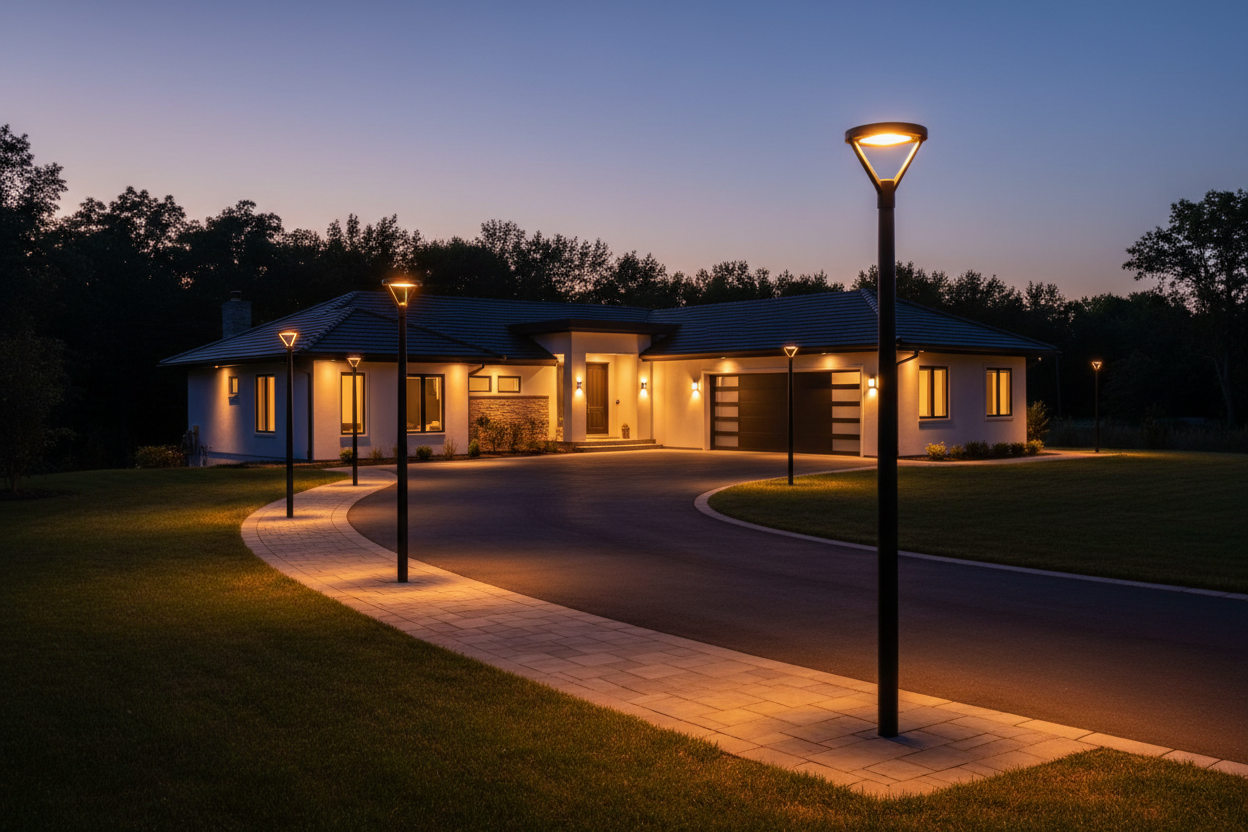
The Dark Truth About Your Property's Blind Spots
You lock your doors. You set your alarm. You might even have cameras watching your front entrance. But here's what most homeowners miss: criminals aren't looking for your strongest defenses. They're hunting for your weakest links—those shadowy corners, unlit pathways, and dark zones around your property that scream "easy target."
Every year, over 1 million home burglaries happen across the United States. And here's the kicker: most of them could've been prevented with proper outdoor lighting. Burglars don't want attention. They want darkness. They want those blind spots where they can work unnoticed, testing windows, checking doors, and scoping out entry points without anyone seeing them.
The good news? You don't need to rewire your entire property or watch your electricity bill skyrocket to fix this problem. Solar street lights have changed the game completely.
Why Traditional Outdoor Lighting Falls Short
Let's talk about why most homeowners struggle with outdoor security lighting. Traditional wired lighting systems come with a laundry list of headaches:
The Wiring Nightmare: Want to light up that dark corner by your back fence? Get ready to dig trenches, run electrical conduit, hire an electrician, and potentially deal with permits. We're talking thousands of dollars and days of disruption to your yard. And if you're renting? Forget about it.
The Electricity Bill Shock: Running outdoor lights all night, every night adds up fast. Many homeowners end up turning lights off to save money, which defeats the entire purpose of having security lighting in the first place.
The Maintenance Hassle: Wired systems mean more points of failure. Exposed wiring can corrode, connections can fail, and when something breaks, you're calling an electrician again.
This is exactly why Rackora developed a complete line of solar-powered outdoor lighting solutions. No wiring. Zero electricity bills. DIY installation that anyone can handle. Let's dive into how this technology actually protects your property.
How Solar Street Lights Eliminate Criminal Opportunities

Solar street lights work on a brilliantly simple principle: they harvest energy from the sun during the day and automatically illuminate your property at night. But the real magic is in how modern systems like Rackora's have evolved to become serious security tools.
Motion Sensor Technology That Actually Works
Here's where things get interesting. The latest solar street lights don't just provide constant illumination—they're smart enough to know when someone's approaching. Motion sensor technology has become incredibly sophisticated, and it serves two critical purposes:
Energy Conservation: Your lights can operate in a low-power mode most of the night, then blast to full brightness when motion is detected. This extends battery life dramatically, ensuring your lights work all night, every night, even after several cloudy days.
Psychological Deterrent: Imagine you're a burglar casing a property in the dark. Suddenly, a bright light floods the area the moment you step into range. That instant illumination is startling and creates the impression that someone noticed you. Most criminals will immediately abort and move on to an easier target.
The 8' Aluminum Solar Lamp Post Light from Rackora features exactly this kind of intelligent motion-activated PIR mode. At just $309.99, you get 18 LED lights with automatic dusk activation and motion sensing that conserves battery while maximizing security impact.

Off-Grid Reliability When You Need It Most
Here's something most people don't think about: what happens to your security lighting during a power outage? Traditional wired systems go dark right when you might need them most. Solar street lights? They keep working because they're completely off-grid.
This off-grid independence means:
- No vulnerability to power outages or electrical failures
- No exposed wiring that can be cut or tampered with
- Continued operation even if your main electrical system is compromised
- Installation anywhere on your property, regardless of electrical access
The 40W 100AH High-Endurance Smart Solar Street Light takes this concept to the extreme. With a massive 100AH lithium iron phosphate battery rated for over 3,000 charge cycles, this system delivers professional-grade reliability. The 68W solar panel ensures rapid charging, while the 40W LED output provides serious illumination—205 lumens per watt means this thing is bright.

At $1,306.99, it's an investment, but consider what you're getting: a commercial-grade lighting system with adjustable color temperature (3000-6800K), aluminum alloy construction that handles extreme temperatures (-10°C to 45°C), and intelligent charge/discharge controllers that maximize battery life. This is the kind of system you install once and forget about for years.
Strategic Placement: Turning Blind Spots Into Bright Spots
Having great solar lights is only half the battle. Where you place them makes all the difference between effective security and wasted money. Let's walk through the critical zones around your property that need attention.
Entry Points and Access Areas
Start with the obvious: every door and ground-floor window should be well-lit. But don't just focus on your front door. Burglars know that's where you're most likely to have lighting and cameras. They're looking for side doors, basement windows, and back entrances that homeowners often neglect.
For these areas, you want consistent, reliable illumination. The Solar Waterproof Lawn Lights are perfect for lining pathways to side entrances or illuminating window areas. At $800.00 for a set, these IP65 waterproof units deliver 10-12 hours of warm light from just 6-8 hours of charging. The 19 LED beads provide gentle but effective illumination, and the light sensor ensures they activate automatically at dusk.

Perimeter and Boundary Lighting
Your property's perimeter is where criminals first approach and assess whether your home is worth the risk. Dark fence lines, unlit driveways, and shadowy yard corners are exactly what they're looking for.
This is where higher-output solar street lights really shine. Position them at regular intervals along your property line, focusing especially on corners and areas hidden from street view. The goal is to eliminate any approach route that offers concealment.
The 50W Solar Street Lights from Rackora are designed specifically for this kind of perimeter coverage. These units provide serious illumination across wide areas, making it impossible for anyone to approach your property unnoticed.
Garage and Outbuilding Protection
Detached garages, sheds, and workshops are often targeted because they're separated from the main house and may contain valuable tools, equipment, or vehicles. These structures need dedicated lighting that operates independently.
Solar solutions are perfect here because running electrical lines to outbuildings is expensive and complicated. A single solar street light mounted on or near your garage provides instant security without any wiring hassles.
The DIY Installation Advantage
Let's talk about something that makes solar street lights a game-changer for most homeowners: you can actually install these yourself. No electrician required. No permits needed. No specialized tools or skills.
What DIY Installation Actually Looks Like
Here's the typical process for installing a solar street light:
Step 1: Choose Your Location
Walk your property and identify the areas that need lighting. Look for spots that get good sun exposure during the day—at least 6-8 hours of direct sunlight is ideal. Mark your chosen locations.
Step 2: Prepare the Mounting Surface
Most solar street lights can be mounted on poles, walls, or dedicated posts. If you're installing a pole-mounted unit, you'll need to set the pole in concrete—this is the most labor-intensive part, but it's still straightforward. For wall-mounted units, you just need to locate studs or use appropriate anchors for your wall material.
Step 3: Assemble and Mount
Solar lights typically arrive partially assembled. You'll connect the solar panel to the light fixture, attach any mounting brackets, and secure the unit to your chosen location. Most systems use standard bolts and can be installed with basic tools you already own.
Step 4: Configure Settings
Modern solar lights like those from Rackora often include adjustable settings for motion sensitivity, brightness levels, and operating modes. Spend a few minutes configuring these to match your needs.
Step 5: Test and Adjust
Let the system charge for a full sunny day, then test operation that night. You may need to adjust the angle of the solar panel for optimal sun exposure or tweak motion sensor settings.
That's it. No trenching. No wiring. No electrician bills. Most homeowners can install a complete solar street light in under two hours.
The Cost Reality: No Wiring Means Real Savings
Let's do some quick math on what traditional wired outdoor lighting actually costs:
- Electrician labor for running new circuits: $500-$1,500 per location
- Materials (wire, conduit, junction boxes, fixtures): $200-$500 per location
- Permits and inspections: $100-$300
- Ongoing electricity costs: $50-$150 per year per light
For a typical property with 4-5 outdoor lights, you're looking at $3,000-$8,000 in upfront costs, plus hundreds per year in electricity. And that's assuming everything goes smoothly with no unexpected complications.
Compare that to solar: the lights themselves are your only cost. Zero installation labor. Zero electricity bills. Ever. The Rackora 8' Aluminum Solar Lamp Post at $309.99 pays for itself in the first year compared to a wired equivalent when you factor in installation and operating costs.
Real-World Performance: What to Actually Expect
Let's cut through the marketing hype and talk about real-world performance. Solar street lights have come a long way, but they're not magic. Here's what you need to know to set realistic expectations.
Brightness and Coverage
Modern LED technology has made solar lights genuinely bright. The 40W Rackora system, for example, delivers 205 lumens per watt—that's 8,200 lumens total. For context, that's equivalent to a 600-watt incandescent bulb. That's serious illumination.
Coverage area depends on mounting height and light distribution. A typical solar street light mounted 8-10 feet high will effectively illuminate a 20-30 foot radius. For perimeter security, plan on spacing lights 30-40 feet apart for continuous coverage.
Runtime and Battery Life
This is where quality matters. Cheap solar lights might give you 4-6 hours of dim light. Professional systems like Rackora's are designed for all-night operation.
The 8' Aluminum Solar Lamp Post provides 6-8 hours of light after a full day of charging. The 40W High-Endurance system with its massive 100AH battery can run for multiple nights even without perfect sun exposure. The Solar Waterproof Lawn Lights deliver 10-12 hours from a single charge.
Battery longevity is equally important. Lithium iron phosphate batteries (like those in the 40W system) are rated for 3,000+ charge cycles. That's over 8 years of daily charging before you see any significant capacity loss.
Weather Resistance
Outdoor lighting needs to handle whatever nature throws at it. Look for proper IP ratings:
- IP44 (like the 8' Lamp Post): Protected against splashing water and dust—fine for most climates
- IP65 (like the Lawn Lights): Fully dust-tight and protected against water jets—handles heavy rain and harsh conditions
- IP66 (commercial systems): Complete dust protection and protection against powerful water jets—built for extreme environments
Rackora systems are also designed for temperature extremes. The 40W High-Endurance model operates from -10°C to 45°C (14°F to 113°F), covering the climate range for most of the United States.
Cloudy Day Performance
This is the question everyone asks: what happens when it's cloudy for several days?
Quality solar lights are designed with battery capacity that exceeds single-night requirements. The 40W system's 100AH battery, for example, stores enough energy for 3-4 nights of operation. Even with reduced charging from cloudy weather, the system continues working.
Motion sensor modes help tremendously here. By operating in low-power mode and only going to full brightness when motion is detected, the system conserves battery during extended periods of poor weather.
Beyond Security: Additional Benefits You'll Actually Notice
While security is the primary reason most people install solar street lights, you'll quickly discover other benefits that improve your daily life.
Convenience and Safety for Your Family
Well-lit pathways mean your family can safely navigate your property after dark. No more fumbling with flashlights to take out the trash, check on pets, or access storage areas. Kids can play outside later without you worrying about them tripping in the dark.
The automatic dusk-to-dawn operation means you never have to remember to turn lights on or off. They just work, every night, without any input from you.
Property Value and Curb Appeal
Professional outdoor lighting dramatically improves how your property looks at night. The warm 3000K color temperature of the 8' Aluminum Lamp Post creates an inviting ambiance that enhances your home's appearance.
When it comes time to sell, quality outdoor lighting is a selling point. It demonstrates that you've invested in the property and provides immediate visual impact during evening showings.
Environmental Impact
Zero electricity consumption means zero carbon footprint from your outdoor lighting. Over a 10-year lifespan, a single solar street light prevents thousands of pounds of CO2 emissions compared to grid-powered alternatives.
For environmentally conscious homeowners, this matters. You're protecting your property while also reducing your environmental impact.
Common Mistakes to Avoid
After helping thousands of homeowners secure their properties with solar lighting, we've seen some common mistakes that reduce effectiveness. Here's what to avoid:
Mistake #1: Choosing the Cheapest Option
Those $30 solar lights at the big box store? They're toys. Dim output, tiny batteries, plastic construction that cracks in the first winter. They might work for decorative pathway lighting, but they're useless for security.
Quality solar street lights cost more upfront because they use better components: high-efficiency solar panels, large-capacity lithium batteries, bright LED arrays, and weather-resistant construction. The Rackora systems are priced fairly for what you're getting—professional-grade components that actually last.
Mistake #2: Poor Solar Panel Placement
Your solar panel needs direct sunlight to charge effectively. Placing lights under tree cover, on north-facing walls (in the Northern Hemisphere), or in areas shaded by buildings will result in poor performance.
Take time to observe sun patterns on your property. The best locations get unobstructed sun from mid-morning through mid-afternoon. If you must install in a partially shaded area, choose a system with a larger solar panel to compensate.
Mistake #3: Ignoring Maintenance
Solar lights are low-maintenance, not no-maintenance. A few times per year, you should:
- Clean the solar panel surface to remove dust, pollen, and debris
- Check mounting hardware for tightness
- Clear any vegetation that's grown to shade the panel
- Verify that motion sensors are still properly aligned
This takes maybe 15 minutes per light and ensures optimal performance year-round.
Mistake #4: Inadequate Coverage
One light rarely solves the problem. Criminals will simply avoid the lit area and use the remaining dark zones. Plan for comprehensive coverage that eliminates blind spots rather than just illuminating a few key areas.
Walk your property at night before installing anything. Identify all the dark areas where someone could approach unnoticed. Then plan your lighting layout to address all of them.
Making the Investment: Which System Is Right for You?
Rackora offers solar lighting solutions at different price points because different properties have different needs. Here's how to choose:
For Pathway and Accent Lighting: Solar Waterproof Lawn Lights ($800.00)
If you need to illuminate walkways, garden areas, or create gentle perimeter lighting, these are your solution. The warm light and attractive design work well for residential applications where you want security without harsh industrial lighting.
Best for: Driveways, garden paths, patio areas, and decorative security lighting around the home.
Shop Solar Waterproof Lawn Lights →
For Residential Security: 8' Aluminum Solar Lamp Post ($309.99)
This is the sweet spot for most homeowners. Attractive design that fits residential aesthetics, motion sensor technology for security, and enough brightness to effectively illuminate entry points and yard areas. The price point makes it practical to install multiple units for comprehensive coverage.
Best for: Front yards, side entrances, garage areas, and general residential security lighting.
Shop 8' Aluminum Solar Lamp Post →
For Commercial-Grade Security: 40W High-Endurance Smart Solar Street Light ($1,306.99)
When you need maximum brightness, extended runtime, and bulletproof reliability, this is your system. The massive battery capacity, high-output LED array, and professional-grade construction make this suitable for large properties, commercial applications, or anywhere you need serious illumination.
Best for: Large properties, perimeter security, parking areas, commercial facilities, and high-security applications.
Shop 40W High-Endurance System →
For Perimeter Coverage: 50W Solar Street Lights
Purpose-built for wide-area illumination, these units provide the coverage needed for property boundaries, long driveways, and large outdoor spaces. The 50W output delivers serious brightness across extended areas.
Best for: Property perimeters, long driveways, large yards, and areas requiring wide coverage.
Shop 50W Solar Street Lights →
Installation Planning: A Step-by-Step Approach
Ready to eliminate your property's blind spots? Here's how to plan your installation for maximum effectiveness:

Phase 1: Assessment (Week 1)
Walk your property at night with a flashlight. Note every dark area, shadowy corner, and unlit approach route. Take photos if helpful. Pay special attention to:
- All doors and ground-floor windows
- Pathways from the street to your home
- Side yards and areas hidden from street view
- Detached structures (garages, sheds, workshops)
- Property boundaries and fence lines
- Areas where someone could hide or work unnoticed
During the day, observe sun patterns. Note which areas get good sun exposure and which are shaded. This determines where you can effectively place solar lights.
Phase 2: Planning (Week 1-2)
Based on your assessment, create a lighting plan. Sketch your property and mark:
- Priority areas that need immediate attention
- Optimal mounting locations for each light
- Sun exposure for each proposed location
- Approximate coverage area for each light
Calculate how many lights you need and which models are appropriate for each location. Remember that it's better to have comprehensive coverage with mid-range lights than a few high-end units with gaps between them.
Phase 3: Installation (Week 2-3)
Start with your highest-priority areas—typically entry points and main pathways. Install one or two lights and test them for a few nights before proceeding. This lets you verify placement and make adjustments before committing to the full installation.
For pole-mounted lights, allow concrete to cure for 24-48 hours before mounting the light fixture. For wall-mounted units, ensure you're anchoring into solid material that can support the weight.
Phase 4: Optimization (Week 3-4)
After all lights are installed, spend a week observing performance. Walk your property at night and look for any remaining dark spots. Adjust motion sensor sensitivity if needed. Fine-tune solar panel angles for optimal charging.
Make notes about battery performance—how long do lights run each night? Do they maintain brightness throughout the night? This helps you identify any units that might need repositioning for better sun exposure.
Frequently Asked Questions
How long do solar street lights actually last?
Quality solar street lights like Rackora's are designed for 10+ years of operation. The LED lights themselves are rated for 50,000+ hours (that's over 13 years of all-night operation). Lithium iron phosphate batteries typically last 8-10 years before needing replacement. The aluminum housing and weather-resistant construction ensure the physical unit holds up for decades.
Will solar lights work in northern climates with less sun?
Yes, but you need to choose systems with adequate battery capacity. The 40W High-Endurance system with its 100AH battery is specifically designed for this—it stores enough energy to operate for multiple nights even with reduced charging. In northern climates, focus on locations with maximum sun exposure and consider slightly oversizing your system to compensate for shorter winter days.
Can I install solar street lights myself, or do I need a professional?
DIY installation is absolutely feasible for most homeowners. The beauty of solar lights is that there's no electrical work required—no permits, no licensed electrician, no specialized tools. If you can use a drill and follow basic instructions, you can install solar street lights. The most challenging part is typically setting poles in concrete, which is still a straightforward DIY project.
What happens during extended cloudy periods?
Quality systems with large battery capacity continue operating for 3-5 nights even without ideal charging. Motion sensor modes help conserve battery during these periods. In practice, even cloudy days provide some charging—solar panels don't need direct sunlight to generate power, just daylight. Unless you're experiencing truly exceptional weather (week+ of heavy overcast), your lights will continue working.
How bright are solar street lights compared to traditional lighting?
Modern solar LED technology is remarkably bright. The Rackora 40W system delivers 8,200 lumens—equivalent to a 600W incandescent bulb or a 100W traditional LED floodlight. That's more than enough for security applications. The 8' Lamp Post with 18 LEDs provides ample illumination for residential areas. You're not sacrificing brightness by going solar.
Do motion sensors work reliably, or do they trigger constantly?
Modern PIR (passive infrared) motion sensors are quite sophisticated. They detect heat signatures from people and animals while filtering out false triggers from wind-blown vegetation or small animals. You can adjust sensitivity to match your needs—higher sensitivity for maximum security, lower sensitivity to reduce false triggers. In practice, they work very reliably once properly configured.
What maintenance do solar street lights require?
Minimal maintenance: clean the solar panel 2-4 times per year to remove dust and debris, check mounting hardware annually for tightness, and clear any vegetation that grows to shade the panel. That's essentially it. No bulbs to replace (LEDs last for years), no wiring to maintain, no electrical components to service. It's genuinely low-maintenance lighting.
Are solar lights effective enough for serious security, or are they just decorative?
This depends entirely on the quality of the system. Cheap decorative solar lights are indeed just for looks. Professional solar street lights like Rackora's are legitimate security tools. The combination of bright LED output, motion sensor technology, and all-night operation provides real security value. Law enforcement consistently recommends outdoor lighting as one of the most effective burglary deterrents—solar lights deliver this protection without the cost and complexity of wired systems.
Can I use solar street lights in areas with no sun exposure?
No. Solar lights require sunlight to charge. If an area receives no direct sun, solar lighting won't work there. However, you have options: some systems allow the solar panel to be mounted separately from the light fixture, connected by a cable. This lets you mount the panel in a sunny location while placing the light in a shaded area. Alternatively, consider a hybrid approach—use solar lights where sun exposure is good and supplement with battery-powered or low-voltage wired lights for shaded areas.

How do solar lights perform in extreme temperatures?
Quality systems are designed for temperature extremes. The Rackora 40W High-Endurance system operates from -10°C to 45°C (14°F to 113°F), covering the range for most of the United States. Lithium iron phosphate batteries perform better in cold weather than older battery technologies. In extremely hot climates, ensure lights are mounted where they get some air circulation to prevent heat buildup. The aluminum construction of Rackora lights helps dissipate heat effectively.
Take Action: Stop Inviting Criminals to Your Property
Every night your property sits in darkness, you're sending a message to criminals: "I'm not paying attention. I'm an easy target." Those blind spots around your home aren't just dark areas—they're opportunities for someone with bad intentions.
The solution doesn't require rewiring your property, hiring electricians, or accepting massive electricity bills. Solar street lights from Rackora give you professional-grade security lighting with zero wiring, zero electricity costs, and DIY installation that anyone can handle.
You've got options at every price point:
- The 8' Aluminum Solar Lamp Post at $309.99 for residential security that looks great and works reliably
- The Solar Waterproof Lawn Lights at $800.00 for pathway and accent lighting that enhances both security and aesthetics
- The 40W High-Endurance Smart Solar Street Light at $1,306.99 for commercial-grade performance and maximum coverage
- The 50W Solar Street Lights for serious perimeter protection
Don't wait until you're dealing with the aftermath of a break-in to take your property's security seriously. Eliminate those blind spots now. Turn your property's weaknesses into strengths. Make your home the one criminals pass by because it's too well-lit, too risky, too much trouble.
Your property deserves better than darkness. Your family deserves better than hoping criminals choose someone else's home. Take control of your security with lighting that works—no wiring required, no electricity bills, just reliable protection night after night.
Ready to eliminate your blind spots? Browse the complete Rackora solar lighting collection and find the perfect solution for your property. Every light you install is one less opportunity for criminals and one more layer of protection for what matters most.
