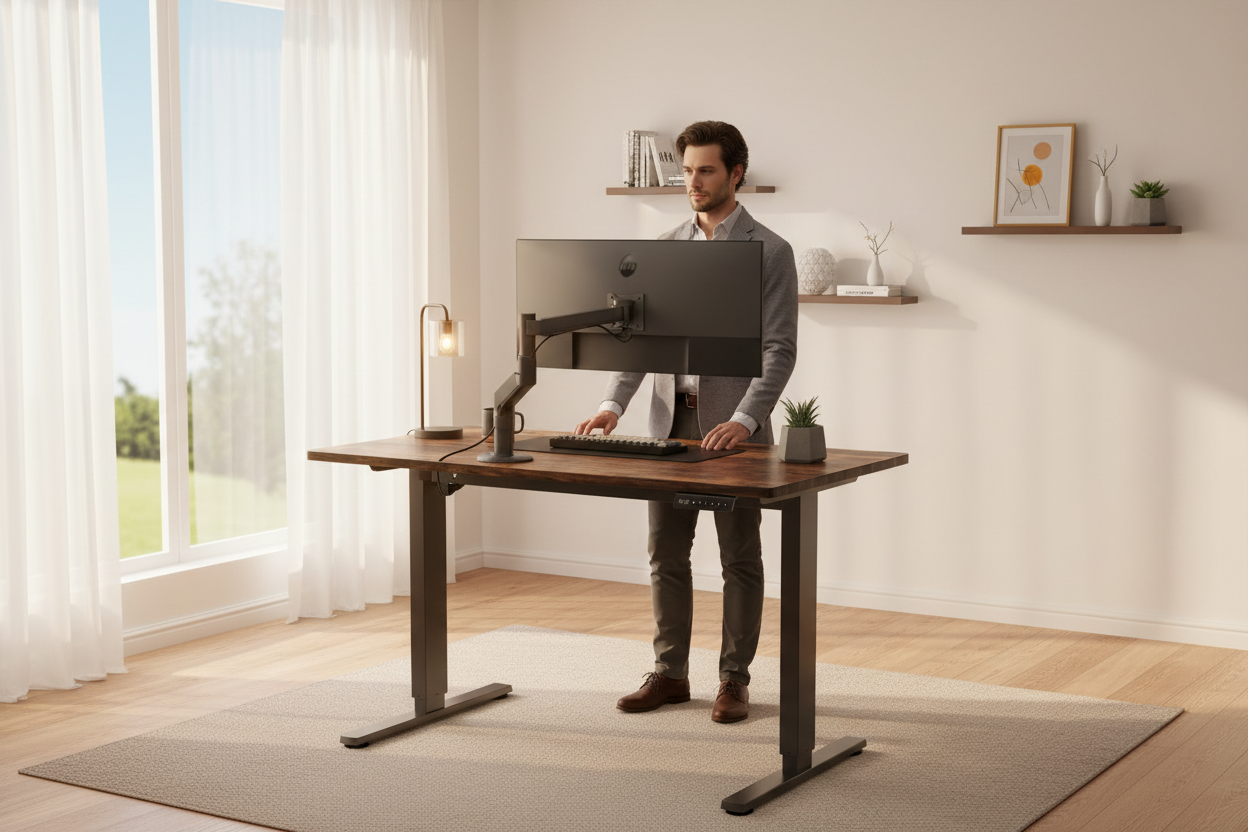
Let's Be Honest: $600 Is Not a Small Number
You've been eyeing electric standing desks for a while now. Maybe your back has been acting up. Maybe you read something about sitting being "the new smoking." Or maybe you just want a cleaner, more functional workspace that doesn't make you feel like you're slowly melting into your chair every afternoon.
But then you see the price tag — $599.99 — and you hesitate. That's a real chunk of money. Is an electric standing desk actually worth it, or is this just another wellness trend that sounds great in theory but collects dust in practice?
We're going to answer that question honestly. No fluff, no hype. Just the health data, the financial math, and the real-world reasoning that will help you decide.
Short answer: Yes, it's worth it — and the electric motor is the reason why.
Why Electric Specifically? The Motor Changes Everything
Here's the thing most people don't talk about when comparing manual crank desks to electric ones: friction kills habits.
A manual crank desk requires you to physically turn a handle 20–40 times every time you want to switch positions. That sounds manageable until you're in the middle of a call, or you're tired, or you just don't feel like it. Within a few weeks, most people stop adjusting altogether. The desk becomes a fixed-height desk you paid extra for.
An electric standing desk removes that friction entirely. You press a button — or tap a preset — and the desk moves in 3–5 seconds. That's it. The habit sticks because the action costs you almost nothing.
This isn't speculation. Behavioral research consistently shows that reducing the "activation energy" of a habit dramatically increases follow-through. The electric motor isn't a luxury feature. It's the feature that makes the whole investment actually work.

Rackora 40" x 24" Ergonomic Electric Standing Desk — $599.99
One-touch height adjustment. Four programmable presets. Built for all-day use.
The Health Case: What the Research Actually Says
Let's get into the numbers, because the health benefits of sit-stand desks are more concrete than most people realize.
1. Standing Burns More Calories — Consistently
A study published in the European Journal of Preventive Cardiology found that standing burns approximately 54 more calories per day compared to sitting, assuming you stand for about 6 hours during an 8-hour workday.
That might not sound dramatic, but do the math over a year:
- 54 calories/day × 250 working days = 13,500 extra calories burned per year
- That's roughly equivalent to running 38 miles — without changing anything else about your routine
You're not going to lose 30 pounds just by standing at your desk. But you will shift your baseline metabolic activity in a meaningful, compounding way. Over 3–5 years, that adds up.
2. Lumbar Pressure Drops Significantly When You Stand
Sitting — especially with poor posture — places enormous compressive load on your lumbar spine. Research from the field of spinal biomechanics shows that standing reduces lumbar disc pressure by up to 40% compared to seated posture.
For anyone who's dealt with lower back pain, that number is significant. Chronic lower back pain is one of the leading causes of missed workdays in the U.S., and it's almost entirely driven by prolonged static posture — exactly what a sit-stand desk is designed to break up.
3. Energy and Focus Improve in the Afternoon
The post-lunch energy crash is real, and it's partly physiological. Blood pools in the lower extremities when you sit for extended periods, reducing circulation and contributing to that foggy, sluggish feeling around 2–3 PM.
Standing activates your leg muscles, improves circulation, and keeps your heart rate slightly elevated — all of which support better cognitive alertness. Many users report that standing for 30–60 minutes after lunch is the single most effective thing they do to maintain afternoon productivity.
4. Long-Term Cardiovascular Risk Reduction
The American Heart Association has linked prolonged sitting to increased risk of cardiovascular disease, independent of exercise habits. In other words, even if you work out regularly, sitting for 8+ hours a day still carries measurable cardiovascular risk. Incorporating standing breaks throughout the day is one of the simplest interventions available.
The Financial Math: $599.99 vs. What You're Already Spending
Let's talk money, because this is where the "is it worth it" question really gets answered.
Scenario A: The Physical Therapy Route
Lower back pain is the most common musculoskeletal complaint among desk workers. If you've already experienced it — or if you're starting to feel the early warning signs — here's what treatment typically costs:
- Physical therapy session (out-of-pocket, no insurance): $75–$150 per visit
- Typical treatment course for lower back pain: 6–12 sessions
- Total out-of-pocket cost: $450–$1,800
- And that's assuming one episode. Many people deal with recurring flare-ups annually.
A single moderate course of physical therapy costs more than the Rackora 40x24 desk. And PT treats the symptom. A standing desk addresses the root cause.
Scenario B: The Productivity Calculation
This one's harder to quantify, but it's real. If standing at your desk improves your afternoon focus by even 15–20%, and you earn $50,000/year, that's a productivity gain worth $7,500–$10,000 annually. The desk pays for itself in the first month.
Even if you're more conservative — say a 5% productivity improvement — you're still looking at a payback period measured in weeks, not years.
Scenario C: The Simple Durability Math
A quality electric standing desk like the Rackora 40x24 is built to last 7–10 years with normal use. At $599.99, that's roughly $60–$85 per year, or about $5–$7 per month.
You probably spend more than that on coffee.
What Makes the Rackora 40" x 24" Worth the Price
Not all electric standing desks are created equal. Here's what separates the Rackora 40x24 from the cheaper options flooding the market:
Dual-Motor Stability
Budget desks often use a single motor, which creates wobble — especially at standing height. The Rackora uses a dual-motor system that lifts evenly on both sides, keeping the surface stable whether you're typing, writing, or have a monitor arm mounted to the edge.
Four Programmable Height Presets
Set your exact sitting height and standing height once, and recall them instantly with a single button press. No guessing, no fine-tuning every time. This is the feature that makes the sit-stand habit effortless to maintain.
Broad Height Range
The desk accommodates users from approximately 5'0" to 6'5", making it genuinely versatile for shared workspaces or households where multiple people use the same desk.
40" x 24" Surface — The Right Size for Real Work
The 40-inch width gives you enough room for a monitor, laptop, keyboard, and a notepad without feeling cramped. The 24-inch depth keeps everything within comfortable reach. It's a thoughtfully proportioned workspace, not just a plank with legs.
Clean Cable Management
The desk includes integrated cable management to keep your setup looking clean as the desk moves up and down. Small detail, big quality-of-life improvement.
Shop the Rackora 40x24 Electric Standing Desk — $599.99 →
How to Actually Use a Standing Desk (So It Doesn't Become Furniture)
The biggest mistake people make with standing desks is trying to stand all day on day one. That's not the goal, and it's not healthy either. Prolonged standing has its own downsides — foot fatigue, varicose veins, lower back strain from poor standing posture.
The research-backed sweet spot is a sit-stand ratio of roughly 1:1 to 2:1 — meaning for every hour of sitting, you stand for 30–60 minutes. Here's a simple protocol to start with:
- Morning (9–10 AM): Sit while you clear email and plan your day
- Mid-morning (10–11:30 AM): Stand during focused work or calls
- Post-lunch (1–2 PM): Stand to fight the afternoon slump
- Afternoon (2–4 PM): Alternate based on task type — sit for deep reading, stand for writing or calls
- Late afternoon (4–5 PM): Your call — listen to your body
Set a timer if you need to. Most people find that after 2–3 weeks, the transitions become automatic.
Other Rackora Desks Worth Considering
The 40x24 is our most popular electric model, but depending on your space and budget, these alternatives might be a better fit:
If You Need More Surface Area

Rackora 47" Standing Desk with Height Adjustment — $489.38
Seven extra inches of width for dual-monitor setups or anyone who needs more horizontal real estate. The white finish keeps things clean and modern.
If You're Working in a Compact Space

Rackora 8x24" Height Adjustable Ergo Standing Desk — $479.99
A narrower footprint without sacrificing the ergonomic height range. Ideal for tighter home office setups where every inch of floor space matters.
If You're Not Ready to Commit to Electric

Rackora 27.5" Compact Manual Height Adjustable Desk — $229.00
A solid entry point if you want to test the sit-stand workflow before investing in a motorized model. Compact, affordable, and genuinely functional for smaller tasks.
Common Objections — Answered Honestly
"I'll just use a standing desk converter instead."
Converters are cheaper upfront, but they sit on top of your existing desk and raise your monitor and keyboard together — which often creates ergonomic problems rather than solving them. They also take up significant desk real estate and can feel unstable. For long-term daily use, a dedicated standing desk is a meaningfully better experience.
"I can get a standing desk for $200 on Amazon."
You can. And it might work fine for light use. But budget electric desks typically use single motors, have limited height ranges, wobble noticeably at standing height, and have shorter lifespans. If you're going to use this desk 8 hours a day, 250 days a year, the quality difference matters — and the cost-per-day math still favors the better desk.
"I'm not sure I'll actually use it."
This is the most honest objection, and it's worth taking seriously. The answer is: if you buy a manual desk, you probably won't use it consistently. If you buy an electric desk with presets, you almost certainly will. The friction difference is that significant. Most Rackora customers report that within two weeks, standing at their desk becomes a default behavior rather than a deliberate choice.
"My back pain isn't that bad yet."
Prevention is always cheaper than treatment. The time to invest in your workspace ergonomics is before the chronic pain sets in, not after. Once you're dealing with a herniated disc or persistent sciatica, a standing desk is still helpful — but you'll wish you'd started sooner.
The Verdict
Is an electric standing desk worth $600? Yes — with one important caveat: it has to be the right desk, and you have to actually use it.
The Rackora 40" x 24" Electric Standing Desk at $599.99 hits the right balance of build quality, ergonomic range, and usability. The electric motor removes the friction that kills the sit-stand habit. The dual-motor system keeps it stable. The programmable presets make transitions effortless.
Compared to the cost of physical therapy, the productivity gains from better afternoon focus, and the long-term health benefits of reducing sedentary time — the math is clear. This desk pays for itself.
The only question is how long you want to wait before making the switch.
Get the Rackora 40x24 Electric Standing Desk — $599.99 →
Frequently Asked Questions
Are electric standing desks actually worth the money?
Yes — specifically because the electric motor removes the friction that causes people to stop using manual desks. When switching positions takes one button press instead of 30 seconds of cranking, you actually do it. That consistency is what delivers the health and productivity benefits. A manual desk that doesn't get used is worth nothing. An electric desk that gets used daily is worth considerably more than its sticker price.
How many calories does standing at a desk burn?
Research published in the European Journal of Preventive Cardiology found that standing burns approximately 54 more calories per day than sitting, assuming roughly 6 hours of standing during an 8-hour workday. Over a full working year (250 days), that's about 13,500 additional calories — equivalent to running approximately 38 miles.
Does standing at a desk really help with back pain?
It can, significantly. Sitting — especially with poor posture — places high compressive load on the lumbar spine. Standing reduces lumbar disc pressure by up to 40% compared to seated posture. However, standing all day isn't the answer either. The goal is alternating between sitting and standing throughout the day, which keeps your spine moving and reduces the static load that causes chronic pain.
How long should I stand at my standing desk each day?
The research-backed recommendation is a sit-to-stand ratio of roughly 1:1 to 2:1 — so for every hour of sitting, stand for 30–60 minutes. Most ergonomics experts suggest starting with 15–30 minutes of standing per hour and gradually increasing as your body adapts. Standing for more than 4 hours continuously is not recommended and can cause its own issues.
What height should my standing desk be set to?
When standing, your desk should be at elbow height — meaning when your arms hang naturally at your sides and you bend your elbows to 90 degrees, your hands should rest comfortably on the desk surface. For most people, this is between 38" and 46" depending on height. When sitting, the same principle applies: elbows at 90 degrees, wrists neutral, monitor at eye level.
Is the Rackora 40x24 desk good for dual monitors?
The 40" width comfortably accommodates a single ultrawide monitor or two standard 24" monitors side by side, especially if you use a monitor arm to free up desk surface. If you regularly work with two large monitors plus a laptop, the 47" Rackora model gives you more horizontal room to work with.
How long does it take to assemble a Rackora standing desk?
Most customers complete assembly in 45–75 minutes with basic tools. The desk ships with all required hardware and clear instructions. Having a second person available for the initial frame assembly makes the process easier, though it's manageable solo.
What's the weight capacity of the Rackora 40x24 electric desk?
Please refer to the product page for the exact rated weight capacity, as specifications can vary. The desk is designed to handle typical office setups including monitors, laptops, and accessories without issue.
Can I use a standing desk mat with the Rackora desk?
Absolutely — and we'd recommend it. An anti-fatigue mat significantly reduces foot and leg fatigue when standing for extended periods. Look for a mat that's at least 3/4" thick with beveled edges. This is one of the most cost-effective accessories you can add to a standing desk setup.
Does Rackora offer a warranty on their electric standing desks?
Yes. Please check the product page or contact Rackora directly for current warranty terms, as coverage details may vary by model. Rackora's desks are built to commercial-grade standards and designed for long-term daily use.
