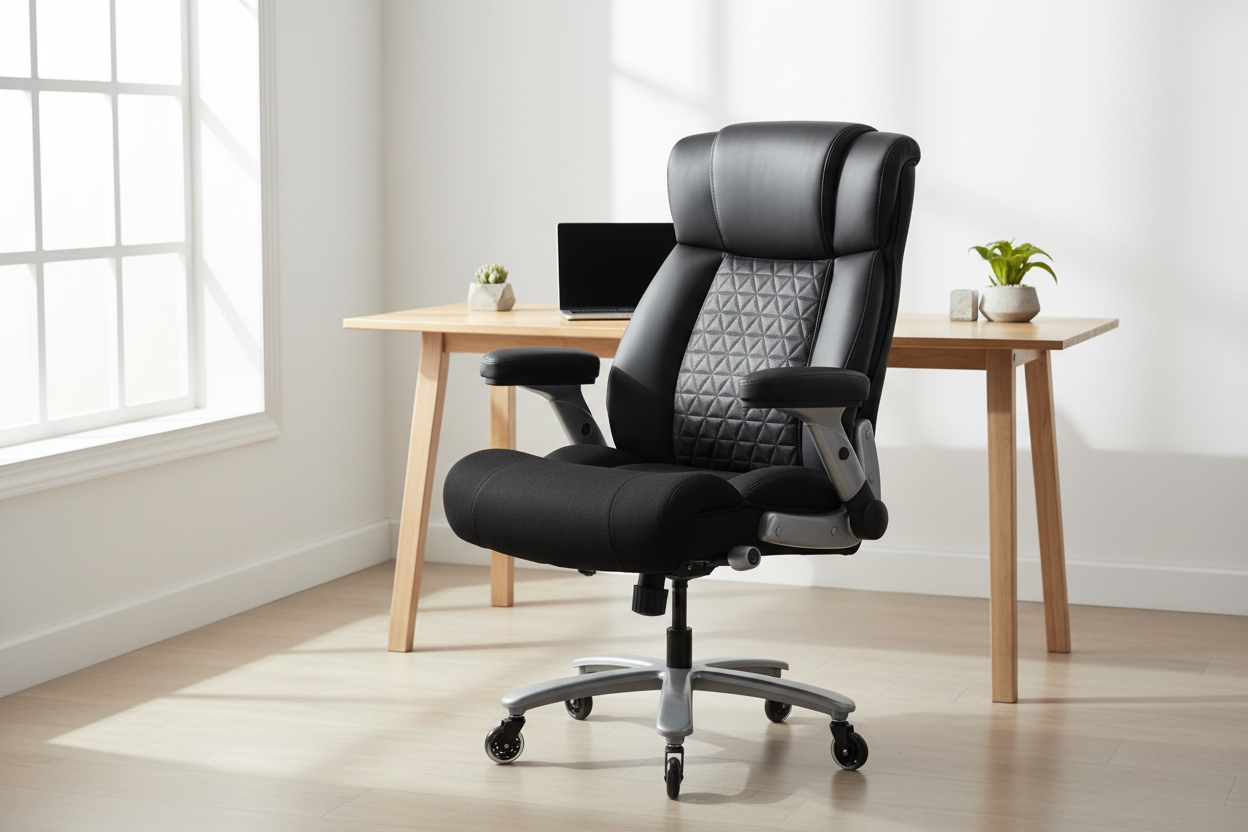
If you've ever had a chair slowly sink under you mid-meeting, heard that unsettling creak when you shift your weight, or felt the armrests wobble like they're about to give out — you already know the problem. Most office chairs are engineered for a 250–275 lb average, and they'll tell you that in the fine print. For big and tall users, that's not a chair. That's a liability.
The good news? The engineering has caught up. Today's best ergonomic chairs for heavy people are built with reinforced steel frames, SGS-certified Class-4 gas lifts, and extra-wide seat pans that actually fit the way your body is shaped. This guide cuts through the noise and shows you exactly what separates a real 500lbs-rated chair from one that just claims to be.
Quick Answer: What Do Heavy People Actually Need in an Ergonomic Chair?
Big and tall users need a chair with a reinforced SGS-certified Class-4 gas lift, a seat width of at least 28", a steel or iron base rated to 500lbs, and high-density foam that won't compress flat within six months. The Rackora Heavy Duty 500lbs Office Chair checks every one of those boxes — and it's currently $520 (down from $649).
Why Do Most Office Chairs Fail Heavy Users?
Picture this: you're three hours into a deep work session. The chair that felt fine in the morning is now digging into your thighs, the lumbar support has drifted to somewhere around your mid-back, and every time you lean back, there's a groan from somewhere underneath you. You've been here before.
The root cause is almost always the same — the chair was never designed for you. Here's what typically fails first:
- Gas lift cylinders: Standard Class-3 lifts are rated for 220–275 lbs. Under sustained heavier loads, they lose pressure and slowly sink — sometimes mid-day.
- Seat foam: Low-density foam (under 1.8 lb/ft³) compresses permanently within weeks of heavy use. You end up sitting on the frame.
- Base and casters: Five-star bases on budget chairs are often aluminum alloy with thin cross-sections. They crack under lateral stress.
- Seat width: A 20" seat pan forces wider users to perch on the edge, cutting off circulation and causing hip pain within an hour.
None of this is your fault. It's a spec problem — and it's fixable.
What Engineering Actually Goes Into a True 500lbs Chair?
Not all "heavy duty" labels mean the same thing. Here's what the engineering actually looks like when a chair is genuinely built for 500lbs of sustained, dynamic load:
SGS-Certified Class-4 Gas Lift: Why Certification Matters
The gas lift is the single most critical component in any office chair. A Class-4 cylinder has a larger bore diameter and thicker cylinder walls than a standard Class-3, which means it maintains pressure under heavier loads and resists the slow-sink phenomenon that plagues cheaper chairs.
SGS certification isn't a marketing badge — it's a third-party lab test that verifies the cylinder can handle the rated load through thousands of actuation cycles. If a chair claims 500lbs capacity but doesn't specify SGS certification on the gas lift, that claim is unverified.
The Rackora Heavy Duty 500lbs chair uses an SGS-certified 4-level gas lift. That's the spec you want.
Reinforced Iron Base vs. Standard Aluminum
Most mid-range chairs use aluminum alloy bases — lightweight, but with limited flex tolerance under heavy lateral loads. A reinforced iron base has significantly higher tensile strength and resists the micro-fractures that develop over time when a heavier user shifts, pivots, and reclines repeatedly throughout the day.
Extra-Wide Seat Pan: The 30.4" Difference
Standard office chair seats run 19–21" wide. For a big and tall user, that means compressed hips, restricted blood flow, and the constant micro-adjustment of trying to find a comfortable position that doesn't exist.
The Rackora 500lbs chair has a 30.4" seat width — wide enough to sit naturally, with room to shift position without hanging off the edge. The waterfall seat edge design (a gentle downward curve at the front of the seat) also reduces pressure on the back of your thighs, which is where most people feel that "legs falling asleep" sensation after an hour of sitting.
High-Density Foam + Breathable PU Leather
High-density foam holds its shape under sustained compression. Paired with breathable PU leather, you get a surface that doesn't trap heat the way bonded leather does — important for longer sessions where a standard chair turns into a sauna.

How Do You Compare Ergonomic Chairs for Heavy People? A Spec-by-Spec Breakdown
Here's a direct comparison of what you typically get in a standard office chair versus what a properly engineered 500lbs-rated chair delivers:
| Feature | Standard Office Chair | Rackora Heavy Duty 500lbs Chair |
|---|---|---|
| Weight Capacity | 250–275 lbs | 500 lbs |
| Gas Lift Class | Class-3 (unverified) | Class-4, SGS-Certified |
| Seat Width | 19–21" | 30.4" |
| Base Material | Aluminum alloy | Reinforced iron |
| Foam Density | Low-density (compresses fast) | High-density (shape-retaining) |
| Recline Range | 90°–105° | 90°–120° |
| Armrests | Fixed | Flip-up (easy entry/exit) |
| Lumbar Support | Fixed pad | Adjustable lumbar + headrest |
| Seat Edge Design | Flat / squared | Waterfall edge (reduces thigh pressure) |
| Price | $150–$300 | $520 (was $649) |
The price gap is real — but so is the engineering gap. A $200 chair that fails in 18 months costs more over three years than a $520 chair that holds up for five.
Which Rackora Chair Is Right for You? A Size & Use-Case Guide
Not every heavy user has the same needs. Here's how to match the right chair to your situation:
If You Need Maximum Capacity (Up to 500lbs) — Heavy Duty Executive Chair
You're working long hours, you need a chair that won't slowly sink or creak, and you want the confidence of a verified 500lbs rating. The flip-up armrests make it easy to get in and out without squeezing past fixed arms — a small detail that makes a big difference when you're using the chair 8+ hours a day.

Rackora Heavy Duty 500lbs Office Chair
Seat Width: 30.4" | Recline: 90°–120° | Gas Lift: SGS Class-4 | Price: $520 (was $649)
→ View Product
If You Want Executive Style with Footrest Support (Up to 500lbs) — Beige Leather Recliner
You work from home, you want something that looks as good as it performs, and you'd like the option to recline fully and extend your legs. The beige bonded leather finish gives it a boardroom aesthetic that holds up in video calls. The 360° swivel and five-star base handle the mobility side.

Beige Big and Tall Executive Leather Chair with Footrest
Capacity: 500lbs | Material: Bonded leather | Footrest: Included | Price: $599.99
→ View Product
If You're 300lbs and Want a Mesh Chair — High-Back Mesh with 3D Armrests
You run hot, you want airflow, and you don't need the full 500lbs rating. A high-back mesh chair with 3D adjustable armrests gives you the breathability of an open-weave back with the support structure of a proper ergonomic frame. The 300lbs rating is verified, and the 3D armrests let you dial in the exact position for your shoulders and elbows.

Ergonomic Office Chair with Lumbar Support — 300lbs Capacity
Back: High-back mesh | Armrests: 3D adjustable | Headrest: Adjustable | Price: $459
→ View Product
What Should You Look for When Buying an Ergonomic Chair If You're Over 250lbs?
Shopping for a heavy-duty chair online is full of traps. Here's a practical checklist to run through before you buy anything:
1. Verify the Weight Capacity — and the Certification Behind It
Any chair can print "400lbs capacity" on a product page. What you want to see is the certification body (SGS, BIFMA, or equivalent) and the specific component that's been tested. The gas lift is the most common failure point — make sure it's explicitly rated and certified.
2. Check the Seat Width, Not Just the Overall Chair Width
Overall chair width includes the armrests. Seat width is the actual usable sitting surface. For most big and tall users, you want at least 26–28" of seat width. The Rackora 500lbs chair's 30.4" seat is on the wider end of what's available at this price point.
3. Look at the Base Material and Caster Rating
Reinforced iron or heavy-gauge steel bases outlast aluminum alloy under sustained heavy use. Casters should be rated for the chair's full capacity — rubber-coated casters also protect hardwood floors better than bare plastic.
4. Foam Density Matters More Than Cushion Thickness
A 4" cushion of low-density foam will compress to 1" within a few months of daily use. High-density foam (1.8 lb/ft³ or higher) maintains its profile. If the product listing doesn't specify foam density, that's a yellow flag.
5. Recline Range and Locking Mechanism
A 90°–120° recline range gives you the flexibility to shift posture throughout the day — which is actually better for your spine than sitting rigidly upright for hours. Make sure the recline locks at multiple positions, not just fully upright or fully reclined.
Is a 500lbs Chair Worth the Investment? Let's Do the Math
Here's a scenario a lot of people recognize: you buy a $180 chair, it starts sinking and creaking within a year, you replace it. Two years later, you've spent $360 and you're still uncomfortable. Meanwhile, a properly engineered $520 chair — used 8 hours a day, 5 days a week — is built to last 5+ years under heavy use.
| Scenario | Year 1 | Year 2 | Year 3 | Total Cost |
|---|---|---|---|---|
| Budget chair ($180) × replace every 18 months | $180 | $180 | $180 | $540 |
| Rackora Heavy Duty 500lbs ($520, one purchase) | $520 | $0 | $0 | $520 |
Over three years, the "cheaper" option actually costs more — and you've spent those three years in a chair that was never built for you. The math isn't complicated.
How Does the L2 Ergonomic Chair Compare for Taller Users?
If you're tall (6'2" and above) but not necessarily in the 400–500lb range, the seat height range and back height matter as much as the weight capacity. The Rackora L2 Ergonomic Chair is designed with a 135° recline and an integrated footrest — useful for taller users who need to extend their legs during breaks without leaving the chair.

L2 Ergonomic Office Chair with Footrest & 135° Recline
Recline: 135° | Footrest: Integrated | Price: $489
→ View Product
What's the Best Ergonomic Chair for Heavy People Who Work from Home?

Working from home changes the equation slightly. You're not just sitting for 8 hours — you're sitting in the same chair for video calls, focused work, casual browsing, and sometimes meals. The chair needs to handle all of it without looking out of place in a home environment.
For home office use, the Beige Executive Leather Chair with Footrest is worth a serious look. The neutral beige colorway works in most home setups, the footrest lets you decompress between calls, and the 500lbs capacity means you're not compromising on durability for aesthetics. At $599.99, it's the premium option in the Rackora lineup — and it shows.
For a more utilitarian home office setup where airflow is a priority, the 300lbs Mesh Chair at $459 gives you the breathability of an open-back design with proper lumbar and headrest adjustability.
How Do You Assemble a Heavy-Duty Office Chair Without Frustration?
Assembly anxiety is real, especially with a 50+ lb chair. Here's what the process actually looks like with the Rackora 500lbs chair:
- Attach the casters to the five-star iron base (they click in — no tools needed).
- Insert the gas lift cylinder into the base.
- Attach the seat mechanism to the underside of the seat pan.
- Lower the seat onto the gas lift (gravity does the work here).
- Attach the backrest to the seat mechanism using the included hardware.
- Adjust the lumbar support and headrest to your position.
Most users complete assembly in under 20 minutes. All tools are included in the box — you don't need anything from your own toolkit.
Ready to Stop Settling for Chairs That Weren't Built for You?
The Rackora Heavy Duty 500lbs Office Chair is engineered from the ground up for big and tall users — SGS-certified gas lift, 30.4" extra-wide seat, reinforced iron base, and adjustable lumbar support that actually stays where you put it.
Currently $520 — down from $649. Ships from US warehouses in 3–7 business days. 30-day hassle-free returns.
Shop Heavy Duty 500lb Capacity Chairs →
New to Rackora? Subscribe to our email list for 15% off your first order. Use code DE30 for an additional 30% off during our Holiday Sale.
Frequently Asked Questions
What is the best ergonomic chair for someone who weighs 400–500lbs?
The Rackora Heavy Duty 500lbs Office Chair is specifically engineered for users in this weight range. It features an SGS-certified Class-4 gas lift, a 30.4" extra-wide seat, and a reinforced iron base — all rated and tested for 500lbs of sustained load. At $520 (down from $649), it's the most rigorously specified option in this category at this price point.
What does "SGS-certified" mean on a gas lift?
SGS is an independent third-party testing and certification organization. An SGS-certified gas lift has been physically tested to verify it can handle the rated load through thousands of actuation cycles — it's not a self-reported spec. For heavy-duty chairs, SGS certification on the gas lift is the most meaningful quality indicator you can look for.
How wide should a chair seat be for a big and tall user?
For most big and tall users, a seat width of at least 26–28" is the minimum for comfortable sitting. The Rackora 500lbs chair's 30.4" seat is on the wider end of what's available in this category, providing enough room to sit naturally without hip compression or edge pressure.
Can a 500lbs-rated chair support someone who weighs less?
Absolutely — and in some ways it's better. A chair rated for 500lbs used by someone who weighs 300lbs will experience less wear on the gas lift, base, and foam over time. The components are simply operating well within their design limits, which extends the chair's lifespan.
What's the difference between a Class-3 and Class-4 gas lift?
Class-4 gas lifts have a larger bore diameter and thicker cylinder walls than Class-3, which means they maintain pressure under heavier loads and resist the slow-sink phenomenon. Standard office chairs typically use Class-3 lifts rated for 220–275 lbs. For users over 300 lbs, a Class-4 lift is the appropriate specification.
How long does a heavy-duty office chair typically last?
A properly engineered heavy-duty chair — with a certified gas lift, high-density foam, and a reinforced base — should last 5–7 years under daily heavy use. Budget chairs with unverified components typically show significant degradation within 12–18 months under the same conditions.
Does the Rackora 500lbs chair work on hardwood floors?
Yes. The chair comes with quiet-glide rubber-coated casters that protect hardwood and laminate floors while providing smooth mobility. Rubber casters are significantly gentler on finished floors than bare plastic casters.
What is the return policy on Rackora chairs?
Rackora offers a 30-day hassle-free return policy on all chairs. If you're not satisfied with your purchase for any reason within 30 days of delivery, you can initiate a return for a full refund.
How long does shipping take for Rackora chairs in the US?
Rackora ships from US-based warehouses. Standard delivery time is 3–7 business days for most US addresses. You'll receive tracking information once your order ships.
Is the Rackora 500lbs chair difficult to assemble?
No. Assembly typically takes 15–20 minutes. All required tools are included in the box, and the instructions are straightforward. The most common step that trips people up is attaching the backrest — make sure the mechanism clicks fully into place before tightening the bolts.
