
Living in a New York City loft comes with its own set of challenges. High ceilings in some areas, surprisingly low clearances in others, exposed ductwork, and that constant battle between maintaining your industrial-chic aesthetic and actually staying comfortable year-round. If you've been eyeing those gorgeous statement ceiling fans with long downrods, I hate to break it to you—they're probably not going to work in your space.
That's where flush mount ceiling fans come in. These low-profile workhorses sit close to the ceiling, typically with just 5-12 inches of clearance, making them perfect for lofts with standard 8-foot ceilings or those tricky mezzanine spaces. But here's the thing: just because they're compact doesn't mean they have to be boring or ineffective.
I've spent the last few months testing different flush mount options in my own Williamsburg loft, and I'm going to walk you through everything you need to know—from understanding CFM ratings to picking finishes that actually complement exposed brick.
Why Flush Mount Fans Make Sense for NYC Lofts
Let's talk about the reality of loft living. Most converted industrial spaces weren't designed with residential comfort in mind. You might have 12-foot ceilings in your main living area but only 7.5 feet in your sleeping loft. Building codes require at least 7 feet of clearance below a ceiling fan, which doesn't leave much room for traditional models.
Flush mount fans solve this problem elegantly. They're also called hugger fans or low-profile fans, and they mount directly to the ceiling junction box without a downrod. This design keeps the blades safely out of the way while still providing serious air circulation.
Here's what makes them particularly smart for urban lofts:
Energy efficiency matters when you're paying NYC utility rates. A quality flush mount fan uses about the same energy as a 100-watt light bulb but can make a room feel 6-8 degrees cooler in summer. That means you can push your AC thermostat up a few degrees and actually notice the savings on your Con Ed bill.
Year-round functionality. Most people don't realize ceiling fans work in winter too. Run them in reverse (clockwise) on low speed, and they'll push warm air that's collected near your high ceilings back down to where you actually live. This is huge in lofts with radiant heating or those old cast-iron radiators that heat unevenly.
They don't fight your aesthetic. Modern flush mount designs have come a long way from those builder-grade brass monstrosities. You can find options with clean lines, matte black finishes, wood tones, and even industrial cage designs that look intentional in a loft setting.
What to Look for in a Flush Mount Ceiling Fan
Not all flush mount fans are created equal, and the cheap big-box store options will remind you of that fact every time they wobble or make that annoying clicking sound. Here's what actually matters:
Motor Quality and Noise Level
This is non-negotiable in a loft where your bedroom, living room, and kitchen might all share the same open space. Look for DC motors rather than AC motors. DC motors run quieter, use less energy, and typically offer more speed settings.
The 52 Inch Flush Mount Ceiling Fan with Dimmable Light ($243.99) uses a DC motor that's genuinely silent on lower speeds. I run mine on speed 2 while I'm working, and I literally forget it's on until I notice how comfortable the temperature is.

Blade Span and CFM Rating
Bigger isn't always better, but it usually is. For loft spaces, you want to match the fan size to your room dimensions:
- Rooms up to 144 sq ft: 42-inch fan
- Rooms 144-225 sq ft: 52-inch fan
- Rooms 225-400 sq ft: 56-inch fan or multiple smaller fans
CFM (cubic feet per minute) tells you how much air the fan actually moves. A good 52-inch flush mount should deliver at least 4,000-5,000 CFM on high speed. The 52 Inch Flush Mount Ceiling Fan with Solid Wood Blades ($231.99) hits this sweet spot while maintaining that warm, natural aesthetic that works beautifully against exposed brick or concrete.

Lighting Integration
In a loft, every fixture needs to pull double duty. Most quality flush mount fans now include integrated LED lighting, which is perfect because you're probably short on ceiling outlets anyway.
Look for fans with adjustable color temperature (usually 3000K-6000K range). Warm light (3000K) for evening ambiance, cool light (5000K-6000K) for task lighting during the day. The ability to dim the light independently from fan speed is also clutch—you don't want to choose between being comfortable and having the right lighting for dinner.
Remote Control and Smart Features
Wall switches are fine, but a remote control is genuinely useful in an open loft where you might want to adjust the fan from your couch or bed. Some newer models integrate with Alexa or Google Home, though I'll be honest—I haven't found voice control to be that much more convenient than a remote for ceiling fans.
What IS useful: timers and sleep modes. Being able to set the fan to turn off after you fall asleep is a game-changer, especially in summer when you want air circulation to fall asleep but don't want to wake up freezing at 3 AM.
Best Flush Mount Ceiling Fans for Different Loft Spaces
For Main Living Areas: Go Big and Quiet
Your main living space is where you'll spend most of your time, so this is where you want to invest in quality. A 52-inch model with solid wood blades brings warmth to industrial spaces while providing serious air movement.
I'm partial to the 52 Inch Flush Mount Ceiling Fan with LED Light and Remote Control ($231.99) for its incredible value. The walnut finish adds organic texture, the 6-speed DC motor gives you precise control, and the integrated 18W LED with three color temperatures means you can dial in exactly the ambiance you want.
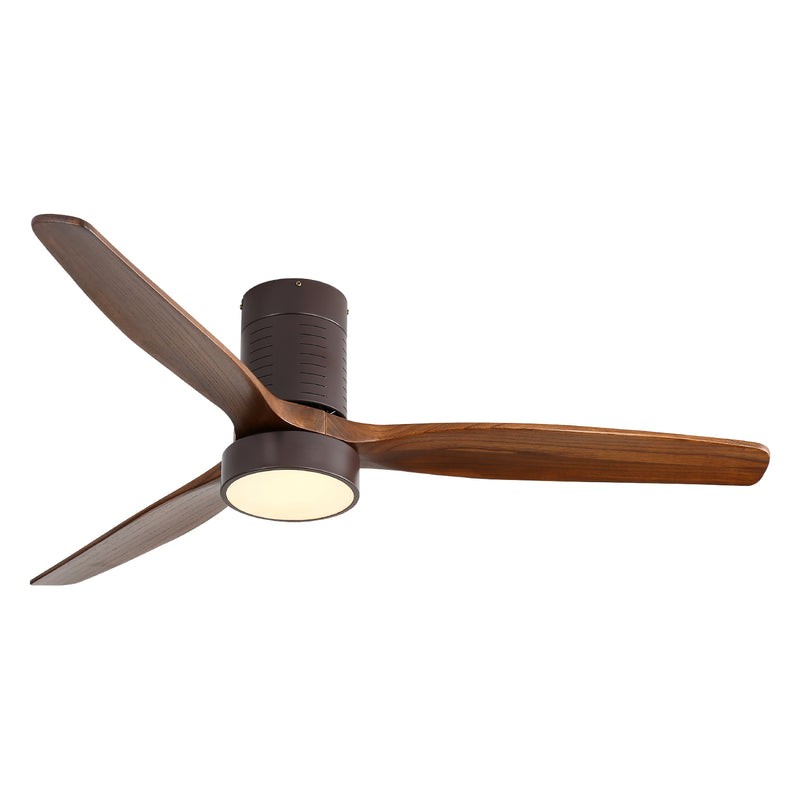
The reversible motor is key here. Summer mode (counterclockwise) creates a downdraft that makes you feel cooler through the wind-chill effect. Winter mode (clockwise) gently circulates warm air without creating a breeze. In a loft with high ceilings and uneven heating, this feature alone can cut your heating costs by 10-15%.
For Sleeping Lofts and Bedrooms: Prioritize Silence
If your bedroom is in a mezzanine or sleeping loft, you're probably dealing with even lower ceiling clearance. This is where flush mount fans really prove their worth—you get air circulation without sacrificing headroom or creating a hazard.
For sleeping spaces, motor noise becomes critical. Even a slight hum that you wouldn't notice during the day becomes incredibly annoying when you're trying to fall asleep. DC motors are essential here, and you want a fan with at least 6 speed settings so you can find that perfect low-speed setting that moves air without creating noise.
The three-blade designs tend to run quieter than five-blade models at the same CFM, though they may need to spin slightly faster to move the same amount of air. It's a trade-off, but in a bedroom, I'll take quieter over maximum airflow every time.
For Kitchens and Dining Areas: Consider Industrial Styles
Open-plan lofts often have kitchen and dining areas that flow into the main living space. These areas benefit from a different aesthetic approach—something that acknowledges the utilitarian roots of loft living.
The 20 Inch Low Profile Caged Ceiling Fan ($243.99) is perfect for these spaces. At just 5.7 inches in height, it works even in areas with 8-foot ceilings. The industrial cage design looks intentional above a kitchen island or dining table, and the 7-blade configuration moves a surprising amount of air for its compact size.

The smaller diameter also makes it safer in areas where you might be standing on a chair to reach upper cabinets or where you're moving around with hot pots and pans. You don't want to worry about bumping into fan blades while you're cooking.
For Minimalist Spaces: Bladeless Designs
If your loft aesthetic leans more minimalist than industrial, you might want to consider a flush mount fan without lights or with a very clean, simple blade design. The 52 Inch Flush Mount Low Profile Ceiling Fan without Light ($169.99) offers a sleek black finish with just three reversible blades.

This works particularly well if you already have good lighting solutions in place—track lighting, pendant lights, or floor lamps. The fan becomes almost invisible against a dark ceiling, providing function without visual clutter. The 100% copper DC motor ensures quiet operation and longevity, which matters when you're installing something you plan to use daily for years.
Installation Considerations for Loft Spaces
Installing a flush mount ceiling fan in a loft isn't quite the same as installing one in a suburban house. Here's what you need to know:
Electrical Box Requirements
Ceiling fans require a proper fan-rated electrical box, not just a standard light fixture box. The fan-rated box is designed to handle the weight and vibration of a spinning fan. If you're in an older converted loft, there's a good chance your existing boxes aren't fan-rated.
This is not a place to cut corners. An improperly supported fan can literally fall from the ceiling. If you're not comfortable verifying the box rating yourself, hire an electrician. In NYC, this typically runs $150-300 depending on whether they need to install a new box or if the existing one is adequate.
Ceiling Height and Blade Clearance
Building codes require 7 feet of clearance between the floor and the fan blades. With a flush mount fan that sits 8-10 inches below the ceiling, you need at least a 7.5-foot ceiling height to be code-compliant.
If you're in a sleeping loft or mezzanine with lower clearance, you might need to get creative. Some people install fans in the main ceiling area positioned to blow air toward the sleeping loft. Others use smaller diameter fans (42-inch instead of 52-inch) to reduce the risk of someone bumping into the blades.
Balancing and Wobble Issues
Wobbling is the most common complaint with ceiling fans, and it's usually caused by installation issues rather than fan quality. In lofts with exposed beams or unusual ceiling structures, getting a perfectly level installation can be tricky.
Most quality fans come with balancing kits—small weights you can clip to the blades to eliminate wobble. If your fan wobbles after installation, don't just live with it. A wobbling fan puts stress on the motor and mounting hardware, reducing lifespan and potentially creating a safety hazard.
Maximizing Efficiency: How to Actually Use Your Ceiling Fan
Buying a great flush mount fan is only half the battle. You need to use it correctly to get the full benefit:
Summer Strategy
Run the fan counterclockwise (when looking up at it) to create a downdraft. This wind-chill effect makes you feel cooler without actually lowering the room temperature. The key is to match fan speed to activity level:
- Speed 1-2: Sleeping or watching TV
- Speed 3-4: General daytime use
- Speed 5-6: When you're really hot or have a full loft of people
Here's the important part: ceiling fans cool people, not rooms. They work through evaporative cooling on your skin. If you're not in the room, turn the fan off. Running it in an empty room just wastes electricity.
Winter Strategy
Switch the fan to clockwise rotation and run it on low speed (1-2). This creates an updraft that pushes warm air away from the ceiling and down the walls, redistributing heat without creating a noticeable breeze.
This is especially effective in lofts with high ceilings where heat naturally stratifies. I've measured temperature differences of 8-10 degrees between floor level and ceiling level in my loft during winter. Running the fan in reverse mode brings that warm air back down where it's useful.
Shoulder Season Strategy
Spring and fall in NYC can be unpredictable. You might not need AC or heat, but the air feels stuffy. This is when ceiling fans really shine. Run them on low-medium speed to keep air circulating, which prevents that stagnant feeling and can reduce the need to open windows (helpful when pollen counts are high or when your neighbors are having loud conversations on the fire escape).
Maintenance and Longevity
A quality flush mount ceiling fan should last 10-15 years with minimal maintenance. Here's how to keep yours running smoothly:
Regular Cleaning
Dust accumulates on fan blades, which can cause imbalance and reduce efficiency. Clean your fan blades every 2-3 months using a microfiber cloth or a specialized fan duster. For wood blades, avoid harsh chemicals—just use a slightly damp cloth.
In NYC, where dust and grime accumulate faster than you'd like, you might need to clean more frequently. I do a quick wipe-down monthly and a thorough cleaning quarterly.
Annual Inspection
Once a year, turn off the power and check:
- All screws and mounting hardware are tight
- No visible cracks in blades or housing
- Motor housing isn't excessively hot after running
- Remote control batteries are fresh
Loose screws are the most common cause of noise and wobble in older fans. A quick tightening session can add years to your fan's life.
Motor Lubrication
Most modern DC motors are sealed and don't require lubrication. If you have an older AC motor fan, you might need to oil it annually. Check your manual—adding oil to a sealed motor can actually damage it.
Common Mistakes to Avoid
I've made most of these mistakes myself, so learn from my experience:
Buying based on price alone. That $60 fan from the big box store might seem like a deal, but it'll wobble, make noise, and probably fail within 2-3 years. A quality fan at $200-250 will last a decade and actually work properly. The cost per year of ownership is lower with the better fan.
Ignoring the reverse function. So many people never switch their fans to winter mode and miss out on 50% of the fan's utility. There's usually a small switch on the motor housing or a button on the remote. Use it.
Running the fan too fast. More speed doesn't always mean more comfort. Find the lowest speed that provides adequate air movement. It'll be quieter, use less energy, and put less wear on the motor.
Installing in the wrong location. Ceiling fans work best when centered in the room or positioned over the area where you spend the most time. In an open loft, you might need multiple fans rather than one large one in a random location.
Forgetting about the light color temperature. If your fan has adjustable color temperature, use it. Warm light (3000K) in the evening helps you wind down. Cool light (5000K) during the day helps you stay alert. This small adjustment makes a bigger difference than you'd expect.
Styling Your Flush Mount Fan
Let's talk aesthetics. A ceiling fan doesn't have to be an eyesore—it can actually enhance your loft's design when chosen thoughtfully.
Matching Finishes to Your Space
Matte black fans work beautifully in industrial lofts with exposed ductwork and metal accents. They create visual continuity with black-framed windows, metal shelving, and industrial lighting.
Wood-blade fans add warmth and organic texture, which is especially valuable in lofts that might otherwise feel cold or sterile. Walnut tones complement leather furniture and warm metals like brass or copper.
Brushed nickel or chrome finishes work in more contemporary lofts with a cleaner, less industrial aesthetic. They pair well with stainless steel appliances and modern furniture.
Coordinating with Lighting
If your fan includes integrated lighting, think about how it works with your other light sources. In a loft with track lighting or pendant lights, you might want a fan with a lower-profile light kit that doesn't compete visually.
Alternatively, if the fan will be your primary light source in a room, choose one with a substantial light output—at least 1500-2000 lumens for a bedroom, more for a living area.
Creating Visual Balance
In a loft with high ceilings, a flush mount fan can look small and insignificant. Combat this by choosing a larger diameter (52-56 inches) and considering the blade design. Wider blades create more visual presence than narrow ones.
You can also create balance through repetition—two matching fans in a large open space often look more intentional than one fan trying to do all the work.
Cost-Benefit Analysis: Are Flush Mount Fans Worth It?
Let's talk numbers. A quality flush mount ceiling fan costs $200-300. Installation (if you hire an electrician) adds another $150-300. So you're looking at $350-600 total investment per fan.
What do you get for that investment?
Energy savings: Running a ceiling fan costs about $0.01-0.02 per hour. Running AC costs $0.30-0.50 per hour. If you can reduce AC usage by just 2 hours per day during summer (June-September), you'll save roughly $75-150 per season. The fan pays for itself in 3-4 summers.
Heating efficiency: Using the reverse function in winter can reduce heating costs by 10-15%. In a NYC loft with high ceilings, that could mean $100-200 in savings over a winter season.
Comfort value: This is harder to quantify, but being comfortable in your own home is worth something. Better sleep, more productive work-from-home days, and the ability to host friends without everyone sweating or freezing—these have real value.
Property value: Quality ceiling fans are a selling point. They're especially attractive to buyers who understand the challenges of loft living. While you probably won't recoup 100% of your investment in increased sale price, it's a feature that makes your space more marketable.
FAQ: Everything Else You Wanted to Know
Can I install a flush mount ceiling fan myself?
If you're comfortable with basic electrical work and have verified that you have a fan-rated electrical box, yes. The installation process typically takes 1-2 hours. However, if you're not confident working with electrical wiring or if you need to install a new electrical box, hire a licensed electrician. In NYC, electrical work often requires permits, and improper installation can be dangerous.
How do I know if my ceiling is too low for a ceiling fan?
Building codes require 7 feet of clearance between the floor and the fan blades. Measure from your floor to the ceiling, then subtract the height of the fan (typically 8-12 inches for flush mount models). If you have at least 7 feet remaining, you're good to go. If not, you'll need to look at ultra-low-profile models or consider alternative cooling solutions.
Will a ceiling fan work with my existing light switch?
Most flush mount fans come with remote controls, so you can use your existing single light switch to provide power to the fan and control everything via remote. If you want separate wall controls for fan and light, you'll need to run an additional wire from the switch to the fan location, which requires more extensive electrical work.
How much noise should I expect from a ceiling fan?
A quality DC motor fan should be nearly silent on low speeds—under 30 decibels, which is quieter than a whisper. On high speeds, you'll hear the sound of air movement (around 45-50 decibels), but you shouldn't hear motor noise, clicking, or humming. If your fan makes mechanical noises, something is wrong—either it's poorly balanced, has loose parts, or is a low-quality motor.
Can ceiling fans really help with heating costs?
Yes, especially in spaces with high ceilings. Heat rises, so in a loft with 10-12 foot ceilings, the warmest air is up where you're not. Running a ceiling fan in reverse (clockwise) on low speed redistributes that warm air without creating a cooling breeze. Studies show this can reduce heating costs by 10-15% in spaces with high ceilings.
What's the difference between AC and DC motors in ceiling fans?
DC (direct current) motors are more energy-efficient, quieter, and typically offer more speed settings than AC (alternating current) motors. They cost more upfront but use 30-50% less electricity and last longer. For loft living where the fan might run 8-12 hours per day, DC motors are worth the investment.
How often should I run my ceiling fan?
Run it whenever you're in the room and want air circulation. Unlike AC, ceiling fans don't cool the room—they cool people through air movement. Running a fan in an empty room wastes electricity. In summer, run it whenever you're home and awake. In winter, run it on low speed in reverse mode during waking hours to redistribute heat.
Can I use a ceiling fan in a room with sloped ceilings?
Flush mount fans are designed for flat ceilings. If you have a sloped ceiling, you'll need a fan with an angled mounting kit or a short downrod with an angled canopy. Some flush mount models offer angled mounting options, but not all. Check the specifications before purchasing.
What size ceiling fan do I need for my loft?
Match fan diameter to room size: 42 inches for rooms up to 144 sq ft, 52 inches for rooms 144-225 sq ft, and 56+ inches for larger spaces. In an open-plan loft, you might need multiple fans rather than one oversized fan. It's better to have two 52-inch fans providing even coverage than one 60-inch fan in a random location.
How do I stop my ceiling fan from wobbling?
First, make sure all screws are tight—on the mounting bracket, motor housing, and blade irons. If it still wobbles, use the balancing kit that came with your fan. Clip the balancing weight to different positions on the blades until you find the spot that eliminates wobble. If wobbling persists, check that the electrical box is securely mounted and that the ceiling itself is solid.
Final Thoughts: Making the Right Choice for Your Space
Choosing a flush mount ceiling fan for your NYC loft isn't just about picking the cheapest option or the one with the most features. It's about understanding your specific space, how you use it, and what will actually make you more comfortable year-round.
Start by measuring your ceiling height and room dimensions. Be honest about your priorities—do you value silence above all else? Is aesthetic integration with your industrial design critical? Are you primarily concerned with energy efficiency?
For most loft dwellers, I recommend investing in quality over quantity. One excellent 52-inch flush mount fan with a DC motor, solid wood blades, and integrated LED lighting will serve you better than two cheap fans that wobble and hum. The 52 Inch Flush Mount Ceiling Fan with Dimmable Light at $243.99 hits the sweet spot of quality, features, and value.
If you're outfitting multiple rooms, consider where you spend the most time and start there. You can always add fans to secondary spaces later. Your bedroom and main living area should be the priorities.
And remember: a ceiling fan is a long-term investment. You'll use it nearly every day for a decade or more. Spending an extra $100 for better quality, quieter operation, and more attractive design is money well spent when you divide it across years of daily use.
Living in a NYC loft means making smart choices about every element of your space. A well-chosen flush mount ceiling fan is one of those choices that pays dividends in comfort, energy savings, and quality of life. Take the time to choose wisely, install it properly, and use it strategically. Your future self will thank you every time you walk into a perfectly comfortable room.
