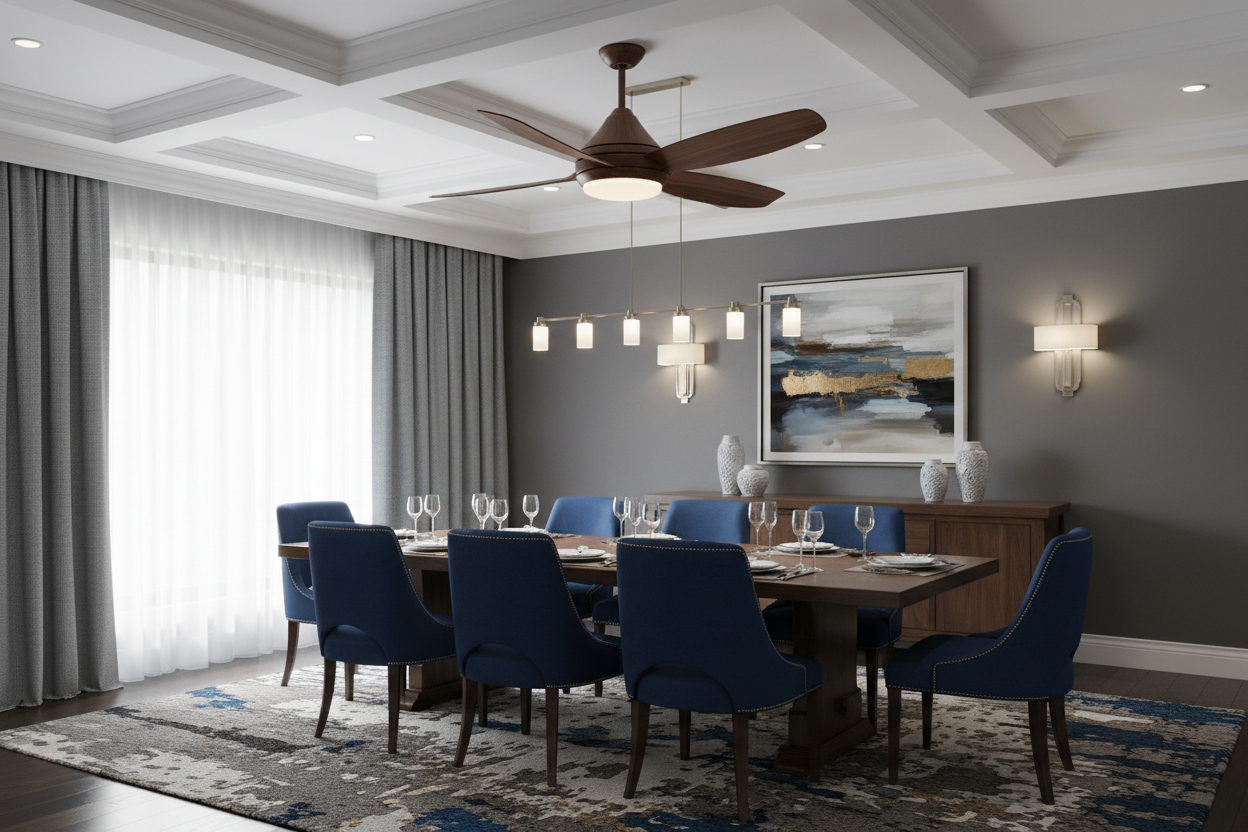
Introduction: Why Your Home Deserves a Premium Ceiling Fan
In the realm of home comfort and design, few fixtures offer the dual benefits of functionality and aesthetic appeal quite like a well-chosen ceiling fan. While air conditioning systems dominate conversations about climate control, ceiling fans have quietly maintained their position as essential home fixtures—and for good reason. They're energy-efficient, cost-effective, and when selected thoughtfully, can serve as stunning focal points that elevate your interior design.
Today, we're diving deep into one particular standout in the ceiling fan market: the 42-inch Black Wood Ceiling Fan with Lights and Remote Control. This isn't just another ceiling fan review—it's a comprehensive exploration of why this specific model represents the sweet spot between form, function, and value for modern homeowners.

Understanding the 42-Inch Sweet Spot: Size Matters in Ceiling Fans
Before we explore the specific features of this black wood ceiling fan, let's address a fundamental question: why 42 inches? In the world of ceiling fans, size isn't arbitrary—it's a critical factor that determines both performance and visual harmony.
A 42-inch ceiling fan occupies what industry experts call the "medium" category, making it incredibly versatile. This size is ideal for rooms ranging from 144 to 225 square feet, which encompasses most bedrooms, home offices, dining rooms, and smaller living spaces. Unlike larger fans that can overwhelm intimate spaces or smaller fans that struggle to move air effectively in medium-sized rooms, a 42-inch fan strikes the perfect balance.
The blade span creates sufficient air movement without the visual bulk of 52-inch or 60-inch models. For homeowners with standard 8-foot ceilings—the most common ceiling height in American homes—a 42-inch fan provides optimal clearance while maintaining the recommended 7-foot minimum height from floor to blade.
The Timeless Appeal of Black Wood: Design Philosophy
Color and material choices in home fixtures reveal much about design sensibility. The combination of black finish and wood construction in this ceiling fan isn't accidental—it's a deliberate fusion of contemporary minimalism and organic warmth.
Why Black Works Everywhere
Black is the chameleon of interior design. It anchors modern spaces with bold sophistication, complements industrial aesthetics with raw edge, and adds dramatic contrast to traditional settings. Unlike trendy colors that date quickly, black maintains its relevance across design movements and personal style evolutions.
In ceiling fans specifically, black offers practical advantages beyond aesthetics. It conceals dust better than lighter finishes, reducing the apparent need for frequent cleaning. It also creates visual weight that grounds a room, particularly in spaces with high ceilings or predominantly light color schemes.
The Wood Element: Bringing Nature Indoors
Wood introduces organic texture and warmth that pure metal or plastic fans simply cannot replicate. Even in black finish, wood grain adds subtle depth and character. This natural element softens the mechanical nature of a ceiling fan, transforming it from purely functional equipment into a design feature.
The wood and stainless steel construction of this particular model creates an interesting material dialogue—the warmth of wood balanced by the cool precision of metal. This combination speaks to contemporary design trends that favor mixed materials and textural variety.
The DC Motor Revolution: Understanding the Technology
At the heart of this ceiling fan lies technology that represents a significant evolution in fan engineering: the DC (direct current) motor. To appreciate why this matters, we need to understand what makes DC motors different from traditional AC (alternating current) motors.
Energy Efficiency That Actually Impacts Your Bills
The 35W DC motor in this fan consumes 65% less energy than comparable AC motors. Let's translate that into real-world terms. If you run your ceiling fan for 8 hours daily during a 6-month warm season, a traditional AC fan might consume approximately 300 kWh annually. This DC motor fan would consume roughly 105 kWh for the same usage.
At the national average electricity rate of $0.14 per kWh, that's the difference between $42 and $14.70 annually—a savings of over $27 per year, per fan. Multiply that across multiple rooms and years of use, and the energy efficiency becomes a meaningful financial consideration, not just an environmental talking point.
The Silence Factor: 35dB Explained
The specification sheet mentions 35dB operation, but what does that actually mean for your daily experience? Decibels measure sound intensity on a logarithmic scale, where every 10dB increase represents a doubling of perceived loudness.
At 35dB, this fan operates at approximately the volume of a whisper or rustling leaves. For context, a quiet library measures around 40dB, normal conversation sits at 60dB, and traditional ceiling fans often operate between 45-55dB. That 10-20dB difference is substantial—it's the difference between background noise you tune out and sound that intrudes on concentration or sleep.
For light sleepers, parents with infants, or anyone who works from home and needs concentration, this whisper-quiet operation transforms a ceiling fan from potential nuisance to invisible comfort provider.
Reversible Motor: Year-Round Functionality
The reversible DC motor feature deserves special attention because it fundamentally changes how you should think about ceiling fans. Most people view ceiling fans as summer cooling devices, but a reversible motor makes them four-season climate control tools.
In summer, the fan rotates counterclockwise (when viewed from below), pushing air downward to create the cooling breeze effect. The moving air increases evaporation from your skin, making you feel 4-8 degrees cooler without actually changing room temperature. This perceived cooling allows you to raise your thermostat setting, reducing air conditioning costs.
In winter, reverse the rotation to clockwise. This pulls air upward and pushes the warm air that naturally rises to the ceiling back down along the walls. This gentle redistribution of heat can improve heating efficiency by up to 10%, particularly in rooms with high ceilings where heat stratification is pronounced.
Integrated Lighting: More Than an Afterthought
Many ceiling fans treat lighting as a secondary feature—a basic bulb housing that provides illumination without consideration for quality or versatility. This model takes a different approach with its color-changing, dimmable LED light system.
Color Temperature Range: 3100K to 6500K
The ability to adjust color temperature from 3100K to 6500K represents the full spectrum of practical indoor lighting. Understanding these numbers helps you leverage this feature effectively.
3100K produces warm white light similar to traditional incandescent bulbs—soft, slightly yellow-toned illumination that creates cozy, relaxing atmospheres. This setting is ideal for bedrooms, dining rooms during evening meals, or any space where you want to promote relaxation.
6500K generates cool white light that mimics natural daylight—crisp, slightly blue-toned illumination that promotes alertness and accurate color perception. This setting excels in home offices, kitchens during food preparation, or any task-oriented environment where you need clear, energizing light.
The middle range (4000-5000K) provides neutral white light that works well for general-purpose illumination in living rooms, hallways, or multi-function spaces.
Dimming Capability: Setting the Mood
Dimmable lighting isn't just about reducing brightness—it's about creating lighting layers and controlling ambiance. The ability to dim this fan's integrated light means you can:
- Reduce glare during movie watching or television viewing
- Create softer lighting for evening relaxation without switching to lamps
- Adjust brightness based on natural light levels throughout the day
- Fine-tune lighting for different activities in multi-purpose rooms
- Reduce energy consumption during times when full brightness isn't needed
The combination of color temperature adjustment and dimming creates remarkable lighting versatility from a single fixture. This eliminates the need for multiple light sources in many rooms, simplifying both installation and daily use.
Remote Control Convenience: The Details Matter
Remote control operation might seem like a standard feature in modern ceiling fans, but implementation quality varies dramatically. This model's remote system deserves examination because it directly impacts daily usability.
Six-Speed Control: Precision Air Movement
Most ceiling fans offer three speeds: low, medium, and high. This model provides six speeds, effectively doubling your control precision. Why does this matter?
Temperature comfort is highly personal and varies based on activity level, clothing, and individual preference. Three speeds often mean choosing between "not quite enough" and "slightly too much" air movement. Six speeds provide the granularity to find your exact comfort point.
This precision is particularly valuable during shoulder seasons (spring and fall) when you need just a whisper of air movement, or in bedrooms where the difference between sleep-disrupting and sleep-enhancing airflow can be subtle.
Timer Function: Set It and Forget It
The inclusion of 1-hour, 2-hour, and 4-hour timer settings addresses a common ceiling fan frustration: remembering to turn it off. These timers serve multiple practical purposes:
Energy Conservation: Set the timer when leaving a room for extended periods, ensuring the fan doesn't run unnecessarily while maintaining comfort during your absence.
Sleep Optimization: Program the fan to turn off after you've fallen asleep, preventing overnight chill while still providing initial cooling comfort. The 2-hour setting aligns well with typical sleep onset timing.
Routine Automation: Use the 4-hour timer for predictable schedules, such as afternoon work sessions or evening relaxation periods.
Installation Considerations: What You Need to Know
Even the best ceiling fan delivers disappointing results if improperly installed. Let's address the practical considerations that determine installation success.
Ceiling Height and Mounting
For standard 8-foot ceilings, this 42-inch fan should be mounted flush or with a short downrod to maintain the 7-foot minimum clearance from floor to blade. This clearance is both a safety requirement and a performance consideration—fans mounted too low create hazards and turbulent airflow.
For ceilings between 9 and 12 feet, use a downrod to position the fan 8-9 feet above the floor. This height optimizes air circulation while maintaining safe clearance. The fan should hang 10-12 inches below the ceiling for best performance.
For sloped ceilings, you'll need an angled mounting bracket (often sold separately) to ensure the fan hangs level. A tilted fan creates wobble, noise, and uneven air distribution.
Electrical Requirements
This fan requires a standard electrical box rated for ceiling fan support. Not all ceiling electrical boxes meet this requirement—standard light fixture boxes often lack the structural support for a fan's weight and vibration.
If you're replacing an existing ceiling fan, the electrical box is likely adequate. If you're installing where only a light fixture existed, verify the box is fan-rated or replace it before installation. This isn't optional—using an inadequate box creates serious safety risks.
The fan requires a dedicated circuit or can share a circuit with other lights, provided the total load doesn't exceed the circuit's capacity. Consult local electrical codes and consider hiring a licensed electrician if you're uncertain about your electrical system's capacity.
Assembly Expectations
Ceiling fan assembly typically requires 1-2 hours for someone with basic DIY skills. The process involves:
- Attaching the mounting bracket to the electrical box
- Assembling the downrod (if used) and motor housing
- Connecting electrical wiring
- Attaching the fan blades
- Installing the light kit
- Balancing the fan (if necessary)
Most manufacturers include detailed instructions, and numerous online video tutorials demonstrate the process. If you're uncomfortable with electrical work or working on a ladder, professional installation typically costs $75-150, depending on your location and installation complexity.
Ideal Room Applications: Where This Fan Excels
The product description mentions suitability for various spaces, but let's explore specific applications and why this fan works particularly well in each.
Bedrooms: The Sleep Sanctuary
Bedrooms represent the ideal application for this fan. The 35dB whisper-quiet operation won't disturb light sleepers, while the six-speed control allows precise comfort adjustment. The dimmable, color-temperature-adjustable lighting eliminates the need for separate reading lights and ambient lighting in many cases.
The timer function shines in bedroom applications—set it for 2 hours to provide cooling as you fall asleep without running all night. The reversible motor helps in winter by redistributing heat from your heating system without creating uncomfortable drafts.
Home Offices: Productivity and Comfort
Home offices demand both comfort and concentration. This fan's silent operation prevents the distraction of fan noise during video calls or focused work. The adjustable lighting supports different tasks—cool, bright light (6500K) for detailed work, warmer tones (3100K) for less intensive tasks or end-of-day wind-down.
The energy efficiency becomes particularly relevant in home offices where the fan might run 8-10 hours daily during work seasons. The DC motor's low power consumption means guilt-free all-day operation.
Dining Rooms: Ambiance and Comfort
Dining rooms benefit from this fan's aesthetic appeal and lighting versatility. The black wood design complements both modern and traditional dining furniture. During meals, dim the light and adjust to warmer color temperatures for intimate ambiance. The gentle air circulation prevents stuffiness during gatherings without creating napkin-blowing drafts.
Covered Outdoor Spaces: Extending Your Living Area
The product description mentions suitability for covered outdoor areas like patios. This application requires clarification: the fan must be protected from direct weather exposure. Covered porches, screened patios, and similar spaces work well, provided the fan isn't exposed to rain, snow, or extreme humidity.
In these applications, the fan extends the usability of outdoor spaces during warm weather, creating comfortable air movement that makes outdoor dining and relaxation more pleasant. The integrated lighting eliminates the need for separate porch lights in many cases.
Maintenance and Longevity: The Long-Term Perspective
A ceiling fan represents a long-term investment in home comfort. Understanding maintenance requirements and expected lifespan helps you maximize that investment.
Routine Cleaning
Dust accumulation on fan blades is inevitable and affects both appearance and performance. The black finish conceals dust better than lighter colors, but regular cleaning remains important.
Clean blades monthly during heavy-use seasons using a microfiber cloth or specialized fan blade duster. For deeper cleaning, use a slightly damp cloth with mild soap, ensuring you dry blades thoroughly to prevent water damage to the wood finish.
The motor housing and light fixture should be dusted quarterly. Turn off power at the circuit breaker before cleaning near electrical components.
Balancing and Wobble
Slight wobble in ceiling fans is common and often easily corrected. If your fan develops wobble:
- Verify all blade screws are tight
- Check that blades are at equal distances from the ceiling
- Use a balancing kit (often included) to identify and correct weight distribution issues
Persistent wobble despite balancing attempts may indicate a bent blade or loose mounting bracket—issues that require attention to prevent motor damage.
Expected Lifespan
Quality DC motor ceiling fans typically last 15-20 years with proper maintenance. The LED lighting component should last 25,000-50,000 hours—roughly 10-20 years of typical use. This longevity means your initial investment amortizes to just a few dollars per year of service.
Comparing Value: The $186.99 Question
At $186.99, this ceiling fan occupies the mid-range price category. Understanding what you're getting for this investment requires context.
Budget Fans ($50-100)
Budget ceiling fans typically feature AC motors, basic three-speed control, limited or no lighting integration, and simpler construction. They work, but they're louder, less energy-efficient, and often lack the refined design and features of mid-range models.
Mid-Range Fans ($150-300)
This category, where our featured fan resides, represents the sweet spot for most homeowners. You get DC motor efficiency, integrated quality lighting, remote control, and better construction without entering luxury pricing territory. The features justify the cost through energy savings, versatility, and longevity.
Premium Fans ($300+)
Premium fans offer additional refinements: higher-grade materials, more sophisticated control systems (smart home integration), designer aesthetics, and extended warranties. For most applications, these extras don't provide proportional value increases over quality mid-range options.
The Value Calculation
Consider the $186.99 investment over a conservative 15-year lifespan. That's $12.47 per year. Factor in the energy savings compared to AC motor fans (approximately $27 annually), and the fan essentially pays for itself in energy savings within 7 years while providing superior performance and features.
Environmental Considerations: Beyond Personal Comfort
Energy efficiency isn't just about lower utility bills—it's about environmental impact. Let's quantify the difference this fan makes.
Carbon Footprint Reduction
The 65% energy reduction compared to AC motor fans translates to approximately 195 kWh saved annually (based on 8 hours daily use for 6 months). In the United States, the average carbon intensity of electricity is about 0.92 pounds of CO2 per kWh.
That means this fan prevents roughly 179 pounds of CO2 emissions annually compared to a traditional fan—equivalent to driving about 200 fewer miles in an average car. Multiply that across multiple fans and years of use, and the environmental benefit becomes substantial.
Thermostat Adjustment Impact
The real environmental win comes from using ceiling fans to reduce air conditioning dependence. By creating a cooling breeze effect, ceiling fans allow you to raise your thermostat setting by 4 degrees while maintaining the same comfort level.
According to the U.S. Department of Energy, each degree of thermostat adjustment saves approximately 3% on cooling costs. A 4-degree adjustment could reduce cooling energy consumption by 12%—a significant reduction in both costs and environmental impact.
Smart Home Integration: Future-Proofing Considerations
While this fan uses traditional remote control rather than smart home integration, it's worth addressing this consideration for tech-focused homeowners.
The remote control system can be integrated into smart home setups using RF-to-WiFi bridge devices or smart switches, though this requires additional investment and technical knowledge. For most users, the included remote provides sufficient convenience without the complexity and potential reliability issues of smart home systems.
The simplicity of dedicated remote control offers advantages: no app updates, no WiFi dependency, no privacy concerns, and no obsolescence risk as smart home platforms evolve. Sometimes, simpler is better.
Common Questions and Concerns Addressed
"Will this fan provide enough cooling?"
Ceiling fans don't actually cool air—they create air movement that increases evaporative cooling from your skin, making you feel cooler. A 42-inch fan with six-speed control provides excellent air circulation for rooms up to 225 square feet. For larger spaces, consider multiple fans or a larger model.
"How difficult is installation?"
Installation difficulty depends on your existing setup and DIY comfort level. Replacing an existing ceiling fan is straightforward for anyone comfortable with basic electrical work. Installing where no fan existed requires verifying or installing a fan-rated electrical box—a job best left to professionals if you're uncertain.
"Will the black finish show dust?"
Black finishes actually conceal dust better than lighter colors. While dust still accumulates, it's less visually obvious between cleanings compared to white or light-colored fans.
"Can I use this fan in a bathroom?"
This fan isn't specifically rated for bathroom use, which requires UL-listed damp or wet location ratings depending on proximity to showers and tubs. For bathrooms, look for fans specifically rated for those environments.
"What if I have low ceilings?"
For 8-foot ceilings, use a flush mount or hugger mount to maximize clearance. The fan should maintain at least 7 feet from floor to blade. If your ceiling is lower than 8 feet, consider a low-profile fan specifically designed for low-ceiling applications.
The Bigger Picture: Ceiling Fans in Modern Home Design
Ceiling fans have evolved from purely functional devices to design elements that contribute to overall aesthetic vision. The resurgence of ceiling fans in contemporary design reflects several trends:
Sustainability Focus: As homeowners prioritize energy efficiency and reduced environmental impact, ceiling fans align with these values while providing tangible comfort benefits.
Multi-Functional Design: Modern homes favor fixtures that serve multiple purposes. A ceiling fan that provides air circulation, heating efficiency, and quality lighting in one fixture appeals to this sensibility.
Material Authenticity: The use of real wood and quality materials reflects the broader design trend away from plastic and synthetic materials toward authentic, durable construction.
Minimalist Aesthetics: Clean lines, simple forms, and neutral colors like black fit seamlessly into minimalist and contemporary design schemes that dominate current trends.
Making the Decision: Is This Fan Right for You?
After this comprehensive exploration, let's synthesize the information into a decision framework.
This Fan Is Ideal If You:
- Have rooms between 144-225 square feet (bedrooms, home offices, dining rooms)
- Value quiet operation for sleep or concentration
- Want energy efficiency without sacrificing performance
- Appreciate versatile lighting that eliminates the need for multiple fixtures
- Prefer straightforward remote control over smart home complexity
- Seek a design that complements both modern and traditional aesthetics
- Want year-round functionality through reversible motor operation
Consider Alternatives If You:
- Have very large rooms (over 300 square feet) requiring larger fans
- Need outdoor-rated fans for uncovered exterior spaces
- Require smart home integration as a primary feature
- Have very low ceilings (under 7.5 feet) requiring specialized low-profile fans
- Prefer traditional brass, bronze, or other metallic finishes
Final Thoughts: The Intersection of Form and Function
The 42-inch Black Wood Ceiling Fan with Lights and Remote Control represents thoughtful engineering applied to a familiar home fixture. It doesn't reinvent the ceiling fan, but it refines the concept through quality materials, efficient technology, and versatile features.
At its core, this fan succeeds because it understands that home comfort isn't one-dimensional. It's not just about moving air or providing light—it's about creating environments that support how we actually live. The whisper-quiet operation respects our need for peace. The adjustable lighting adapts to our activities. The energy efficiency aligns with our values. The timeless design complements our aesthetic choices.
In a market crowded with options ranging from bare-bones budget models to over-engineered smart home devices, this fan occupies a sensible middle ground. It provides the features that genuinely improve daily life without unnecessary complexity or cost.
For homeowners seeking to enhance comfort, reduce energy consumption, and add a refined design element to their spaces, this ceiling fan delivers on all counts. It's not the cheapest option, nor the most expensive—it's simply a well-executed solution to the timeless challenge of creating comfortable, beautiful living spaces.
The question isn't whether ceiling fans remain relevant in modern homes—they clearly do. The question is which ceiling fan deserves a place in your home. For many homeowners, this 42-inch black wood model with its DC motor efficiency, integrated lighting versatility, and thoughtful design provides a compelling answer.
Ready to transform your space with efficient, stylish comfort? Explore the 42-inch Black Wood Ceiling Fan with Lights and Remote Control and discover how the right ceiling fan can elevate both your comfort and your home's design.
