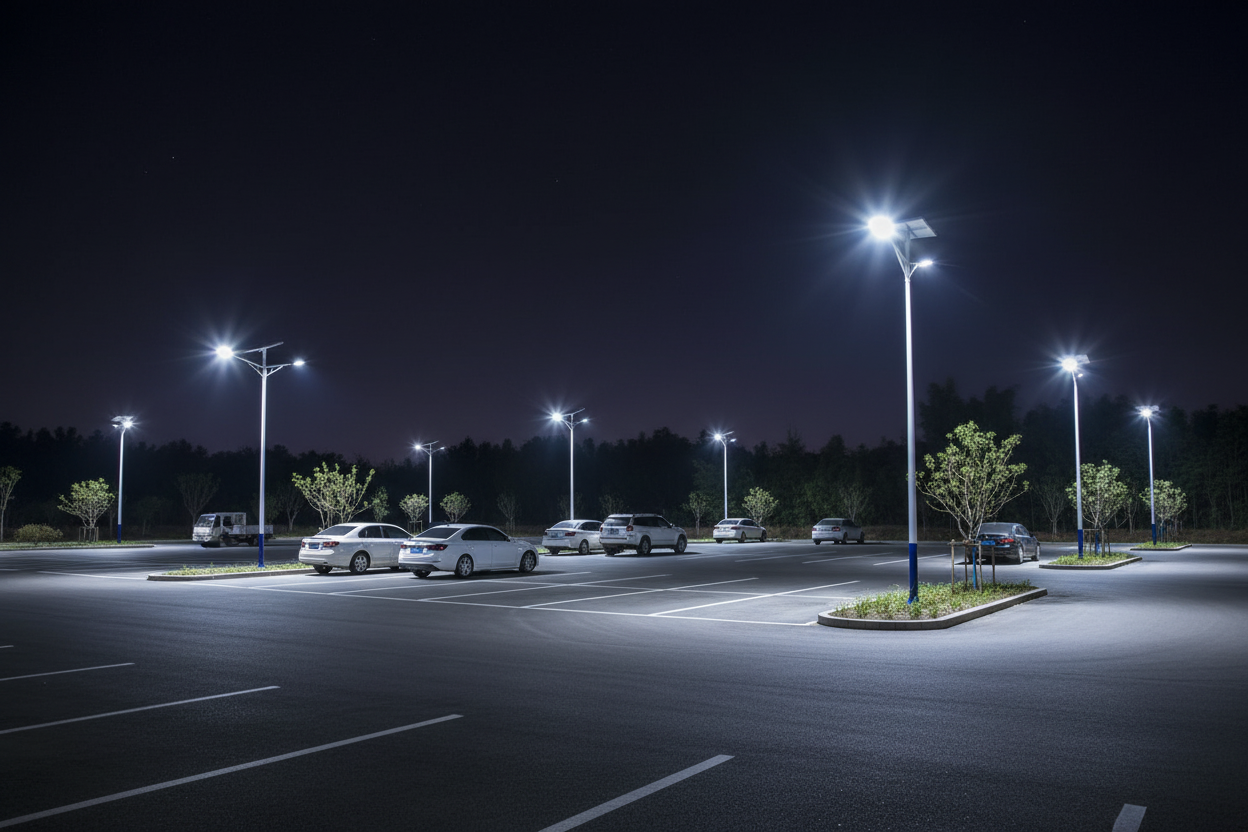
Last month, I watched a facilities manager at a mid-sized distribution center in Ohio calculate the cost of running traditional grid-powered parking lot lights. The numbers were sobering: $847 per month in electricity, plus another $1,200 annually for bulb replacements and maintenance calls. When a transformer issue left half the lot dark for three days, he'd had enough.
He's not alone. Across the United States, property owners are discovering what municipalities and commercial operators have known for years: solar street lighting technology has finally caught up to—and in many cases surpassed—traditional grid-powered systems in both performance and total cost of ownership.
This isn't the solar lighting of five years ago. We're talking about systems that deliver consistent, reliable illumination through winter nights in Minnesota and summer storms in Florida. Systems that pay for themselves in 18-24 months and keep working for a decade or more.
Why Solar Street Lights Make Sense in 2026
The math has fundamentally changed. Between rising electricity costs (up 23% nationally since 2020), improved battery chemistry, and more efficient LED technology, the break-even point for commercial solar lighting has dropped from 5-7 years to under two years in most applications.
But the real story isn't just about money. It's about reliability, flexibility, and eliminating the headaches that come with traditional electrical infrastructure.
The Hidden Costs of Grid-Powered Lighting
When most people calculate lighting costs, they focus on the monthly electric bill. That's a mistake. The real expense shows up in places you don't expect:
Trenching and electrical work: Running power to a new light pole 200 feet from your building? Budget $35-65 per linear foot for trenching, conduit, and wire. That's $7,000-$13,000 before you even install the first fixture. Hit rock or need to cross a paved area? Add another 40-60% to those numbers.
Permit delays: Electrical work means permits, inspections, and coordination with utility companies. A straightforward parking lot lighting project can take 6-8 weeks just to get approval to start. Solar installations? Most jurisdictions treat them like signage—simple permits that clear in days, not months.
Ongoing maintenance: Grid-powered systems fail in predictable ways. Ballasts burn out. Photocells stick. Contactors weld shut. Each service call costs $150-300, and you're looking at 2-4 calls per fixture over a 10-year period. Solar systems have fewer failure points and most issues can be diagnosed and fixed without an electrician.
Vulnerability to outages: When the grid goes down, your lights go dark. For businesses that operate 24/7 or need security lighting, that's not acceptable. Solar systems keep working regardless of what's happening with the local utility.
Understanding Modern Solar Street Light Technology
The solar lights available today bear little resemblance to the dim, unreliable units from even five years ago. Three key advances have transformed the category:
LiFePO4 Battery Chemistry
Older solar lights used lead-acid or early lithium-ion batteries that degraded quickly in temperature extremes and lost capacity after 300-500 charge cycles. Modern LiFePO4 (lithium iron phosphate) batteries handle 3,000+ cycles while maintaining 80% capacity, work reliably from -4°F to 140°F, and don't suffer from the memory effects that plagued earlier technologies.
What this means in practice: A quality LiFePO4-based system installed today will still be delivering 80% of its original runtime in 2034. The old lead-acid systems needed battery replacement every 2-3 years.
High-Efficiency Monocrystalline Panels
Solar panel efficiency has climbed from 15-17% to 21-23% for quality monocrystalline modules. That doesn't sound dramatic until you realize it means 30-40% more power generation from the same physical footprint. In practical terms, a modern 150W panel generates as much power as a 200W panel from 2018—while being smaller and lighter.
This matters because it means solar lights can now work reliably in locations that would have been marginal five years ago. Partially shaded areas, northern latitudes, locations with frequent cloud cover—all are now viable for solar lighting.
Intelligent Power Management
Early solar lights were binary: on or off. Modern systems use microprocessor control to optimize performance based on battery state, ambient light levels, and time of night. A typical intelligent system might run at 100% brightness from dusk until 11 PM, drop to 60% from 11 PM to 5 AM when traffic is minimal, then ramp back to 100% until dawn.
This adaptive approach extends runtime dramatically. Where a fixed-output system might provide 8-10 hours of illumination, an intelligent system can stretch that to 12-14 hours from the same battery capacity.
Real-World Performance: What to Expect
Let's talk specifics. A properly specified commercial solar street light system should deliver:
Illumination levels: 15-25 foot-candles directly under the fixture, 3-8 foot-candles at the edge of coverage. That's sufficient for parking lot security, pathway lighting, and perimeter applications. It's not stadium lighting, but it's more than adequate for the vast majority of commercial and residential applications.
Coverage area: A dual-head 60W system on a 20-foot pole provides useful illumination over a 40-50 foot diameter circle. For parking lot applications, that typically means one fixture per 4-6 parking spaces, depending on layout.
Runtime: 12+ hours per night in normal operation, with 2-3 days of autonomy during extended cloudy periods. In practice, this means the lights work every night, all night, regardless of weather—as long as the system gets some sun exposure every few days.
Seasonal variation: Yes, solar lights produce less power in winter. But modern systems are sized to handle this. A system that charges fully in 6 hours of summer sun might need 8-9 hours in winter—but winter days are also shorter, so the lights don't need to run as long. Properly sized systems maintain full performance year-round in all 50 states.
The 60W Dual-Arm Configuration: Why It Works
Single-head solar lights have their place, but for commercial applications, dual-arm configurations offer significant advantages:
Better light distribution: Two 30W fixtures spread 5-6 feet apart provide more even coverage than a single 60W head. You eliminate the harsh shadows and dark spots that come with single-point lighting.
Redundancy: If one LED array fails (rare, but it happens), you still have 50% illumination rather than total darkness. For security and safety applications, this matters.
Aesthetic flexibility: Dual arms look more substantial and professional than single-head units. For customer-facing applications—retail parking, office complexes, municipal installations—appearance matters.
Directional control: You can aim each head independently, which is invaluable for irregular spaces or when you need to avoid light trespass onto neighboring properties.

Sizing and Specification: Getting It Right
The most common mistake in solar lighting is under-specification. A system that works 90% of the time isn't acceptable—you need 100% reliability. Here's how to size correctly:
Battery Capacity
Your battery needs to store enough energy for 3-4 days of operation without recharging. This handles extended cloudy periods and gives you a safety margin for battery degradation over time.
For a 60W system running 12 hours per night, you're consuming 720 watt-hours daily. Multiply by 3 days and add 20% for system losses, and you need roughly 2,600 watt-hours of storage. At 3.2V nominal voltage (standard for LiFePO4), that's about 135Ah of capacity.
Anything less, and you're gambling on weather. Anything more is wasted cost and weight.
Solar Panel Sizing
Your panel needs to fully recharge the battery in one day of good sun, even in winter. In most of the continental US, that means sizing for 4-5 hours of effective sun in December.
To replace 720 watt-hours in 5 hours, you need 144 watts of panel capacity—but that's before accounting for charging losses (about 15%) and panel degradation over time (another 10%). A 150W panel provides the right margin.
Bigger panels charge faster and provide more cushion, but they also cost more and create more wind load on the pole. 150W is the sweet spot for 60W lighting systems.
Pole Height and Placement
Pole height determines coverage area and light distribution. For parking lots and general area lighting, 18-20 feet is standard. Go taller and you increase coverage but reduce light intensity at ground level. Go shorter and you get brighter light but less coverage.
The 6-meter (19.7-foot) pole height is ideal for most commercial applications. It's tall enough to provide good coverage and prevent tampering, but not so tall that you need special equipment for installation or maintenance.
Placement matters as much as height. Solar panels need unobstructed south-facing exposure (in the Northern Hemisphere). Even partial shading from buildings or trees can reduce charging by 40-60%. When planning your layout, think about sun exposure first, lighting coverage second.
Installation Reality: What You're Actually Getting Into
Solar street light installation is straightforward, but it's not trivial. Here's what to expect:
Foundation Work
A 6-meter pole with dual fixtures and a 150W panel creates significant wind load. Your foundation needs to handle it. Standard installation uses a ground cage (essentially a steel basket) set in concrete.
For typical soil conditions, you're looking at a hole 24-30 inches in diameter and 36-42 inches deep. That's about 1.5 cubic yards of concrete—roughly three 80-pound bags. The ground cage drops in, you pour the concrete, and you wait 3-7 days for full cure before installing the pole.
Rocky soil or high-wind areas may require deeper foundations or engineered solutions. Soft or sandy soil might need a larger diameter. When in doubt, consult local building codes or a structural engineer.
Assembly and Erection
The pole, fixtures, and panel ship separately and require assembly on-site. Budget 2-3 hours for a two-person crew with basic tools:
1. Mount the dual arms to the pole (4 bolts per arm)
2. Attach the LED fixtures to the arms (2 bolts per fixture)
3. Run wiring from the battery compartment through the pole to each fixture
4. Mount the solar panel bracket to the pole top
5. Install the panel and connect to the charge controller
6. Set the pole in the foundation flange and bolt down
The trickiest part is the lift. An assembled 6-meter pole with fixtures and panel weighs 80-90 pounds and is awkward to handle. You can do it with two people and a stepladder, but a small crane or boom lift makes the job much easier and safer.
Commissioning
Once the pole is up, commissioning is simple: connect the battery, verify the charge controller is functioning, and wait for dusk. The light sensor should trigger the fixtures automatically. Most systems ship with the battery partially charged, so you'll get illumination the first night even if installation happens on a cloudy day.
Give the system 2-3 sunny days to fully charge before evaluating performance. Initial runtime may be shorter until the battery reaches full capacity.
Maintenance and Longevity
One of solar lighting's biggest advantages is minimal maintenance. No bulbs to change, no ballasts to replace, no electrical connections to corrode. But "minimal" doesn't mean "zero."
Routine Maintenance
Panel cleaning: Dust, pollen, and bird droppings reduce panel efficiency. In most climates, rain handles this naturally. In dry or dusty environments, plan on hosing down the panel 2-4 times per year. A dirty panel can lose 15-25% of its output.
Fixture cleaning: LED lenses accumulate dirt and insects. An annual wipe-down with glass cleaner maintains optimal light output.
Fastener inspection: Wind vibration can loosen bolts over time. Annual inspection and re-torquing of critical fasteners (arm mounts, panel brackets) prevents problems.
Battery check: Modern charge controllers provide battery status information. An annual check ensures the battery is holding capacity and the charging system is functioning correctly.
Expected Lifespan
LED fixtures: 50,000-70,000 hours, or 11-16 years at 12 hours per night. In practice, LEDs rarely fail completely—they gradually dim over time. At 50,000 hours, expect 70-80% of original brightness.
LiFePO4 battery: 3,000-5,000 cycles, or 8-13 years depending on depth of discharge and temperature extremes. This is the component most likely to need replacement during the system's life.
Solar panel: 25-30 years with gradual degradation. Expect 90% output at 10 years, 80% at 20 years.
Charge controller and electronics: 10-15 years. Solid-state components with no moving parts are highly reliable.
Pole and hardware: 20-30+ years for galvanized steel in most environments. Coastal installations may see accelerated corrosion.
Bottom line: Plan on 10-12 years of maintenance-free operation, with battery replacement around year 8-10 being the only significant expense.
Cost Analysis: The Real Numbers
Let's compare total cost of ownership for solar versus grid-powered lighting over 10 years. We'll use a typical parking lot application requiring 8 light poles:
Grid-Powered System
Initial installation:
- 8 poles with fixtures: $8,000
- Trenching and electrical (avg 150 ft per pole): $72,000
- Permits and inspection: $2,500
- Total: $82,500
Operating costs (10 years):
- Electricity (8 fixtures × 100W × 12 hrs × 365 days × $0.14/kWh): $48,672
- Bulb replacement (8 fixtures × 3 replacements × $85): $2,040
- Maintenance calls (8 fixtures × 2 calls × $200): $3,200
- Total: $53,912
10-year total: $136,412
Solar System
Initial installation:
- 8 complete solar light systems: $7,192
- Foundation work (8 poles × $300): $2,400
- Installation labor (8 poles × $400): $3,200
- Permits: $500
- Total: $13,292
Operating costs (10 years):
- Electricity: $0
- Battery replacement year 8 (8 batteries × $180): $1,440
- Routine maintenance (annual cleaning × 10 years × $400): $4,000
- Total: $5,440
10-year total: $18,732
Savings: $117,680 over 10 years
The numbers speak for themselves. Even if you double the solar system costs to account for unexpected issues, you're still saving $80,000+ over a decade. And these calculations assume stable electricity rates—if rates continue climbing at historical averages, the gap widens further.

Common Applications and Use Cases
Parking Lot Lighting
This is where solar street lights shine (pun intended). Parking lots need reliable overnight illumination but rarely have convenient electrical access. Solar eliminates trenching costs and provides consistent lighting without ongoing electrical expenses.
Typical spacing: One 60W dual-arm fixture per 4-6 parking spaces, depending on pole height and layout. For a 50-space lot, budget 8-12 fixtures.
Pathway and Sidewalk Lighting
Parks, campuses, residential developments, and commercial properties all need pathway lighting for safety and navigation. Solar lights install anywhere without disturbing landscaping or hardscaping.
Typical spacing: 40-60 feet between poles for continuous illumination, 80-100 feet for marker lighting.
Perimeter and Security Lighting
Warehouses, storage facilities, and industrial sites need perimeter lighting for security. Solar lights can be placed exactly where needed without regard for electrical infrastructure.
Typical spacing: 50-80 feet for continuous coverage, with fixtures aimed outward to illuminate the perimeter and create a deterrent effect.
Rural and Remote Applications
Farms, ranches, rural driveways, and remote facilities often lack electrical service or face prohibitive costs to extend power. Solar lighting provides a practical solution.
Typical spacing: Varies widely based on application. Driveway lighting might use one fixture every 100-150 feet, while a farmyard might need 4-6 fixtures for comprehensive coverage.
Municipal and Public Spaces
Parks, playgrounds, bus stops, and public parking areas benefit from solar lighting's independence from the grid. Power outages don't affect solar lights, ensuring public safety even during emergencies.
Typical spacing: Determined by local lighting codes and safety requirements, usually 30-50 feet for high-traffic areas.
What to Look for When Buying
Not all solar street lights are created equal. Here's what separates quality systems from cheap imports that fail in six months:
Battery Chemistry and Capacity
Insist on LiFePO4 batteries with documented capacity ratings. Avoid systems that don't specify battery chemistry or capacity—they're usually using cheap lead-acid batteries that won't last.
For a 60W system, minimum battery capacity should be 100Ah. 135Ah provides better autonomy and longer life.
Panel Wattage and Efficiency
The panel should be rated for at least 2.5× the fixture wattage. For a 60W system, that means 150W minimum. Monocrystalline panels are worth the small premium over polycrystalline for their superior efficiency and longevity.
LED Quality and Quantity
Premium 5050 or 5730 LEDs from reputable manufacturers (Epistar, Bridgelux, Cree) provide better light output and longer life than no-name LEDs. A 30W fixture should have 60-80 individual LED chips.
Color temperature matters too. 4000K (neutral white) provides good visibility while being less harsh than 5000K+ (cool white). Avoid 3000K (warm white) for security applications—it doesn't provide enough contrast.
Pole Construction
Galvanized steel is standard and appropriate for most applications. Wall thickness should be 2.5mm minimum for a 6-meter pole. Thinner walls save cost but compromise structural integrity and longevity.
Tapered poles (wider at the base, narrower at the top) handle wind load better than straight poles and look more professional.
Charge Controller Features
Look for MPPT (Maximum Power Point Tracking) charge controllers rather than basic PWM types. MPPT controllers extract 20-30% more power from the solar panel, which translates to faster charging and better performance in marginal conditions.
Intelligent power management—the ability to adjust brightness based on battery status and time of night—extends runtime and battery life significantly.
Warranty and Support
A quality solar street light should come with at least a 2-year warranty on electronics and 5 years on the panel. Be wary of sellers who don't provide clear warranty terms or have no US-based support.
Installation Tips from the Field
After installing hundreds of solar street lights, here are the lessons that matter:
Sun exposure trumps everything: A perfectly positioned light in partial shade will underperform a poorly positioned light in full sun. When planning your layout, use a sun path calculator to verify the panel will have unobstructed exposure from 9 AM to 3 PM year-round.
Foundation depth matters: Skimping on foundation depth to save concrete is false economy. An under-spec'd foundation will fail in high winds, potentially causing injury or property damage. Follow the manufacturer's specifications or local building codes, whichever is more stringent.
Wire connections are critical: Use dielectric grease on all electrical connections and ensure proper polarity. A reversed connection can damage the charge controller or battery. Most systems use color-coded wiring, but verify with a multimeter before making final connections.
Allow for thermal expansion: Metal poles expand and contract with temperature changes. Don't over-tighten bolts during installation—leave a small amount of play to prevent stress cracking.
Test before you lift: Connect the battery and verify the system functions before installing the pole. It's much easier to troubleshoot issues on the ground than 20 feet in the air.
Document your installation: Take photos of the foundation, wiring, and final installation. Record the installation date and initial battery voltage. This information is invaluable for warranty claims and future maintenance.
Troubleshooting Common Issues
Lights don't turn on at dusk: Check battery voltage first. If the battery is depleted, the system won't operate until it recharges. Verify the light sensor isn't obstructed or damaged. Confirm all wiring connections are secure and correct polarity.
Lights turn off before dawn: Usually indicates insufficient battery capacity or inadequate solar charging. Check for panel shading, dirt on the panel, or a failing battery. Verify the charge controller is functioning correctly.
Dim or flickering lights: Often caused by loose connections or a failing LED driver. Check all wiring connections and ensure the battery voltage is within normal range (3.0-3.6V for LiFePO4).
Inconsistent operation: May indicate a failing charge controller or battery. Use a multimeter to verify charging voltage and battery voltage under load. If readings are erratic, the charge controller likely needs replacement.
Physical damage: High winds, vehicle impacts, or vandalism can damage poles, fixtures, or panels. Most components are modular and can be replaced individually without replacing the entire system.
The Environmental Case
Beyond the financial benefits, solar street lighting delivers measurable environmental advantages:
Carbon reduction: A single 60W solar street light eliminates approximately 350 pounds of CO2 emissions annually compared to grid-powered lighting (assuming average US grid mix). Over 10 years, that's 3,500 pounds per fixture.
Grid independence: Distributed solar lighting reduces peak demand on the electrical grid, which helps prevent brownouts and reduces the need for peaker plants (the dirtiest, least efficient power generation).
Reduced light pollution: Solar lights are inherently directional and use intelligent controls to minimize unnecessary illumination. This reduces sky glow and light trespass compared to always-on grid-powered systems.
No trenching impact: Eliminating trenching preserves landscaping, prevents soil disruption, and avoids the carbon cost of heavy equipment operation.
For organizations with sustainability goals or LEED certification requirements, solar lighting provides documentable environmental benefits that contribute to green building credits.

Making the Decision: Is Solar Right for Your Application?
Solar street lighting isn't the answer for every situation. Here's how to decide:
Solar Makes Sense When:
- Electrical infrastructure is more than 100 feet away
- You need lighting in remote or difficult-to-access locations
- Trenching costs are prohibitive due to rock, pavement, or landscaping
- You want to avoid ongoing electrical costs
- Grid reliability is questionable
- Installation timeline is tight (no waiting for utility coordination)
- Environmental impact is a consideration
- You're lighting a temporary or semi-permanent installation
Grid Power May Be Better When:
- Electrical service is already available at the pole location
- You need extremely high light levels (100W+ per fixture)
- The location has severe shading that can't be mitigated
- You're in an extreme northern latitude with very short winter days
- Local codes prohibit solar installations
- You need specialized lighting controls or integration with building management systems
For most commercial, municipal, and residential applications, solar lighting is now the practical choice. The technology has matured, costs have dropped, and the total cost of ownership strongly favors solar over grid power.
A Specific Recommendation
If you're looking for a proven, well-engineered solar street light system for commercial applications, the 60W Dual-Arm Solar Street Light with 6M Pole represents the current state of the art.
This system delivers everything discussed in this guide:
- Dual 30W LED fixtures with 60 premium 5050 LEDs per head
- 135Ah LiFePO4 battery for 3+ days autonomy
- 150W monocrystalline solar panel
- 6-meter galvanized steel pole with proper taper and wall thickness
- Intelligent MPPT charge controller
- 12+ hour runtime with automatic dusk-to-dawn operation
- Complete mounting hardware and ground cage
At $899, it's priced competitively while using quality components that will deliver a decade or more of reliable service. That works out to less than $90 per year over a 10-year lifespan—a fraction of the cost of grid-powered alternatives.
More importantly, it's a system that works. No surprises, no compromises, no wondering if it'll make it through the winter. Just reliable, consistent illumination night after night, year after year.
Final Thoughts
The solar street lighting industry has reached an inflection point. The technology is mature, the economics are compelling, and the performance is proven. What was once a niche solution for remote locations has become a mainstream choice for any application where running electrical service is expensive or impractical.
The facilities manager in Ohio I mentioned at the start? He installed eight solar lights in his parking lot in November 2025. By March 2026, he'd recouped his investment through eliminated electrical costs and avoided maintenance. By 2028, those lights will have paid for themselves twice over. By 2035, they'll still be working while grid-powered alternatives will have required multiple service calls and component replacements.
That's the real story of solar street lighting in 2026: it's not about being green or trendy or cutting-edge. It's about making a smart business decision that saves money, reduces hassle, and delivers reliable performance for years to come.
If you're planning a lighting project—whether it's a parking lot, pathway, perimeter security, or any other outdoor application—do the math on solar. Factor in all the costs: trenching, permits, ongoing electricity, maintenance, and the value of your time dealing with outages and service calls.
More often than not, you'll find that solar isn't just competitive—it's the obvious choice.
Ready to make the switch? Check out the 60W Dual-Arm Solar Street Light with 6M Pole and see how modern solar technology can transform your outdoor lighting while cutting costs and eliminating maintenance headaches.
